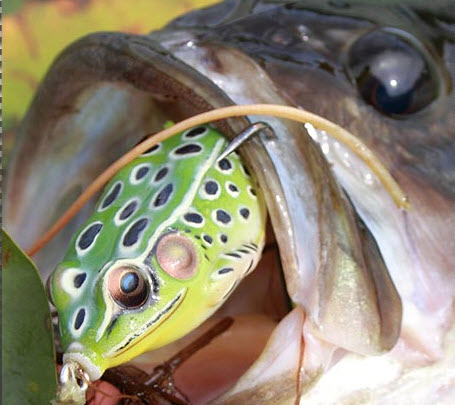
I’ve always wanted to coin a term for a fishing technique. So here goes: drowning a frog.
On a recent mild December afternoon, I headed down to my favorite little test pond to play with a new hollow frog from Koppers. I wasn’t really expecting to catch many on a topwater, being as late as it was, with the nights cooling off into the 30s and a drop in the water temperature too. But, I wanted to see this frog at work.
It’s funny how little instances can influence a fishing trip. I forgot my scissors, so instead of trimming the frog’s legs, as I normally do, I left them at full length. This kept the frog’s head upright – it looks incredibly realistic this way – and the butt end hanging down a little farther than I usually prefer. This ended up leading me to the drowning frog technique.
I had walked the frog a couple times past a piece of man-made fish habitat built out of some wooden palettes without any luck. I made a final pitch out to the cover and let the frog settle a few inches away from it. Then, with extra slack in the line, I used hard, slack-line snaps to make the frog dart back and forth practically in place. The beauty was that the heavy tails kept the frog’s butt down, and it sort of bobbed straight up and down – as I’d imagine a drowning frog would look. And sure enough, a 2 1/2-pounder barreled out of the water and choked on the frog. I set both hooks into the top of the fish’s mouth, and the tails were in its gullet.
How does that happen in December? It happens when you drown a frog.
Actually, a frog is a good cool-weather topwater lure, in my opinion. It’s not as loud and obnoxious as most poppers and walkers, and it can be fished very slowly, or in place as I demonstrated, to entice sluggish bass. I also believe at times that bass like a big meal in winter, especially a big easy meal that puts a lot of calories in their bodies, without burning a lot of calories in the process. A frog fits that profile.
The only problem I ran into is that several fish tried to pull the frog down by the tails but weren’t aggressive enough to break the surface. My next step will be to trim the legs, which should force them to get the hooks in their mouths when they bite, and to add a weight to the frog’s butt so I can still create the up-and-down bobbing presentation.