
KIMBERLING, Mo. — The Ozark Division of the Phoenix Bass Fishing League Presented by T-H Marine will get an early start on the 2026 season with its first tournament of the year set for Jan. 31 on Table Rock Lake. The southwestern Missouri gem should produce solid bags of all three bass species as well as an interesting litmus test for how the new three-hour limitation on forward-facing sonar will impact the BFLs in 2026.
What to expect
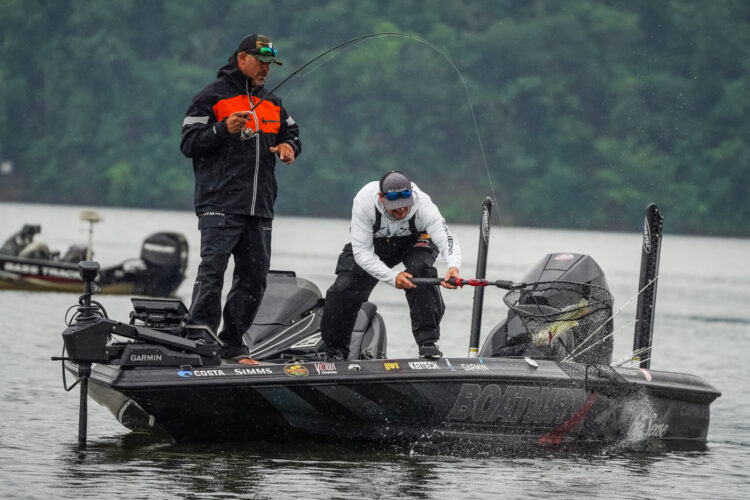
A guide on Table Rock, Eric Olliverson has been on the water just about every day this winter, and he said the fishing has been good. It hasn’t been all deep fish, either – Olliverson reported that the unusually mild winter so far in the Midwest has plenty of bass still feeding around the banks.
“We’ve had such an unseasonably warm winter that our water temperatures for most part of the lake is still in the low 50s,” Olliverson said. “I know that’s going to change once we start getting some cold fronts coming in, but the fishing is still very good. Of course, we’ve got a really good deep bite. But the shallow bite has been really strong as well.”
If that continues, it would boost weights at the season-opener. That’s because, this year, BFL competitors are limited to just three hours per day using forward-facing sonar.
It’s no secret that the technology has dominated on Table Rock in recent years. Olliverson expects it to still play a significant role in this event, and he said picking the right three-hour window to use it will be pivotal.
“I love the strategy involved in it,” he said. “It’s going to be very critical to the guys using the technology to be able to pick that right window, whether they’ve got a strong morning bite or a good afternoon bite or maybe a midday bite.”
The biggest factor that determines when anglers should use forward-facing sonar and how good the bite will be without it will be weather. Per Olliverson, the nastier the weather, the better the bite is likely to be.
“The worse the weather that we’re still able to have a tournament, it’ll be better,” he said. “If we’ve got a cool day with a lot of wind, clouds, pre-front or even during a front, those are always the very best conditions for Table Rock, especially in the wintertime.”
Baits to bring
Regardless of whether they’re using modern technology, expect to see lots of anglers lean on wintertime staples – jighead minnows, jerkbaits and Alabama rigs. Olliverson also expects wide-wobbling crankbaits, a classic Table Rock technique, to produce some bass.
One other interesting possibility Olliverson raised is that some anglers might stay offshore and continue to target bait-chasing schools of bass even when they’re not using forward-facing sonar. Look for those anglers to utilize 2-D sonar to locate the fish and target them vertically with jigging spoons, ice jigs and Damiki rigs.
“Without that ping, a lot of those fish will actually stay under your boat a little bit longer,” Olliverson said. “So, a little old-school 2-D action going on. I think it’ll be a big player this time of year.”
What will it take?
Typically, winter tournaments on Table Rock take anywhere from 18 to 22 pounds to win, depending on the conditions. Olliverson thinks the winner will still get to that range at this event, but the weights will drop off more quickly due to the technology restrictions. He predicted it will take about 15 pounds to make the Top 10.
He also guessed that, while there’s a healthy population of all three bass species in Table Rock, the winning bag will consist of either largemouth or smallmouth – most likely largemouth.
“To win down here, you have to really focus on the largemouth or the smallmouth,” he said. “Those two species will weigh the most. The guy whose got five largemouth will win, but you could have five smallmouth and have a shot, too.”