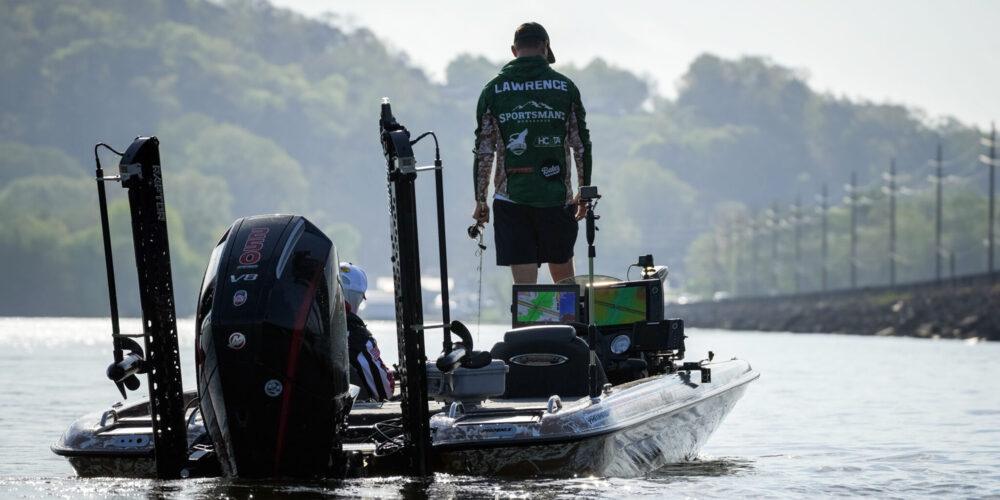
Astute observers during the first half of the 2026 Bass Pro Tour season might have noticed an extra couple appendages protruding pros’ boats, or perhaps some anglers trolling around with their shallow-water anchors deployed even in open water.
No, those anglers didn’t forget they had their poles down. They were utilizing the hottest new accessory on the BPT this year, brakes.
Brakes on a bass boat aren’t quite like those on a vehicle. Simply put, they’re a pair of rear-facing trolling motors that can be attached to shallow-water anchors and deployed via a button at the bow. When turned on, their reverse thrust can quickly stop a boat – hence the name – and even reverse the vessel without an angler turning his bow-mounted trolling motor around.
Brakes aren’t exactly a new development, but this year, they seem to have gone from something a few pros utilized to a common sight on the Bass Pro Tour. Mercury pro Bradley Roy thinks the trend is here to stay.
“I do think in the next five years that you’re going to see 90-plus percent of the boats on tour have them,” Roy predicted. “Competition really drives a lot of this stuff, and if another guy has it and I don’t, then I’m possibly at a disadvantage. And they are really good.”
Crappie fishing roots
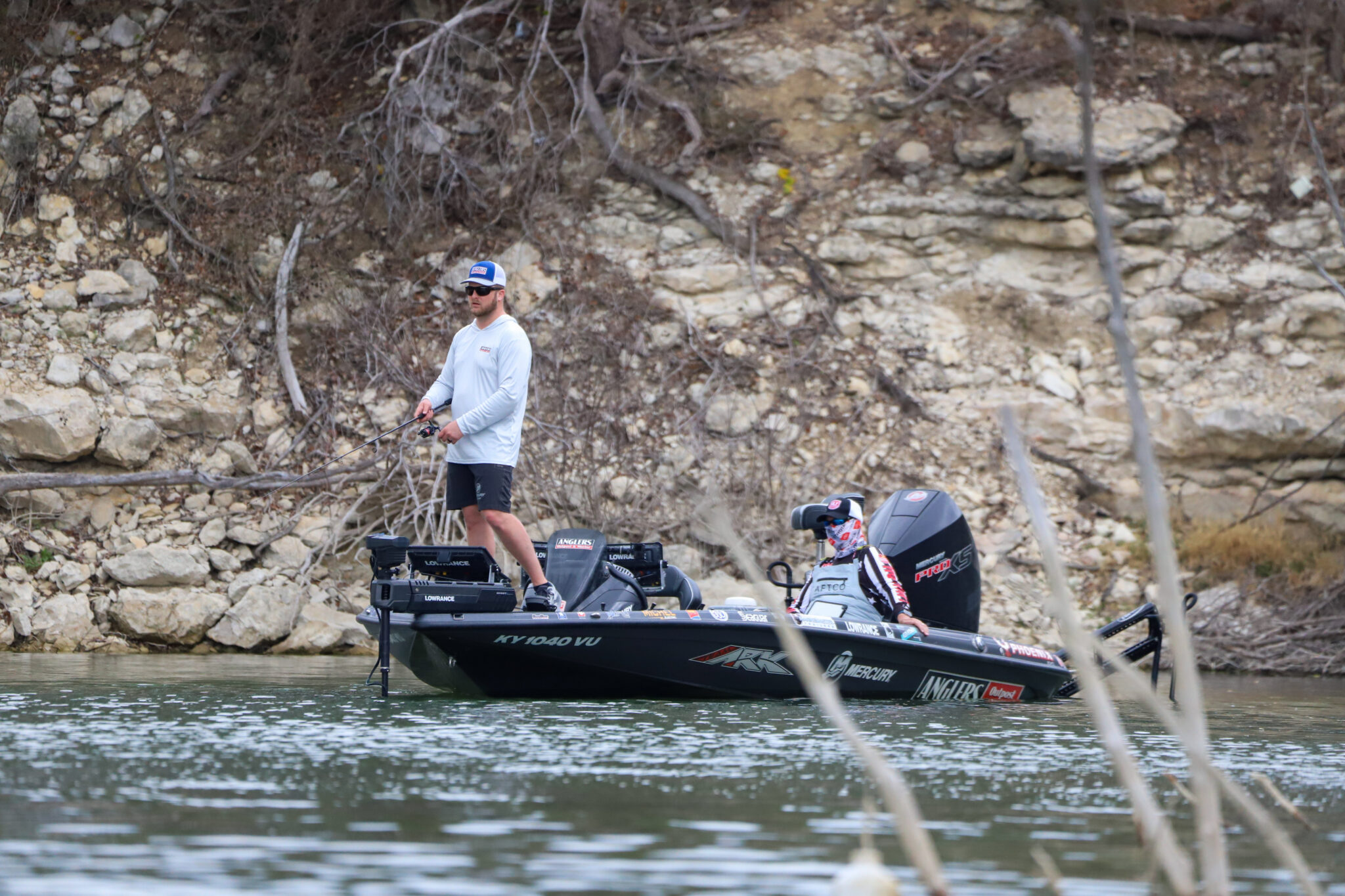
Boat brakes first gained popularity among crappie anglers – in fact, you might hear some anglers refer to them as “crappie brakes.” That’s how Jake Lawrence, one of the earliest adopters in the bass tournament realm, found out about them.
In 2022, before he started fishing tournaments full-time, Lawrence guided on the Tennessee River. One of his services was spending a day in clients’ boats to help them better understand their electronics. When he saw a pair of brakes hanging from a crappie angler’s boat, it didn’t take him long to understand the potential for bass fishing.
“I pulled up, and I said, ‘Wait a minute, what have we got going on here?” Lawrence said. “From the moment I hit the button there, it was a no-brainer.”
The reason the brakes appealed so much to Lawrence – and the application most anglers associate with them – is their usefulness when targeting suspended bass with forward-facing sonar (which, of course, has taken the sport by storm in recent years). Lawrence explained that anglers who are panning for roaming bass need to cover water quickly, which can make it difficult to stop in time once they spot a fish or a prime piece of cover. Before brakes, the only way to do so was to turn the trolling motor around and kick it into high gear, which pushed a wave of current toward the fish, usually spooking them.
“What we call backwashing or prop-washing an area is never a good idea,” the Mercury pro said. “That’s always something that we try to avoid at all costs.
“If we’re looking at a fish that’s 30, 40, 50 feet deep, it’s not nearly as critical. But most of what we’re targeting are these fish that are really in the top 10 for 15 feet of the water column, and those are the ones that are absolutely going to feel that prop was and the backwash of you trying to reverse and stop your forward momentum.”
Upon outfitting his own boat with brakes, Lawrence quickly saw his efficiency with forward-facing sonar increase. He’s since partnered with Performance Fishing Electronics, and he thinks their brakes gave him a marked advantage over his competitors during his rapid rise through the tournament ranks. He went from dominating local events in 2023 to breezing through the Tackle Warehouse Invitationals in 2024, when he won on Lake Eufaula and finished second in the Angler of the Year standings, to once again winning an event and finishing second in AOY in his rookie season on the Bass Pro Tour in 2025.
“I was very, very early into it and really utilized that,” he said. “If you look back at my tournament results back then, you can really see how much of an advantage I had when I was one of if not the only person running them.”
Now, he thinks brakes are more important than ever. As more anglers have learned how to target suspended bass, those fish have become more wary and “less forgiving” of imperfect presentations.
“These fish are not fresh anymore,” Lawrence said. “These are not necessarily even the easiest fish in the lake to catch. So, you’ve really got to have every advantage and put as many of the cards on your side of the table as possible.”
Uses beyond FFS
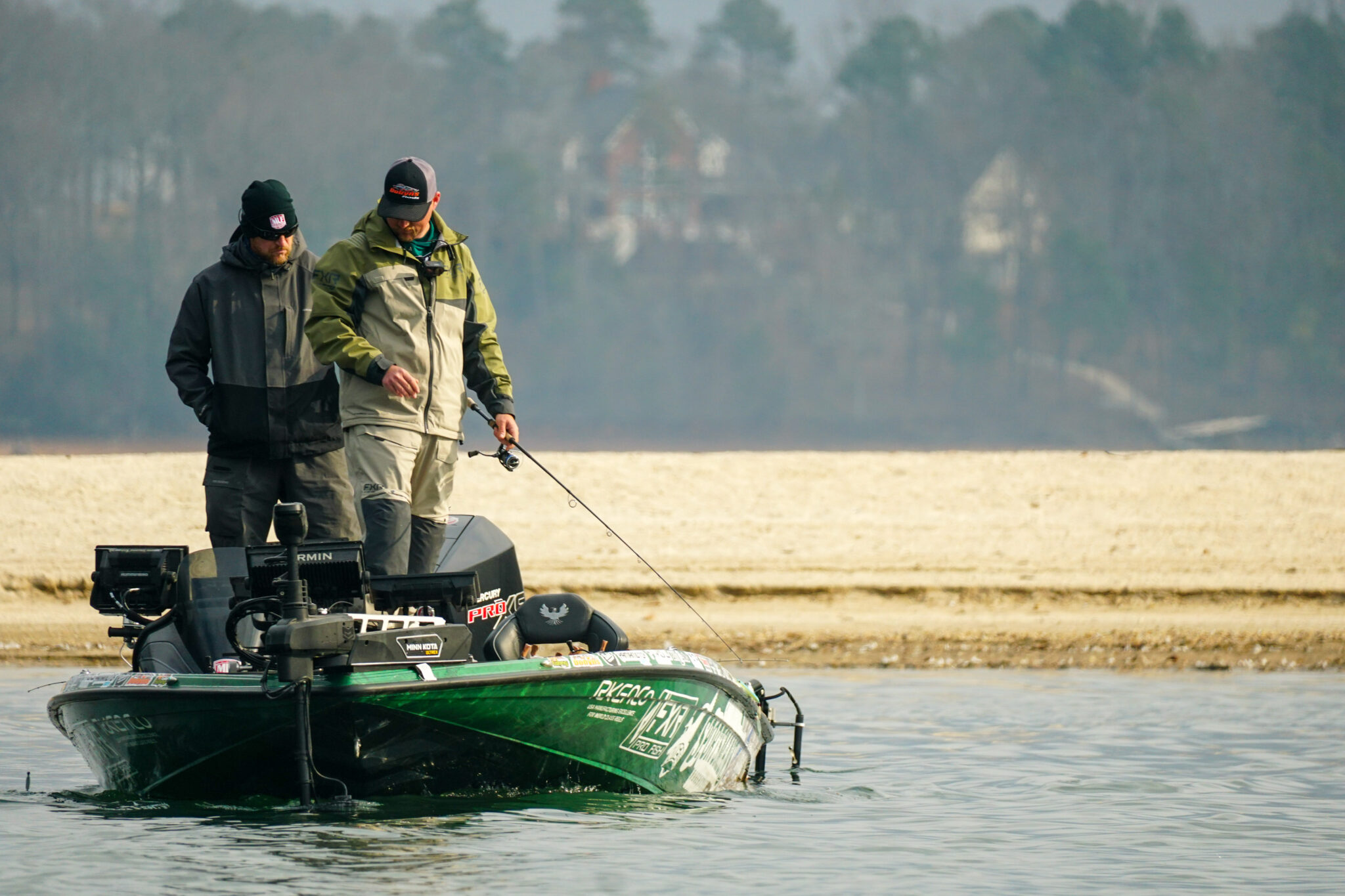
Like Lawrence, Roy first decided to add brakes to his boat last fall to increase his efficiency with forward-facing sonar. Especially on the BPT, when every fish counts and anglers are only allowed one period per day using forward-facing sonar, the Kentucky pro said anything that can put a couple more fish in the boat is valuable.
“I wanted every advantage I had to make sure that I had a good forward-facing sonar period,” Roy said. “What I didn’t realize was how much I would use them even beyond forward-facing sonar.”
Both Roy and Lawrence emphasized that brakes have utility beyond targeting suspended bass. For one, Roy finds himself using them in a similar manner even when he isn’t using modern sonar – keeping himself from overshooting a target or blowing through an area too quickly.
“A couple times at Guntersville, I was fishing the grass edge where I was letting the wind blow at my back so I could be a little more stealthy, but it was too deep for my poles to reach – it was 10 foot deep, 11 foot deep,” he said. “So, instead of putting my poles down, I could keep my brakes in the water and just kind of bump myself back, and I wasn’t blowing those fish out with my trolling motor as bad.
“The other scenario I think about a lot is if you’re fishing down a bank you’re not familiar with – which happens when we travel the country – and all of a sudden, you see a stump or something under the water that you haven’t seen before, and you’re far enough away you could still catch a fish off it, but you’re too close to hit your trolling motor backwards. The brakes being 20, 25 feet behind your trolling motor give you an opportunity to back the boat up or slow down without turning your trolling motor around.”
Lawrence added that he’s found brakes to be helpful when he’s fishing boat docks, as he can navigate in and out of tight spaces better without sending prop wash under the docks. He also outlined a situation every angler can relate to – retrieving a bait that’s hung up in super shallow water.
“We’ve all made a bad cast – we throw it in the rocks on the bank, or say it’s a bush, and we throw just a little too far and get hung up in it,” he said. “It’s always that nightmare of running that trolling motor up in the middle of it, reversing back out, smacking limbs. Obviously, it’s the least stealthy way of doing that, but you also run the chance of damaging your prop. With these brakes, man, it is so cool; I go ahead and put them down if they’re not already, I sneak up there with my trolling motor, and once I’m able to nose the boat up there very quietly, I just hit my brakes and rattle my bait out, back up, and it’s like you never really impacted that area.”
A tool for just about everyone
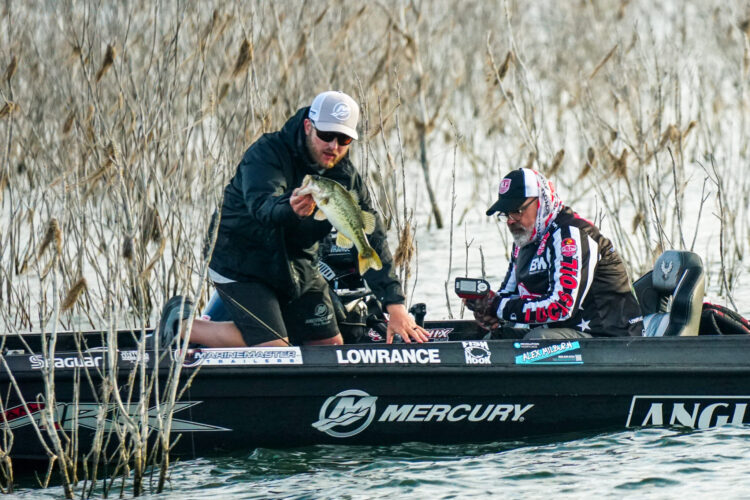
Two concerns about brakes might be durability and ease of use, but Lawrence and Roy downplayed both. Roy said his brakes, made by RiffRaff Fabrication, were easy to install and learn – all you need is a pair of shallow-water anchors to mount them on and a 12-volt battery to power them. Lawrence noted that he’s never broken his brakes despite running through plenty of rough water and hitting submerged obstacles with them.
“It’s no secret, there is a lot of standing timber (in Texas),” Lawrence said. “I absolutely abused those things last week and still haven’t had an issue.”
Roy, whose family owns Anglers Outpost and Marine boat dealership, said brakes aren’t just for fully rigged tournament vessels. He thinks they might be even more useful on, say, a 17-foot aluminum boat.
“I foresee them being a bigger deal for those guys that run smaller aluminum boats that blow around real easy, because they can put a set of brakes on their boat, and they can control that in the wind a lot more than they can with just one trolling motor,” he said.
The one scenario when Lawrence takes the brakes off his boat is if he’s going to be fishing a shallow, vegetation-filled lake. But he noted that the Performance Fishing Electronics brakes are easy to take off and re-attach. It takes him less than 10 minutes to do so.
“Really the only place that I don’t utilize them is when I’m fishing an ultra-shallow body of water that is full of submerged vegetation, whether that be coontail, milfoil, hydrilla,” Lawrence said. “When you set those down in a clump of submerged grass, you’re going to come up with a wad of it. It can be problematic in that scenario.”
Lawrence doesn’t think brakes will become quite as ubiquitous as shallow-water anchors or bow-mounted trolling motors. He noted that anglers who spend most of their time fishing shallow cover in less than 10 feet of water can just rely on their poles.
But for everyone else, and especially those competing at a high level, he thinks brakes are well on their way to becoming mainstream. He’s surprised it took this long for them to really catch on among BPT pros.
“You can’t hide this advancement – and not that I even want to, but if you did, you couldn’t,” he said. “So, I knew everybody was going to see, and it’s just such a no-brainer.”