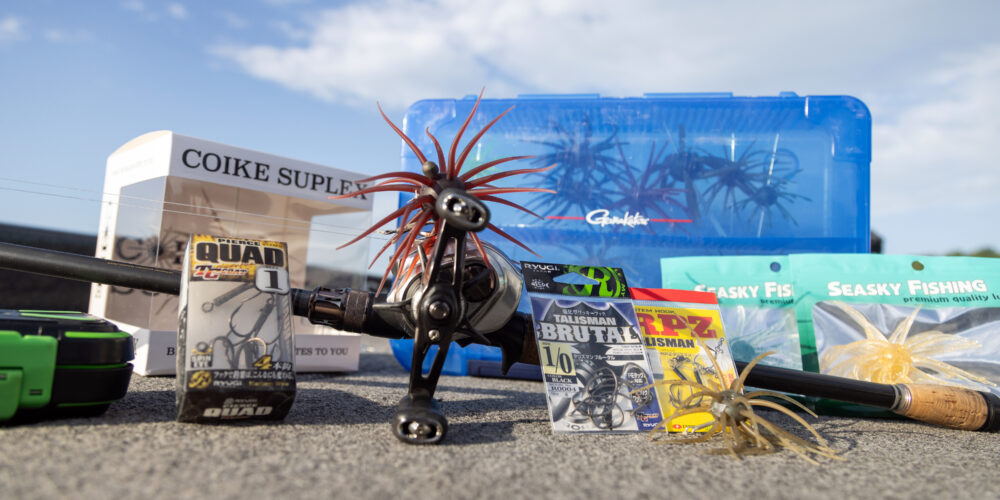
About four years ago, someone in Japan tipped off Alton Jones Jr. about a bait that had started winning tournaments there. The Bass Pro Tour pro has long been plugged into the Japanese bait scene, so he got his hands on one – a soft-plastic sphere covered in spikes.
Jones wasn’t sure how to rig the odd creature. He tried fishing it on a drop-shot and on the bottom with a half-ounce bullet weight, didn’t get any bites, set it aside and forgot about it.
That bait, of course, was a Hideup Coike, the originator of the craze that has taken bass fishing by storm in 2026.
“It’s something that I kick myself for, because I’ve had one for like four years,” Jones said. “It was probably 2022 the first time I ever got my hands on an urchin bait and was told by a guy in Japan, ‘Hey, they’re winning some tournaments over here on it. You might want to check it out.’”
Jones is far from the only angler with a story like that. The Coike has been catching bass in Japan for about a decade, but because it looks and fishes so different than most American plastics, it took a while to catch on in the U.S. Once it did, though, it started dominating tournaments so rapidly that some anglers paid more than $100 per bait on the secondary market just to experience it firsthand. And the craze is only gaining steam.
Whether you call them Coikes, spikeballs, or, for the purposes of this article, urchin-style baits, there’s no more denying the power of these plastics. They’ve probably accounted for more wins than any other bait so far this year across all tournament levels. As a result, seemingly every bait manufacturer in the country has been rushing to capitalize on the wave with an urchin of their own or a better way to rig them. It doesn’t take a fortune-teller to know that ICAST next week is going to be dominated by new urchin baits and components.
With that in mind, we asked three Bass Pro Tour anglers to share the lessons they’ve learned about the best ways to rig and fish urchins.
How do you fish those things?
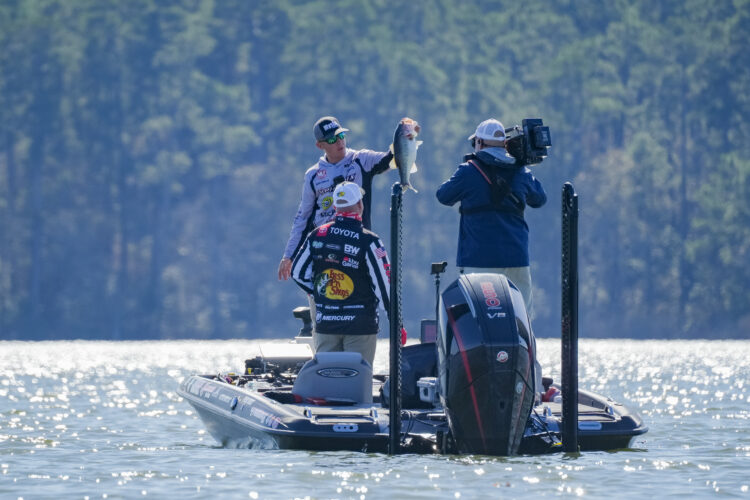
Jake Lawrence shared a similar story to Jones’. The Mercury pro first heard about the Coike a year or more before it went mainstream, but he simply couldn’t wrap his mind around how it would work.
Lots of theories have been shared about why bass seem so willing to eat a bait that looks like a children’s toy. Jones thinks it’s as simple as showing the fish something they haven’t seen before in a way that elicits a reaction strike.
“I think we try to outsmart ourselves a lot of times,” he said. “We try to make reasons and excuses of why a bass eats a certain thing, what he thinks it is, and when you really just dumb it down and pretend a bass is a cat, the urchin makes sense.”
So, how do you present a bait that decidedly does not match the hatch? The most successful method seems to be weighting an urchin so it sinks very slowly, then working it in the middle of the water column with twitches and pauses. Justin Lucas compared the retrieve to a suspending jerkbait.
“Just fishing it almost like a jerkbait is the best way I can describe it to people,” he said. “It’s just quick pops, good jerks with the rod tip. You’re just trying to make that bait jump around and make those arms kind of undulate in the water.”
As for when and where to fish it, anglers are still figuring out the bait’s limitations. But in Lawrence’s experience, it’s not a magic bullet. Urchin baits have shown an ability to trigger bass – and particularly big ones – that won’t bite anything else. However, their success can be situational. That’s another reason it took Lawrence a while to get on board. The first few times he tried an urchin bait on his home fishery, Kentucky Lake, he struggled. Then, he traveled to a different lake and weighed almost 40 pounds for his biggest five.
He’s found it to be most potent when targeting isolated cover and individual fish.
“This certainly works for groups of fish, but where I have found it to be even more powerful is on those individual, kind of solitary fish that are generally fairly hard to get to bite,” Lawrence said. “This bait seems to really entice that singular fish to eat, where some wouldn’t do it with a minnow or something like that.”
Jones agreed, saying that while he’s caught fish on the urchin in a range of conditions, the sweet spot seems to be targeting bass that are suspended on pieces of cover. Stained to dirty water is a bonus.
He thinks that’s why the bait has been especially dominant lately. After bass spawn, those tend to be popular staging spots, making the fish more susceptible to urchins.
“It’s good year-round; it has its place all year,” the Mercury pro said. “But postspawn into early summer seems to be the time when the majority of the population will eat it. It kind of goes from, other times of the year, just a big-fish hunting thing, to you start getting a lot more bites on it.”
A sea of urchin options
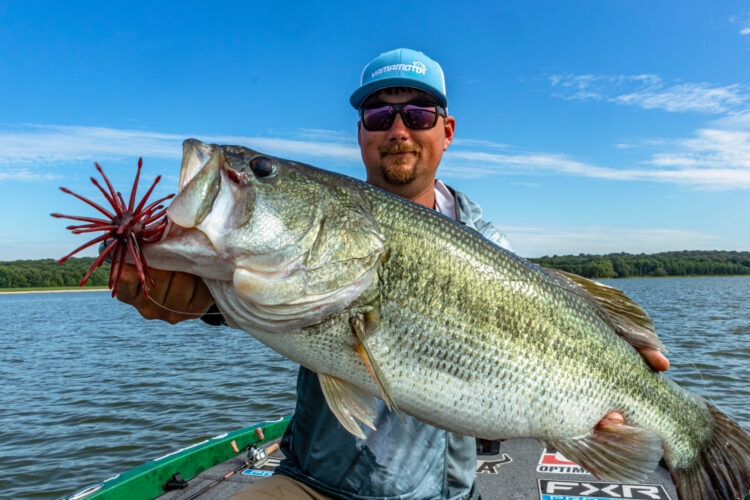
Due to the scarcity of Coikes and the sudden spike in demand, most anglers have been throwing whatever urchin bait they can get their hands on. But as the industry catches up on supply, it’s quickly becoming a saturated category with an overwhelming number of model, size and material options.
Hideup’s Coike is the O.G., and it’s offered in several sizes ranging from a 13-millimeter diameter to the 32-millimeter Coike Suplex. However, Coikes have become virtually impossible to get without receiving an advance tip about a fresh shipment or shelling out big bucks on the secondary market.
Among the newer options is Berkley’s PowerBait MaxScent Moeba, which was released in May and features 3.5- and 4.5-inch size options. Lucas, who caught several fish during his runner-up finish at Stage 4 on O.H. Ivie and Lake Brownwood on a then-unreleased Moeba, likes that the bait not only offers the proven attraction of MaxScent, it’s made of a heavier material than other urchin baits (most of which are made of TPE – a highly durable, floating plastic). It’s still durable but not as buoyant, meaning an angler can fish it straight out of the package without adding weight.
“It’s naturally heavier with the plastic that it’s made out of, so you can cast it further and skip it better,” he said. “I only put a weight in a Moeba if I’m trying to get it deeper than 8 or 10 feet.”
Jones helped design the Geecrack Magnum Cue Bomb, which will make its public debut soon, while Lawrence has already found some tournament success with the newest offerings from Yamamoto. The Yamamoto Uni was one of the first widely available urchins in the U.S., and this week, the company unveiled the new Uni HD. The bait is made from a denser plastic than the original and comes in three sizes: the original (16 mm), the Mas (20 mm) and the Max (24 mm).
Lawrence used the Uni Max to catch several scorable bass during his Top 10 finish in the most recent Bass Pro Tour event at Grand Lake. He believes the dense material gives the bait better action.
“It seems like it’s more of water movement, like water displacement, that seems to make a really, really big difference in terms of which one to throw over the next,” he explained. “It seems like the harder, more dense material is what you want. I get more of a reaction out of that than I do any other stuff.”
As for picking the right size, Lawrence and Lucas said they start with smaller baits when targeting smaller fish or smallmouth and spotted bass. But Jones urged anglers not to be afraid to go big. Especially when dealing with dirty water, he’s found plus-sized urchins up to 30 mm have more drawing power than their smaller counterparts.
“If I’m targeting fish over 3 pounds, I haven’t seen an urchin bait on the market that’s too big,” he said.
Rigging and tackle tips

Even more daunting than selecting the best urchin bait is figuring out how to rig them. Ask a handful of anglers for their preferred method, and you’re liable to hear everything from a single hook to a double hook (like a frog hook) to a treble hook to a quad hook. There’s also been a deluge of weighted hooks designed specifically for urchins, with more surely on the way.
“Anybody who tells you this is the only way to throw it, don’t believe them,” Jones said. “Because we’re all really in the tinkering stage.”
The one thing Lawrence, Lucas and Jones all agree on is inserting a nail weight into the preexisting hole in the center of the bait rather than affixing a weight to the line or the hook. However, each has a different hook preference. Jones uses a quad hook and buries one prong deep into his Magnum Cue Bomb, then bends that arm inward so it pins the bait to the shank. While that means he has to use a new hook if he wants to change baits, his bait is never going to fly off the hook, and he still has three hook points available to hook a fish. Lucas opts for a treble. Lawrence uses a treble most of the time but swaps to an Owner Jungle flipping hook if he’s fishing in thicker cover and wants his bait to be more snag-resistant.
“I’m still on the treble hook craze,” Lawrence said. “I do use a single hook as well, but I primarily do that when I’m around heavier cover. If I’ve got an option, I’m going to run the treble.”
All three anglers have thrown urchins on both spinning and casting tackle. They prefer casting gear unless throwing baits that are too small to cast effectively or when skipping under cover like docks. Casting tackle gives them more power to hook and fight big fish, and for Lawrence, he believes the bait performs better on straight fluorocarbon than braid to a leader.
Due to its Japanese roots, many consider the urchin a finesse technique. But Jones emphasized that is not the case.
“It’s a big-line deal, even on the smaller ones,” said Jones. “You’re dealing with a lot of really hard plastic, and I think the fish are so mesmerized by all the strands, I don’t think finesse really even plays into it at all. Even on my spinning rod setups, I’m throwing 16-pound leader, which may not sound like a ton, but that’s enough to flip a 4-pounder into the boat and not even think twice about it.”
Lessons learned
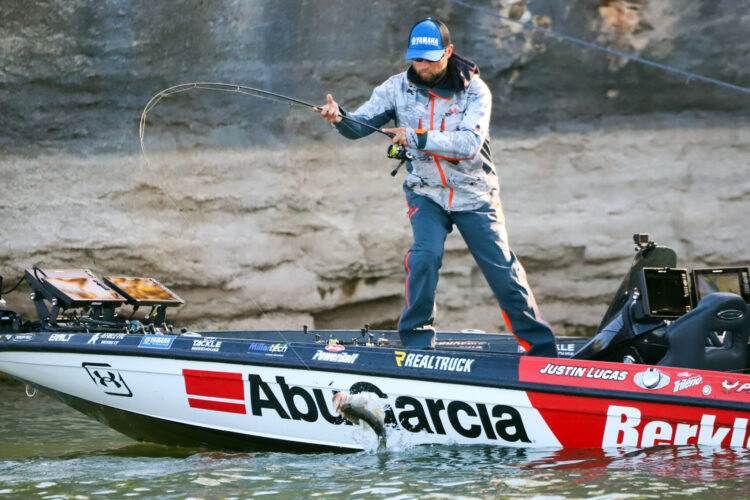
One of the reasons Lucas didn’t embrace the urchin sooner was the misconception that it’s only applicable with forward-facing sonar, which is only allowed for one period per day during Bass Pro Tour competition. But he quickly found out that it excels when blind casting to cover, too. His first tournament success with a Moeba came during the Qualifying Round of Stage 3 on Lake Whitney, when he caught nearly 60 pounds of his 70-10 total without forward-facing sonar.
That said, forward-facing sonar can boost efficiency by allowing anglers to read how a fish reacts to each movement of the bait. Using the technology, Lawrence has learned that he can turn a few extra followers into biters by quivering an urchin if his usual jerk-and-pause retrieve won’t get them to commit.
“You’re playing that typical cat-and-mouse, like you keep it away from them,” he said of his standard retrieve. “But once I have done that for several feet and I can tell that that fish is not going to bite – if he was going to, he would have already done it – I will at that point start almost kind of a minnow shake. Just kind of quivering that bait in place.”
The other tip Lawrence shared is not to use too much weight. The exact weight he chooses depends on the size of the bait, the wind and the desired depth, but he wants his Uni to fall as slowly as possible. That can make for some painfully slow fishing, but he’s seen the rewards.
“The sink rate is very, very important,” Lawrence said. “I generally want to go as light as I can possibly be and still be able to get the bait to them. Obviously, you’ve got to get it down there to them, but the slower that I can get it to him, the better. When I’m twitching that, when he comes at it and I’ve got to let it rest, I want that bait to suspend or come as close to suspending as possible. I don’t want that bait to really sink super fast.”
All three anglers agreed that the urchin craze is just getting started. Lucas believes it’ll eventually turn into a tool that shines in a few specific situations – like the Alabama rig or the Senko – but he doesn’t think it’s going away.
“I think it’s going to last for several years at least, if not longer,” he said. “Yeah, it’s going to get tougher to get bit on it as they see more, but you’re going to have windows where it’s going to completely dominate. So, it’s not going away. Anything that can win a professional-level event never goes away completely. Like, that’s a proven technique that can catch bass over multiple days and win at the highest level – that’s going to last.”