COLUMBIA, S.C. — PowerStop Brakes Stage 3 Presented by Strike King on Lake Murray delivered a wide range of patterns, plenty of big bass and a duel between the top two anglers in the Fishing Clash Angler of the Year standings on the final day. While we’ve already covered Drew Gill’s latest win in depth, when you have 30 hours of live tournament competition across four days, there’s always interesting tidbits that don’t make it into the daily coverage. Here are a few news items, notes and other nuggets to put a bow on a memorable event.
FFS excelled, but perhaps not as much as it appeared

Throughout the tournament, there was a strong forward-facing sonar bite, particularly in the mornings. As the event progressed, taking advantage became more and more important, to the point that it largely determined who would win the Championship Round. Gill and Jacob Wheeler separated themselves from the rest of the field while using forward-facing sonar in Period 1, and Wheeler couldn’t quite make up enough ground during the latter two periods to overcome his 9-pound, 6-ounce, deficit to Gill at the end of the first.
That said, due in part to the Bass Pro Tour’s new rules, which limit pros to one period per day in which they can utilize the technology, this event was about far more than just pinging minnows.
According to SCORETRACKER Insider™ Presented by Strike King, a little less than 40% of the scorable bass caught and the total weight across the entire field were captured by anglers using forward-facing sonar. Given that the field spent roughly one-third of its time with the technology on (yes, there were those anomalies who didn’t use it at all, but most opted to this week), you might think that number would be higher. But those stats show that the field as a whole didn’t catch fish at an astronomically higher rate while using forward-facing sonar than they did with their transducers turned off – especially when you consider that those who laid off their fish on the second and third afternoons almost all did so during periods when they weren’t using forward-facing sonar.
That said, the percentage of weight caught by those using forward-facing sonar did increase as the event progressed. On Day 1, forward-facing sonar use accounted for 33.6% of the total weight. That number increased to 41.8% on Day 2, 42.3% during the Knockout Round and a whopping 52.4% during the Championship Round.
Whether the root cause was the shallow fish on Murray getting pressured more quickly than those out deep, changing weather conditions or a shift in the bass’ behavior as they transitioned toward the spawn remains unclear. However, that trend was clearly a result of another phenomenon on Murray: The fish stopped biting reaction baits.
Crankbaits and other moving baits accounted for several strong starts to the event – look no further than Jeff Sprague’s dominant Qualifying Round win, during which he caught all his bass on a Norman Deep Little N. However, for some reason, the bass got off the moving bait bite.
That started to become apparent during the Qualifying Round, then really crystalized on Championship Sunday, when each of the top-five finishers caught every single one of their fish on soft plastics. No surprise, the jighead minnow paired with forward-facing sonar did most of the damage, while drop-shots, wacky worms and Neko rigs accounted for the rest.
Appreciating Sprague’s strong start
Speaking of Sprague, while his first career Bass Pro Tour victory continues to elude him, he deserves recognition for what he was able to do during the Qualifying Round.
The veteran Texan put together the two best days of any angler in the field on Days 1 and 2. His Day 1 total of 59-13 had him 9 pounds clear of his nearest competitor, then he went out and one-upped himself on Day 2, stacking up 62-3. Oh, by the way, he did that while spending pretty much all of Period 3 in practice mode. Had he wanted to, he probably could have eclipsed 80 pounds on the day, maybe more. Now with 14 BPT Top 10s to his name, Sprague’s breakthrough feels like just a matter of time.
Gill’s meteoric rise by the numbers
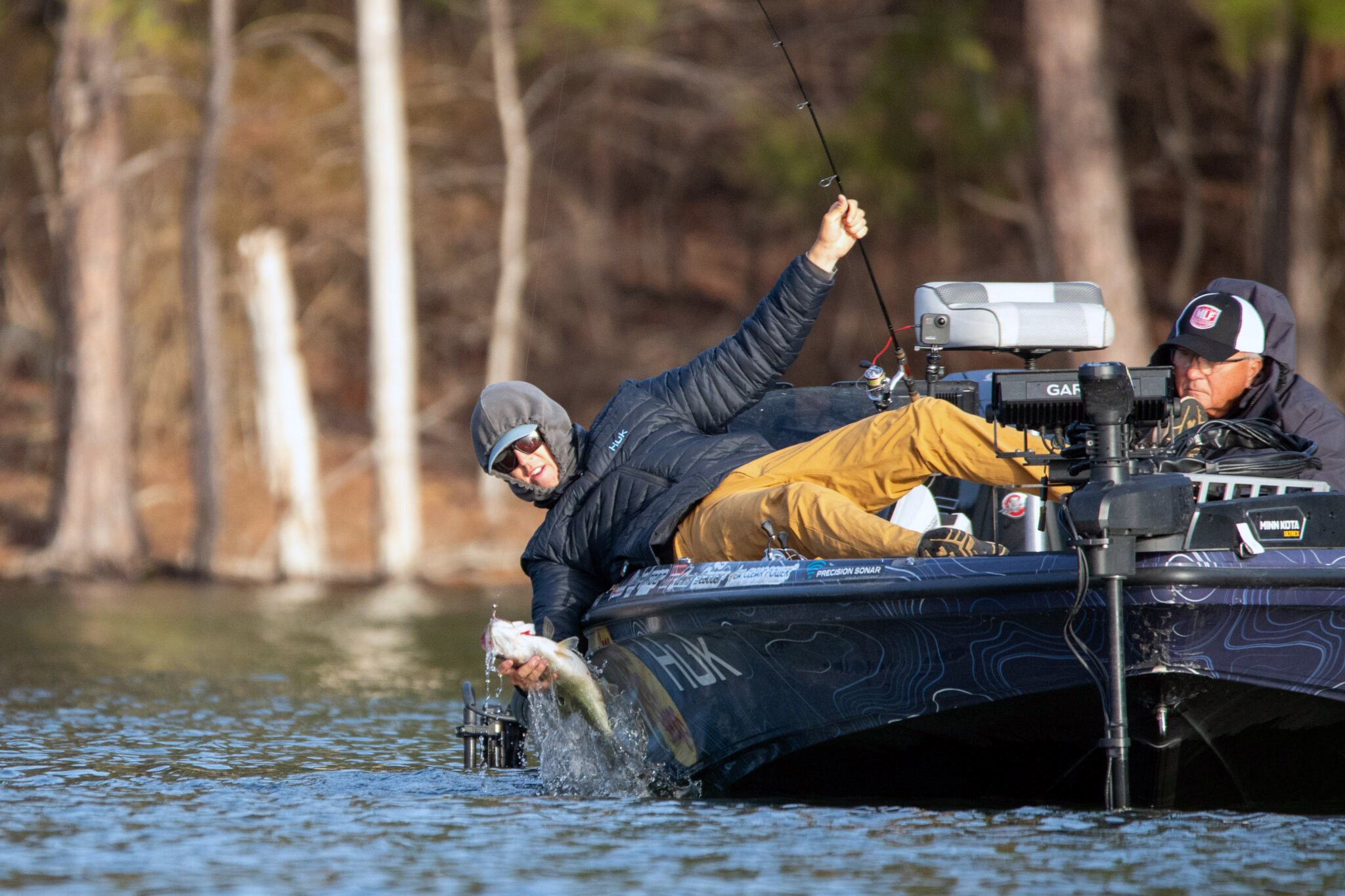
If you’ve paid even passing attention to professional bass fishing over the past few years, you know that Gill has taken the sport by storm. After his second Bass Pro Tour win, it’s worth taking a deeper dive into just how dominant he’s been.
Since joining the BPT at the start of the 2024 season, Gill has racked up seven Top 10s and two wins in 10 events. After finishing second to Wheeler in the AOY race as a rookie, he’s now back in the same spot, currently six points back of Wheeler.
Gill has done that while fishing a schedule loaded with events at other levels, too. Since the start of 2023, the 22-year-old has competed in 12 Tackle Warehouse Invitationals events, notching eight Top 10s and one win. Don’t forget, he passed up an opportunity on a fishery that probably would have suited him, too, when he withdrew from the 2024 season finale on the Detroit River so he wouldn’t take a spot from someone trying to qualify for the Bass Pro Tour. Gill also has 10 career Toyota Series Top 10s to his credit, including at each of the past three Toyota Series Championships. He also teamed up with Marshall Robinson to win the General Tire Team Series Summit Cup in Florida last fall.
Add all that up, and Gill has 15 Top 10s and three wins in 22 national-tour events since turning pro. That’s a Top-10 rate of 68.2% and a win rate of 13.6%. His 24 Top 10s at all levels of MLF competition since the start of the 2023 season are by far the most of any angler. He has an excellent chance of cracking the million-dollar mark in career earnings in 2025, just his third year as a full-time pro. Already, he’s racked up $872,232. Insane.
Other notes:
- While Wheeler fell just short of capturing his ninth Bass Pro Tour trophy, he did earn some major redemption on Lake Murray. The last time he competed on the fishery, in 2023, he finished 75th out of 80 anglers. That marked the worst finish of his BPT career and, more than anything else, is the reason he’s not gunning for his fifth straight Angler of the Year crown this season.
- The average weight of a scorable bass across the event wound up at 3-1. That’s the heaviest mark for a BPT regular-season event since the St. Lawrence River last year, and the heaviest for a predominately largemouth event since Stage 2 of 2024 at Santee Cooper. In all, the field weighed 72 bass of 5 pounds or bigger. Dave LeFebre caught the Berkley Big Bass for the event with a 7-8 on Day 2.
- Year after year, newcomers to the top levels of tournament fishing continue to show they belong. All three BPT rookies – Marshall Hughes, Jake Lawrence and Colby Miller – made the Knockout Round at Murray. Lawrence finished 10th, recording his second Top 10 in three events to start his BPT career, while Hughes finished 16th and Miller 17th. Lawrence now sits sixth in the AOY standings, and Miller is 10th.