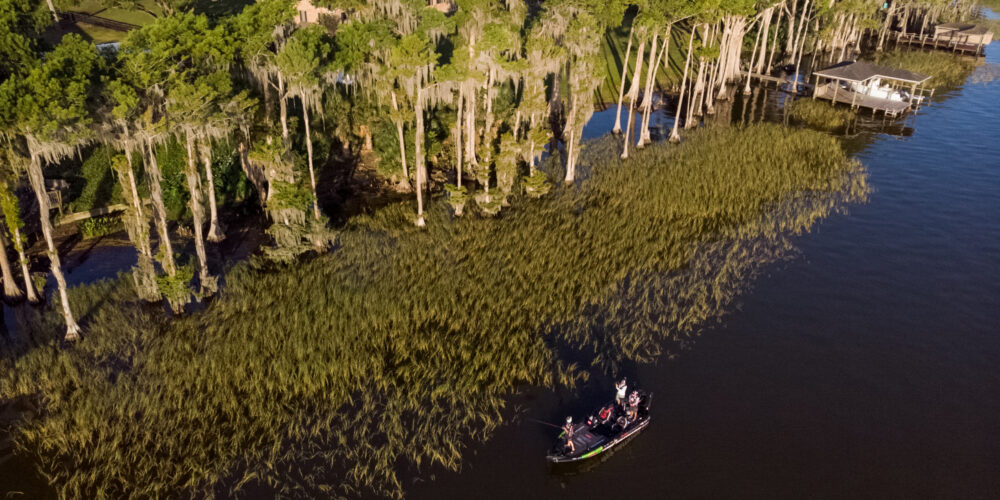
After a thrilling start to the 2025 season on Lake Conroe, Bass Pro Tour action will return Thursday. Suzuki Marine Stage 2 Presented by YETI will take the 66-angler field to Florida’s Harris Chain of Lakes.
Fishing fans will be no strangers to late-winter tournaments in the Sunshine State. However, this event could provide a fresh twist on Florida.
Unusual weather in the area lately – a freezing cold snap that brought snow followed by sunny skies and temperatures in the 80s – should have the fish spread out across the vast venue. Factor in the 2025 Bass Pro Tour’s unique forward-facing sonar restrictions, which will allow anglers to utilize the technology for one of three periods each day, and local pros think we should be in for a diverse event.
Playing field itself is a ‘puzzle’
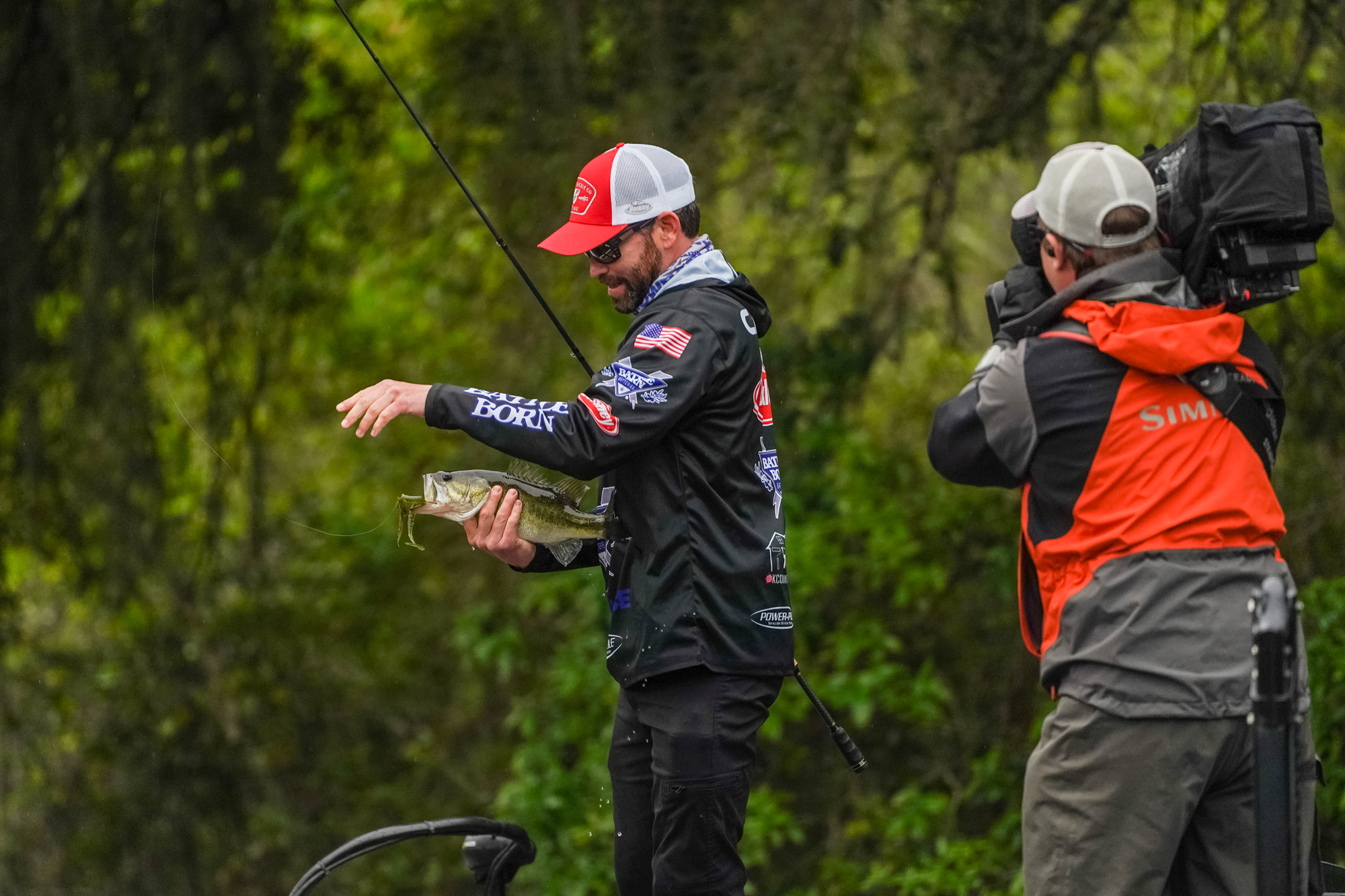
The Harris Chain is one of the most unique tournament fisheries in the country. The field will take off from Venetian Gardens in Lake Harris, and from there they’ll be able to run to Little Lake Harris, Lake Apopka, Lake Dora, Lake Eustis, Lake Griffin and a few other smaller lakes.
Just about every lake in the chain has ample aquatic vegetation, both submerged and emergent. Throw in natural wood, boat docks, riprap in the canals that connect the lakes plus offshore habitat like shell beds and there are countless places for bass to live.
With only two days of practice, simply figuring out where to fish will be a big part of the battle. Andrew Marbury, a biologist for the Florida Fish and Wildlife Conservation Commission who oversees the Harris Chain, said most of the chain has been fishing well, but he pointed to Dora, Griffin and Lake Beauclair as three lakes that stand out. Keith Carson, who lives in nearby DeBary, Florida, also said he’s heard a lot of buzz about Griffin lately. It has plenty of healthy submerged grass, plus the Emeralda Marsh Conservation Area on its northeast side – a habitat-rich environment that is trolling motor only.
“Griffin and Beauclair have a good bit of vegetation throughout both lakes, Beauclair especially,” Marbury said. “That’s really extremely important to recruiting fish, and also it holds some big fish, too.”
One lake that would have attracted quite a few anglers but may not now is Apopka. According to Marbury, Apopka recently experienced a fish kill that impacted “thousands of fish” across all species that live in it. While Marbury said the fish kill, which occurred Jan. 31-Feb. 2, seems to have subsided, local biologists have yet to determine a cause or how much the bass population was depleted.
“It’s tough to tell right now when it comes to the impact,” Marbury said. “I know we’ve talked to some anglers that have been out there and were even catching fish during the event of this fish kill.”
Further compounding the challenge of figuring out where to fish is the fact that any angler who heads to Apopka or Griffin will have to make a long run that includes waiting to pass through a lock. The Bass Pro Tour format, which allows competitors a 30-minute ride around between takeoff and lines in each morning and doesn’t require them to return for a weigh-in, makes the long journeys more feasible than most tournaments. However, its every-fish-counts scoring can also make it costly to miss fishing time – especially in the morning, when the bite is often best in Florida.
Carson said anglers who run to Griffin or Apopka will miss at least the first 30 minutes of Period 1. Fellow Floridian Bobby Lane, who finished second when the BPT visited the Harris Chain in 2021, said that could be challenging to overcome.
“There’s a risk in locking,” Lane said. “If Harris, Eustis or Dora are fishing good in the morning, there’s no way a guy locking in is going to catch up. It’s kind of a puzzle, and we’ve got to figure out how to put the puzzle together.”
What are the bass doing?
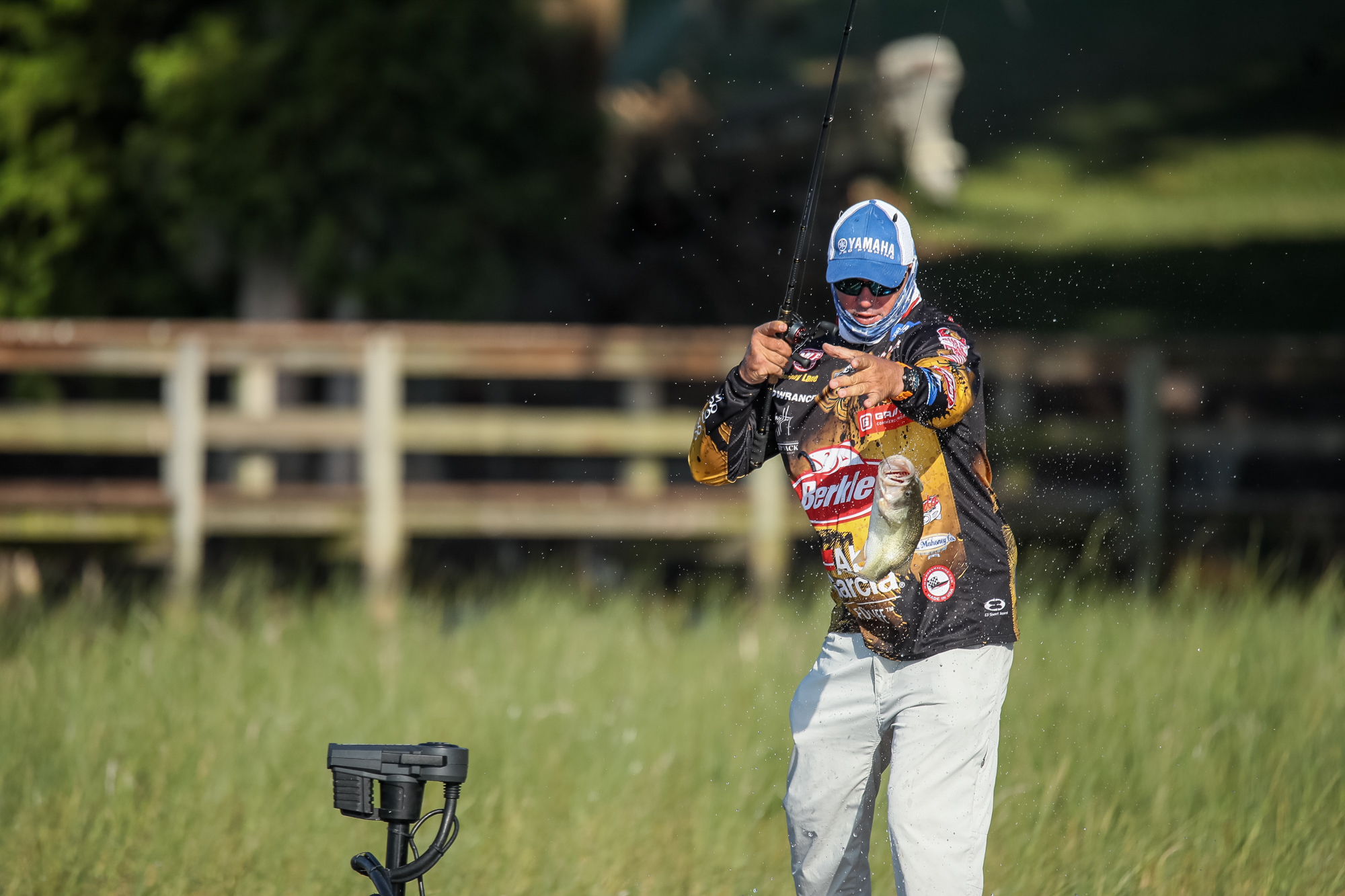
Which lake and/or area proves most productive will depend in large part on what the bulk of the bass are doing. On that front, Carson and Lane don’t really know what to expect.
Due to the extreme recent weather (which Marbury said caused water temperatures to spike from 47 degrees to 65 within about a week), the two pros both figure to find fish in all three phases of the spawn – prespawn, spawn and postspawn. If the warm weather continues, Carson said there might even be shad spawning in the mornings, which is rare in February.
As a result, even though he’s well acquainted with the fishery, he has no idea how this event is going to be won.
“I think the fish are going to be in all the stages,” Carson said. “So, you’re going to have offshore fish, you’re going to have spawning fish, you’re possibly going to have shad spawn fish. And how this tournament will be won, I actually don’t know. I’m interested to see what happens.”
With fish doing so many different things, Lane thinks MLFNOW! viewers will get to see a wide range of approaches.
“I think we’ll see guys throwing ChatterBaits, swim worms, flipping, crankbaits, frogs, drop-shot rigs, shaky heads and topwater baits,” he said. “I think it’s all going to work. I don’t think one guy is going to be able to light it on fire in one spot. I think he’s going to have to cover a lot of water.”
Carson agreed about the importance of covering water. While plenty of past Florida tournaments have been won off one offshore sweet spot or stretch of bank, the BPT format will force anglers to not only find fish that are grouped up, but probably more than one group.
“In a normal five-fish tournament, you could just go down the bank in a decent area and get five bites, and if they’re five good ones, you could win a tournament,” Carson explained. “On a group of fish that maybe wouldn’t even get you a check on the Bass Pro Tour, you could do really well in five fish. But on the Bass Pro Tour, you need to be in an active area where the fish are biting, and you need to catch them constantly throughout the day.”
The forward-facing factor
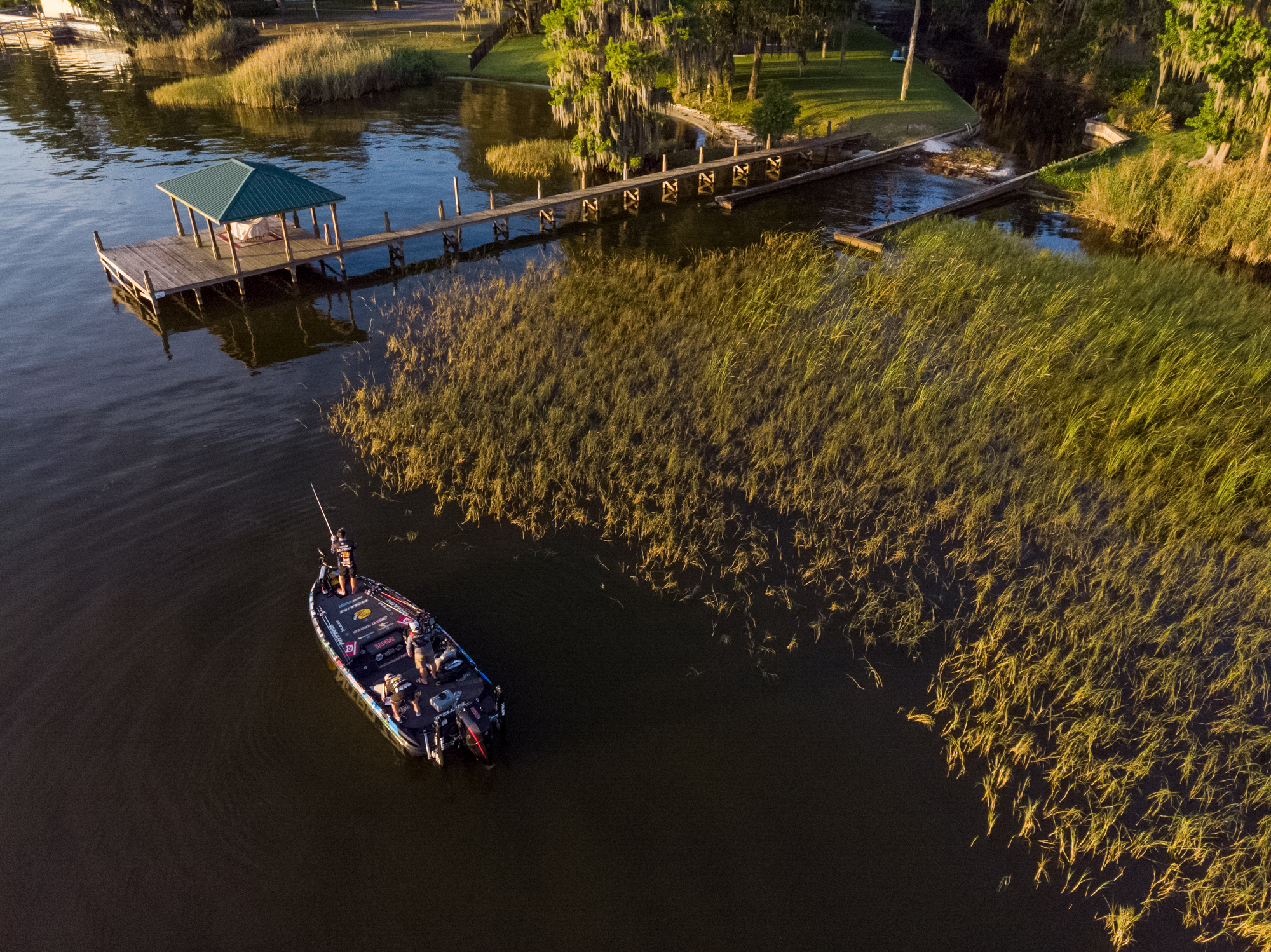
One wild card that could add to the number of ways fish are caught in this event is forward-facing sonar. We’ve seen in recent years that the technology can play a major role even in Florida’s shallow, grassy lakes, and both Carson and Lane expect to see some anglers take advantage of it during their one allotted period each day.
“I think someone like Drew Gill will be kind of pinpointing fish with a drop-shot,” Carson said when asked how anglers could utilize forward-facing sonar. “But I would say for most of us it would be more like scanning for fish on shell bars or on drop-offs with grass, stuff like that.”
However, don’t expect to see anglers stacking up weight nearly as fast during their one forward-facing period each day as they did on Conroe. There, bass were chasing offshore schools of baitfish in huge numbers, and the shallow bite was slow, meaning anglers had to take advantage of their forward-facing period in order to contend.
On the Harris Chain, Carson thinks it’s possible to catch fish just as effectively with the transducers turned off.
“It was a huge factor at Conroe; I don’t think it’ll be as big of a factor on Harris,” he said. “At Conroe, fish were out chasing shad over timber and out in open water, so sonar was pretty much the only way you could catch those fish effectively. I don’t think we’re going to see that at Harris. It will be a factor, but if someone won it without using it, it wouldn’t surprise me in the least.”
Given all the variables in play, Carson said it’s hard to predict how much weight it’ll take to advance to the Knockout and Championship Rounds and ultimately win. He theorized that it’ll take around 40 pounds per day to advance out of the Qualifying Round and more than 60 pounds to hoist the trophy – possibly as high as 80. That jives with the 2021 BPT visit, when Ott DeFoe won with 73-14 in the Championship Round.
While he may not know yet exactly how and where they’ll be caught, Carson is confident fans will see plenty of fish hit SCORETRACKER®, including some big ones.
“Man, with how the weather has warmed, I think they’re going to be biting,” he said. “I think it’s going to be really good fishing.”
Where/how to watch Stage 2
Fans can catch all four days of Stage 2 action on the Harris Chain via the MLFNOW! livestream, which can be seen daily from 7:30 a.m. to 4:00 p.m. ET here on MajorLeagueFishing.com; on the MLF mobile app; at MyOutdoorTV and on the Major League Fishing channel on Rumble.