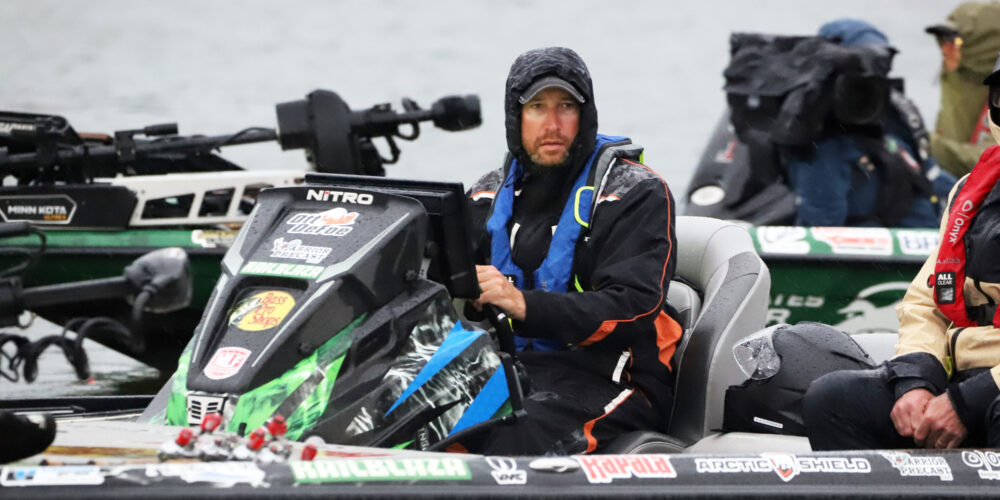
GILBERTSVILLE, Ky. — As Bradley Roy put it, Lowrance Stage 5 Presented by Mercury will be “like trying to get reacquainted with an old friend.”
The Bass Pro Tour field blasted off on Kentucky Lake and neighboring Lake Barkley for the first time ever Thursday morning. Kentucky Lake has hosted more tournaments than any other fishery in MLF/FLW history and used to be a regular destination for all national tournament trails, especially this time of year. But after a downturn in its largemouth population, this is the first time since 2018 that a top-level tour has visited the final reservoir on the Tennessee River chain.
The landmarks may look familiar to the 66-angler field as they race south from Kentucky Dam Marina, and the lake is back to pumping out solid weight. But, this is a different Kentucky Lake. There’s no submerged vegetation and smallmouth have become the dominant species, especially in terms of size. As a result, those who haven’t spent much time on Kentucky and Barkley in the past seven years found the two-day official practice period tricky. For many, there are still more questions than answers.
“We’re used to the old Kentucky Lake, and it’s just not that way anymore,” Jeremy Lawyer said. “I tried to practice the way it used to be and everything, and I don’t know that you can really practice that same way anymore.
“There’s a lot of good anglers who have fished here for a lot of years scratching their heads right now and wondering how they’re going to start this tournament.”
Ledges or shallow cover?
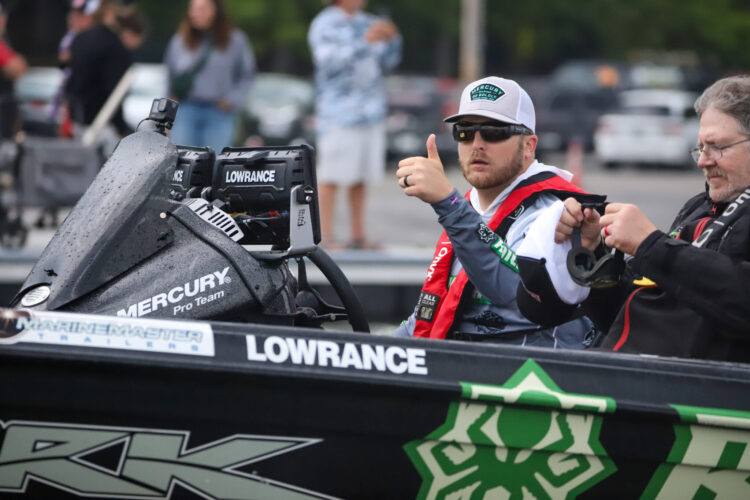
More than anything else, Kentucky Lake used to be known for huge schools of largemouths congregating on its river-channel ledges. In the past, it would have been a foregone conclusion that an early-June tournament would turn into an offshore shootout.
According to the BPT pros, there are still a few schools to be found offshore, but it’s nothing like the lake’s 2000s heyday.
“The mouth of every decent creek arm should have a school of fish in it,” Ott DeFoe said. “You idle 15 or 20 minutes in and around the mouth of every creek, and there should be a school or two of fish – it might have 10, or it might have 50, but there should be a school of fish. And that just wasn’t really the case of the way it used to be.”
All three of DeFoe, Lawyer and Roy predicted there will still be a handful of anglers who find offshore schools, and those pros will probably rocket to the top of SCORETRACKER® early. However, because smallmouth tend to be more nomadic than largemouth, finding those groups hasn’t been easy, and it’s no sure thing that they’ll stay put or reload as the event progresses.
“I don’t think they let you graph them like those old largemouth used to,” Lawyer said. “So, I think guys are going to have to fish more old, traditional fishing to come across one, and I don’t know where many places are to actually be able to do that with any kind of numbers.”
As a result, all three pros think Stage 5 will see a blend of patterns. Roy said the water level is a tad low for the shallow bite to be at its best, but there’s still plenty of shallow cover holding fish – docks, riprap, water willow and a bit of natural wood.
“There’s always been a good shallow-water bite on Kentucky Lake,” said Roy, the Kentucky native. “But you’ve never needed that shallow-water bite because the offshore bite was so good. So, now that the offshore bite is a little tougher, especially with our format, a guy may need to mix both.”
The dilemma anglers will have to figure out is whether the slow-and-steady nature of targeting shallow cover can keep up with the offshore bite, which can be explosive when it’s on but inconsistent if fishing pressure or conditions cause the bass to break up.
“If you get a little school of fish fired up and catch five, seven, 10 scorables, boom-boom-boom, that can happen really, really quick,” DeFoe said. “Having to catch them one at a time on the bank, to go throughout the day and catch a dozen scorables would be a pretty good day. But offshore, if you don’t hit that one place – you hit one place and you catch two, and then you catch one here, and then your next place, somebody is on – and before you know it, you’ve caught seven. So, it’s tricky.”
Largemouth or smallmouth?
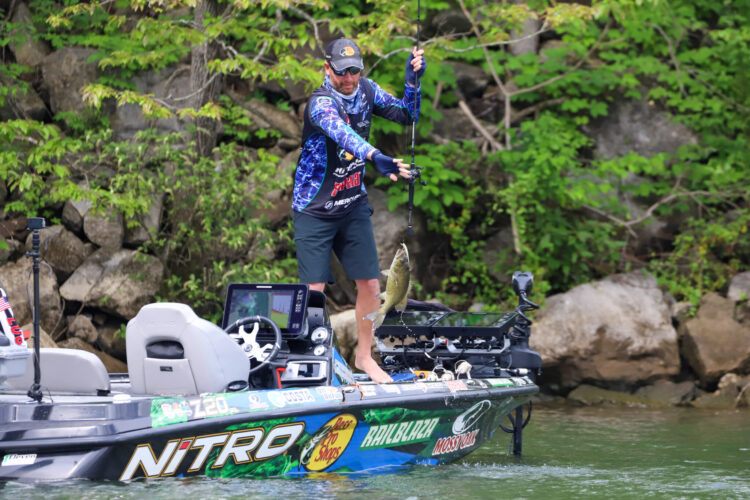
Perhaps the biggest reason the bass on Kentucky Lake aren’t behaving the same way they did a decade ago is because there’s a different dominant species in town. Roy estimated that there are more smallmouth than largemouth swimming in the competition waters, especially in the 4-plus-pound range. Recent tournament results back that up – virtually all of the Top 10 at last year’s Tackle Warehouse Invitationals event weighed mostly brown fish.
However, that event was held in mid-April, when most of the smallmouth were on or near spawning beds. This time of year, they’re quite a bit harder to find, especially during the periods when anglers can’t utilize forward-facing sonar.
“There’s definitely more smallmouth in here, but I feel like to specifically target them is a lot more difficult in the summer,” Roy said. “They’re not as easy to pick off as they are in the spring when they’re spawning and things of that nature. And then also without forward-facing sonar, they’re pretty tough to catch.”
While the largemouth population seems to be rebounding, Lawyer said it’s more spread out this time of year, too. He also reported catching quite a few smaller than the 1-8 minimum scorable weight during practice.
“When we were here (in April) for the Toyota Series, I feel like it gave me a little bit of a false premonition, because at that time, every largemouth in the lake was coming to the bank, and it made it seem like there was a lot of largemouth back in the lake,” he said. “And now, getting back out here and knowing those fish have swam off somewhere else, it definitely seems to be that the smallmouth are going to play a much bigger role.”
As a result, Lawyer thinks any anglers who have spent time targeting smallmouth on Kentucky Lake in recent years and know where to look for them will have a significant advantage. (He predicted home-lake favorite Jake Lawrence could “make us look like idiots.”) That said, because of the transient nature of summertime smallmouth, there could be as many or more pros targeting largemouth at this event.
“I think there’s probably some guys that found a group of smallmouth, and they won’t be there tomorrow morning,” Lawyer said. “That’s just kind of what it is.”
Kentucky Lake or Barkley?
The field won’t just have to figure out whether to target largemouth or smallmouth, to fish shallow or deep. There’s a whole other variable in play this week: Lake Barkley.
The Cumberland River impoundment, which is connected to Kentucky Lake via a canal, hasn’t historically been able to keep pace with its neighbor. But if the offshore schools on Kentucky Lake get too crowded, Barkley and its plentiful shallow cover could be a productive place to get away from the crowds.
The three pros interviewed differed on how much time they spent on Barkley in practice and whether they think it can compete. Roy devoted all of his practice time to Kentucky Lake. Lawyer, who won the 2016 BFL All-American on Barkley, spent about two-thirds of the second practice day there, but he predicted the entire Top 10 will come from Kentucky Lake. DeFoe, meanwhile, is more bullish on Barkley.
“I actually spent the majority of my time over there, so I hope it plays,” he said.
Overall, the three competitors shared a similar outlook in that they expect the offshore bite to win the event, but they think anglers who stick to the shallows will have a real chance to crack the Top 10 and perhaps a better shot to cash a check.
“I fully expect the ledge deal to win and account for most of the Top 10, but I do feel that other stuff will make Top 10s and possibly be half of the checks,” DeFoe said.
It’s no secret which baits will play a major role offshore – expect to see lots of ledge staples like deep-diving crankbaits, football jigs and hair jigs with a smattering of new-school tactics (jighead minnows, drop-shots and Neko rigs) mixed in. Around shallow cover, DeFoe said swim jigs, topwater presentations and flipping baits could all produce.
“Whether it’s a white or a bluegill color, I do think a swim jig is going to be the single biggest shallow-water player either lake,” he said.
Both DeFoe and Roy expect it to take around 50 pounds across the two-day Qualifying Round to make the Knockout Round, although that mark might be a bit high. The battle for the Qualifying Round win, which comes with an automatic trip to the Championship Round, could be a barn burner with those anglers who find willing offshore schools stacking up weight in a hurry. However, as the event progresses and those schools get pressured, it could be anyone’s trophy to win.
Don’t miss any of the action
The Qualifying Round will span Thursday and Friday, with the anglers who rank second through 20th qualifying for the Knockout Round. Weights will zero, then the Top 10 will earn berths in Sunday’s Championship Round, where weights will once again reset and the angler who amasses the most weight will earn the $150,000 top prize. Watch all the action live on MLFNOW! from 7:30 a.m. to 4 p.m. CT Thursday through Sunday at MajorLeagueFishing.com, the MLF and MyOutdoorTV (MOTV) apps and the Major League Fishing Channel on Rumble.