
Both the winning angler and winning baits at Bass Pro Shops REDCREST Presented by MillerTech should look familiar. Mercury pro Dustin Connell claimed his second straight championship and third career title on Lake Guntersville, and he did so by leaning on two of the same tools that earned him the 2024 win on Lay Lake: a CrushCity Mooch Minnow on a jighead and a CrushCity Freeloader on a scrounger head. Fellow Mercury pro Wesley Strader also incorporated a jighead minnow in his runner-up finish.
Don’t let that fool you, though; this was far from another of the minnow beatdowns that have become commonplace in recent years, in which seemingly everyone in the field stares at their screens while casting similar baits to suspended fish.
For one thing, both Connell and Strader bucked conventional wisdom on Guntersville by running roughly 70 miles from takeoff each day to the riverine waters below the Nickajack Dam, where they caught largemouth, smallmouth and spotted bass. Plus, forward-facing sonar wasn’t a factor for either angler. In fact, Connell – who caught his winning total of 87 pounds, 11 ounces off the walls of the dam – said he didn’t catch a fish all event that he first spotted with his Lowrance ActiveTarget.
“I don’t think I caught a bass this week using forward-facing sonar,” Connell said shortly before he accepted the trophy. “I really can’t even remember one. … There was so much current, so much shad. I said, I ain’t even going to bother with it.”
The jighead minnow has become inextricably linked to the debate surrounding forward-facing sonar. But Connell and Strader showed that, even if you don’t have the technology at your disposal, you can still take advantage of the hottest trend in bass fishing. Fellow Bass Pro Tour angler Luke Clausen predicted that fishing “blind” will be the next evolution of the jighead minnow craze.
“The more people play around with it and realize that you can catch them without forward-facing, I think it will get more widespread,” said the longtime Mercury pro.
It helps to know where to throw

While the jighead minnow only recently became a national phenomenon thanks to its effectiveness when paired with forward-facing sonar, the technique long predates the technology. Strader noted that he’s been fishing straight-tail plastics on jigheads for years in Tennessee – a technique locals call “tight-lining.”
Traditionally a wintertime technique, tight-lining sees anglers cast to steep banks and allow their bait to pendulum back toward the boat on a semi-taught line so that it follows the slope of the bottom. Strader employed the same technique along river-channel banks on the upper reaches of Guntersville. He believes smallmouth were spawning and guarding fry on those banks, so he would shake his minnow just above the bottom until it intercepted a bass.
“I always thought it was just a wintertime deal, but since forward-facing has come out, you can see what’s going on a little bit better,” Strader explained. “A lot of times, I’ll go down the bank throwing it and not even looking at it. It’s just tight-lining like we’ve done for years.”
While Connell wasn’t targeting bedding bass, he employed a similar technique, casting into current seams and shaking his bait along the dam walls where bass were corralling shad.
The commonality between Connell and Strader’s success: Their bass were positioned close to structure. That’s perhaps the easiest scenario to use a jighead minnow without forward-facing sonar.
Part of the appeal of the bait is how natural it looks, but that also means it doesn’t excel at getting bass’ attention from afar. So, whether it be near the bottom, the bank or a piece of cover, knowing where fish are positioned makes it easier to put a jighead minnow in front of them and provoke a bite.
“When those fish are relating to something, you can fish it over that when you’re not able to look at the bait,” Clausen said. “I think it really excels when fish are relating to the bottom or a piece of structure, something like that.”
Indeed, Strader said keeping his bait within a few inches of the bottom was key to his success on Guntersville.
“You had to have your boat in 10 foot of water and it be close to the bank,” he said. “When it got flatter, you didn’t catch as many. So, it had to be deep, and you wanted to keep that minnow down close to the bottom. You’d start ticking rocks when you pick it up.”
A few other ingredients tend to aid the blind minnow bite. Clean water is a major help. The dirtier the water, the more important it is to present a bait close to the fish, which is difficult to do without forward-facing sonar. Clausen has also found that smallmouth and spotted bass tend to travel farther to eat a minnow than largemouth.
“Spots and smallmouth, traditionally, will just swim further, and fish in clear water in general will swim further,” Clausen said. “So, the clearer the water, the easier it is to do that when you’re not actually looking at a fish. The dirtier water makes it more challenging.”
Minnow shaking from the back of the boat
Targeting bass that are suspended in open water – the new frontier that forward-facing sonar has helped unlock – tends to be more difficult without the technology. That was evident at Stage 1 on Texas’ Lake Conroe. Several anglers were able to use minnows to stack up big weights during their one period per day with forward-facing sonar. But, faced with off-color water and largemouth constantly moving as they chased schools of shad, no one could replicate that bite with their transducers turned off.
However, in the right situations, Clausen has had success targeting suspended fish without underwater eyes. The most important piece to doing so is knowing roughly how deep the fish are – as forward-facing sonar has shown, keeping the bait above the bass is imperative. Once you have an idea of the prime depth and how fast your bait falls, you can count it down to the proper zone and work it back to the boat at a slightly upward angle, or let it swing down through the water column – like tight-lining away from the bank.
“Getting the bait to the bottom and shaking it above the bottom is kind of an easier feel to know how far your bait is off the bottom versus just in open water,” Clausen said. “But if we see bait balls down 10, 15 feet, I may throw a 1/4-ounce (jighead) and count it down to 5 and start shaking it so that pendulum intersects that layer of activity.”
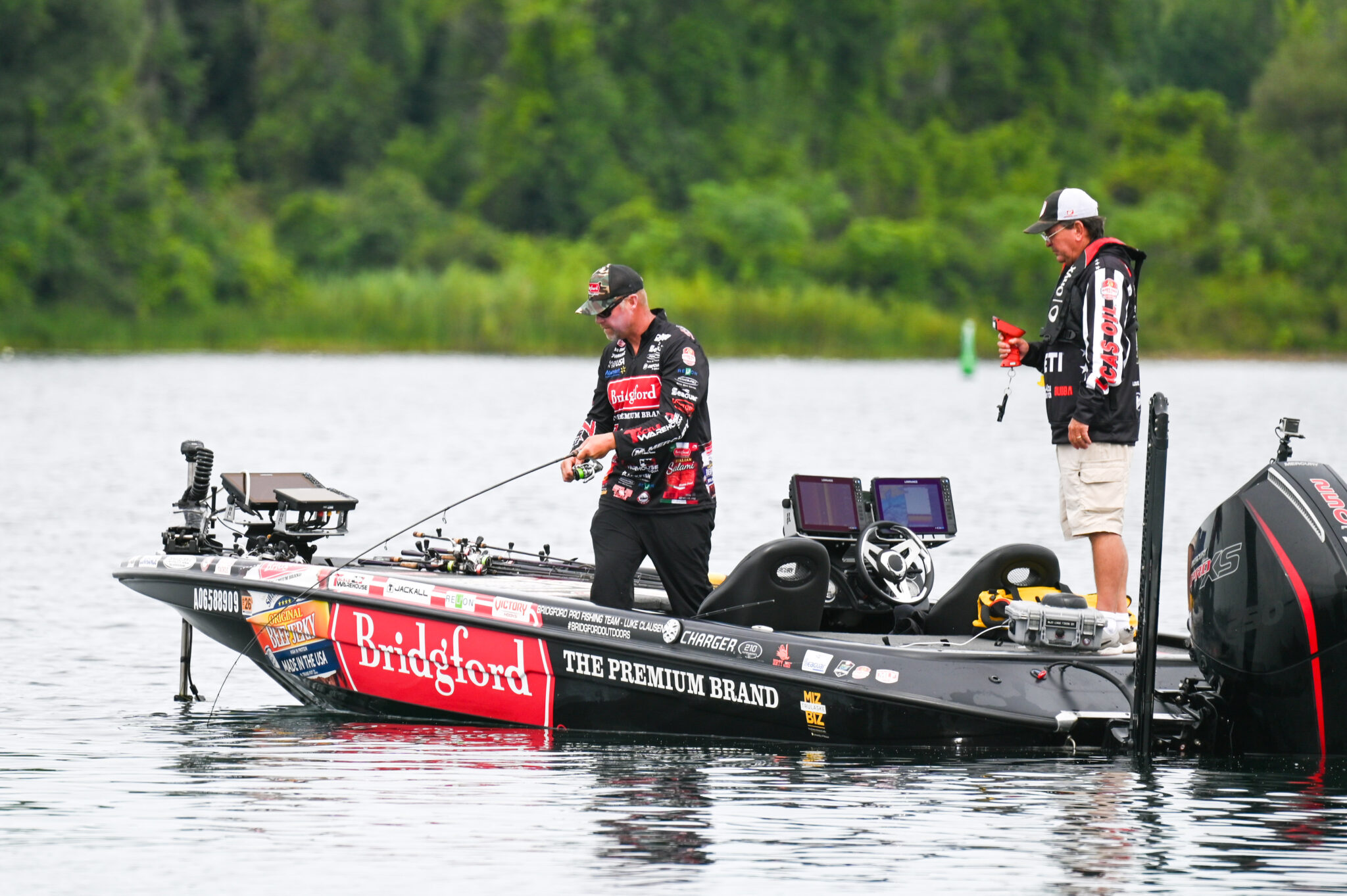
Not only is throwing a jighead minnow without forward-facing sonar a strategy Bass Pro Tour competitors have started to employ when they’re not allowed to utilize the technology, Clausen expects it to gain traction among co-anglers as more boaters target suspended fish offshore. The Eastern Washington native has found plenty of success wielding a minnow from the back of the boat while fishing with friends.
“When people quit being disgruntled about their buddy using forward-facing in the front, they’re going to realize they can still catch fish without having it in the back of the boat,” Clausen said. “I’ve seen times, especially at home, that a guy in the back of the boat will catch more than if someone is throwing at isolated fish. You’re targeting one fish; well, the guy casting around just fishing, you can catch more fish.”
Clausen’s one tip for co-anglers throwing a minnow: Use the biggest bait the bass are willing to bite.
“The bigger minnow you can get away with, I always believe there’s more draw to it,” he said. “So, say like a 5-inch (Z-Man) Jerk ShadZ, if they’re willing to bite a bait that big, fishing blind with a bigger bait like that I think a lot of times gets more bites, just because it draws fish from further distances.”
It’s clear that forward-facing sonar makes anglers more efficient with a jighead minnow. However, you don’t need to have thousands of dollars’ worth of technology to get in on the trend. In fact, part of its beauty is its simplicity – just grab a spinning rod, ballheads of varying weights and a few packs of soft plastics, and you’re good to go.