It only takes a glance at the current Top 10 in the School of the Year standings for the Columbia PFG College Fishing Presented by Abu Garcia ranks to spot the outlier. Every program but one is located in Alabama, Tennessee or Georgia.
The exception: Michigan’s Adrian College. The Bulldogs currently sit second, just 10 points back of Montevallo University, the Alabama powerhouse that has won three of the past four School of the Year titles.
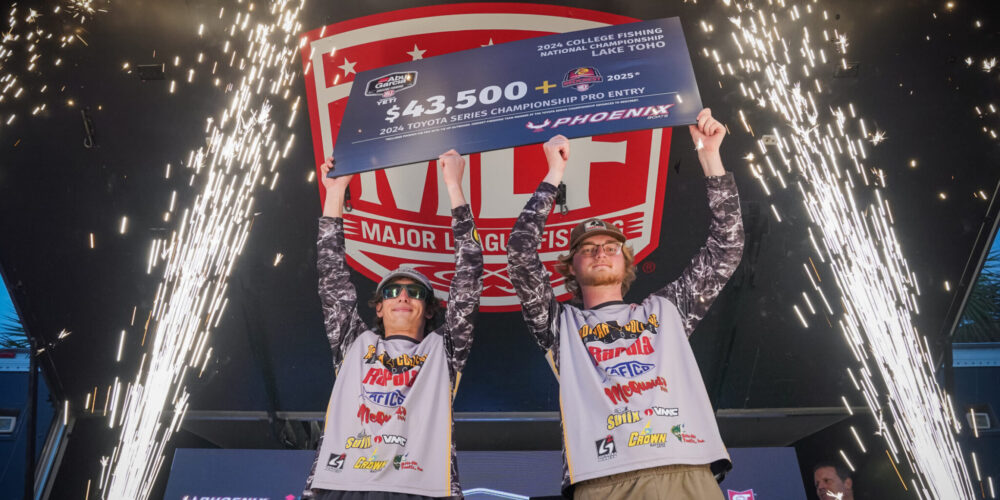
Despite its northern location, this is far from the first year Adrian has competed at the upper echelon of the college ranks. The Bulldogs won their first School of the Year title in 2019, just four years after coach Seth Borton founded the program. They had a duo win the Bassmaster national championship in 2021. Then, in January 2024, Braylon Eggerding and Lucas Washburn claimed the MLF National Championship in epic fashion, topping the field by 1 ounce on Lake Toho thanks to an 11-pound, 7-ounce kicker.
Borton understands that his team faces an uphill battle to contend with Montevallo and the other Southeastern programs that enjoy year-round fishing and close proximity to most of the tournament venues. But thanks to Adrian’s buy-in, momentum from recent successes and a culture built around “overcomers,” the Bulldogs continue to prove that there don’t have to be limitations on what a Northern program can achieve.
Top-notch institutional support
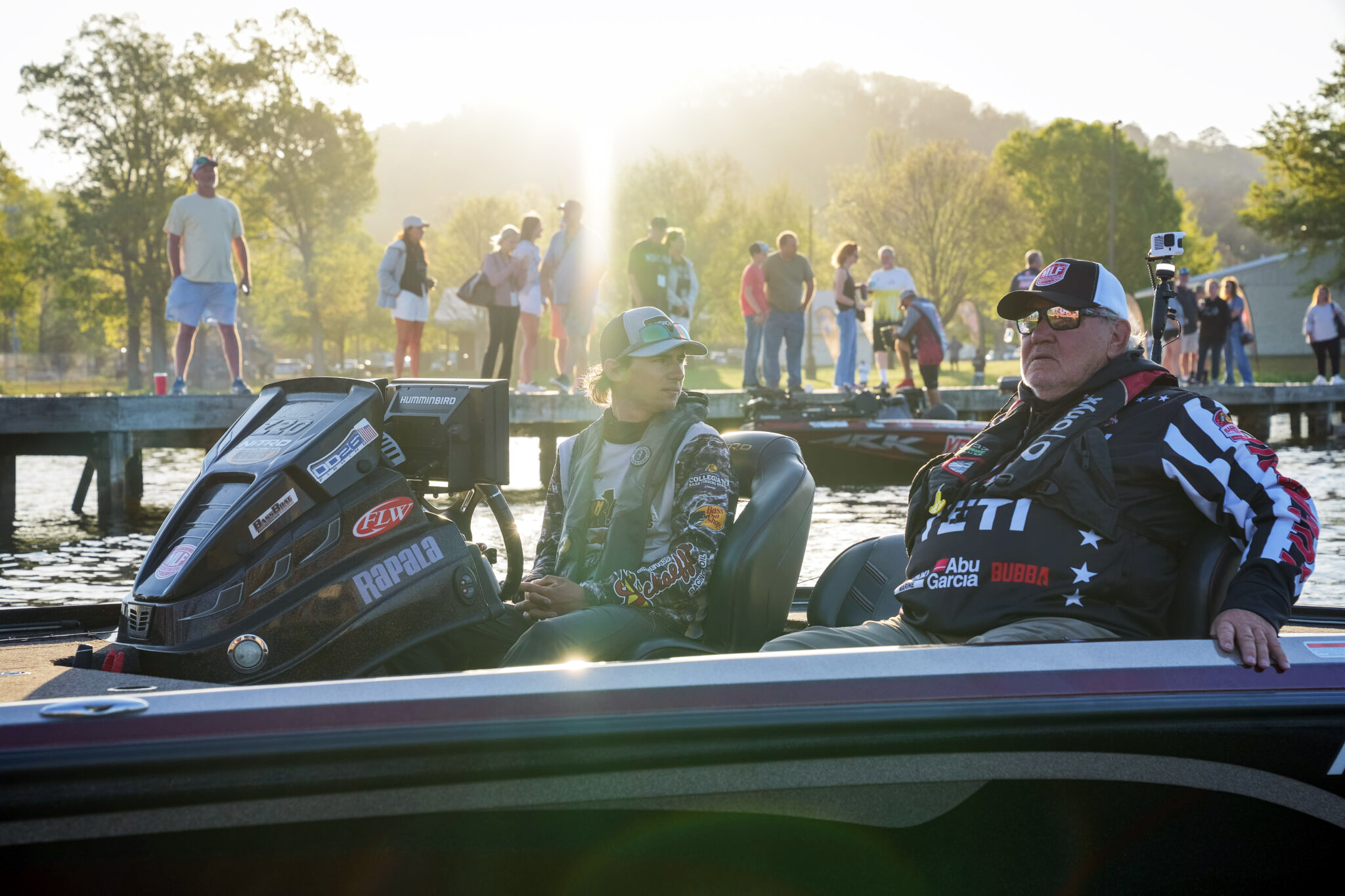
Borton is a longtime tournament angler who has always worked in the outdoor industry. When a friend who worked at Adrian told the Michigan native that the school was interested in forming a bass fishing team and asked if he’d be interested in coaching, Borton was intrigued. But the former college basketball player who described himself as “highly competitive” didn’t want to head a program that had no chance of competing at the highest level. Adrian’s institutional commitment sold him.
“They were not somebody that tip-toed into anything,” he said. “It was either we’re going to do this and do it right, or we’re not going to do it. And they kind of took most of my recommendations in terms of showing investment from the school in terms of budget and vehicles and boats and that kind of stuff. That’s kind of what catapulted things forward.”
The school provides the team with five tow vehicles, two bass boats and on-campus storage for them. It also funds the extensive tournament travel. Adrian is slated to compete in 16 events in 2026, all of which are at least 8 hours away from campus (and most much farther than that).
Eggerding, who went on to represent Adrian as a competitor at REDCREST last spring following his national championship triumph, said the institutional support was a big reason why he chose to stay in his home state and attend Adrian rather than fishing for a Southern program.
“In four years, I haven’t paid for a dime of gas, lodging, food,” the senior said. “You just can’t really get that anywhere else. So, that definitely caught my eye, and that’s one of the biggest reasons I came here. They just help us out so much.”
Still, being based in Michigan comes with challenges. Borton noted that his anglers are usually at a disadvantage in terms of experience on the fisheries where they compete. Weather is an issue, too. Michigan’s lakes are iced over for at least a quarter of the year, and the team often has to contend with winter weather as it travels to and from springtime tournaments. Plus, as nice as the university’s support is, resources don’t go as far when you have to travel across the country for just about every event.
“Another team can bring 20 teams and travel two hours to a tournament, and I can dump every single resource I have into it and bring seven teams, and it costs me more than what it costs another team to bring 20,” Borton explained.
With College Fishing becoming an increasingly popular pathway to the pros, recruiting has also gotten tougher for Adrian. Borton can’t blame prospective anglers who want to spend four years at a Southeastern institution, where they’re within driving distance of many popular stops for professional tours.
“It’s getting harder and harder with so many tournaments in the South,” he said. “A lot of kids are looking at, well, why would I stay up north? There’s no tournaments up here. So, it’s just getting to be a tricky recruiting scenario, because most of my best Northern kids that I used to be able to get pretty easily are all heading south, because there’s nothing coming up north anymore.”
Recruiting the right fits
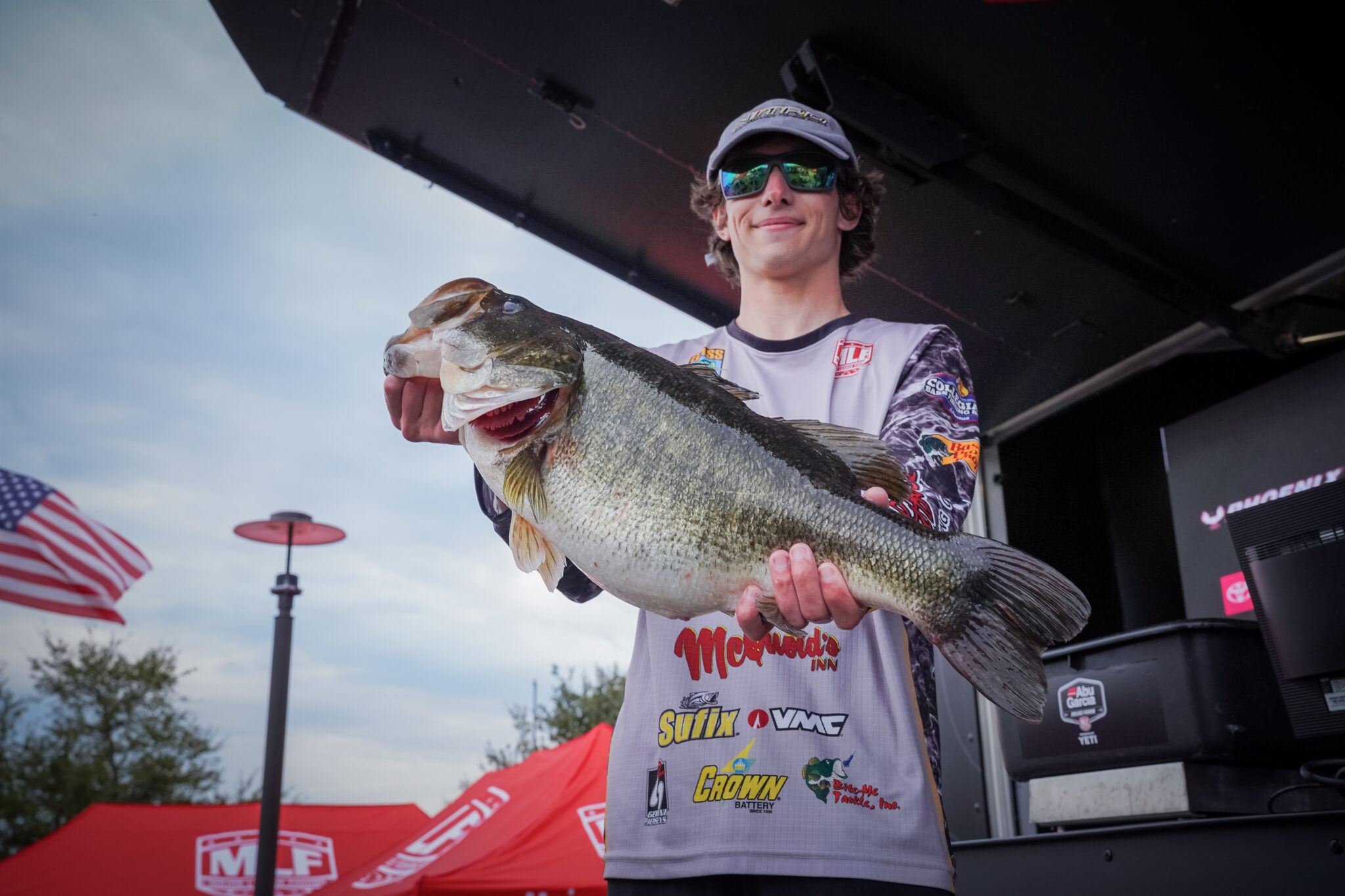
So, how has Borton risen above those challenges? It starts, as all college sports do, with recruiting. Attracting anglers who have already won big in high school isn’t always easy, so Borton looks for prospects who have a chip on their shoulder and embrace the challenge of overcoming obstacles.
“When I recruit, the No. 1 thing that I’m looking for is a kid that has some dog, the kid that has some fight,” he said. “Willingness to overcome anything and everything that comes his way. … If you want to dive into anything and go, ‘This is what I’ve got control over; this is what I’m going to take advantage of and just try to be a fighter and an overcomer,’ you’re going to achieve things, and we’re going to achieve things collectively.”
Eggerding, who hails from Grand Rapids, said Adrian has also appealed to Northern anglers’ regional pride. Everyone in his recruiting class were Michigan residents who stayed in-state. Eighteen of the 26 anglers listed on the Adrian roster are from Michigan, and all but two are from the Upper Midwest (Indiana, Ohio, Pennsylvania, etc.).
“A lot of the guys from Michigan, who went to high school and grew up here, we came here together,” Eggerding said. “We had one of the biggest classes in a while in our grade, and pretty much all of us were from Michigan. So, we had known everyone going into it and felt like we had good chemistry.”
Of course, the biggest factor in successful recruiting is having a track record of success to show anglers that they can win big and advance to pro tours from Adrian. Both Eggerding and Borton said the national championship win in 2024 has been huge in that regard.
“You kind of need those catalyst type moments,” Borton said. “Anytime you’re increasing your visibility, it increases awareness and opens kids’ eyes to, ‘Oh, maybe I can achieve what I want to achieve from that area of the country.’”
Starting strong on Seminole

Long before the ice had melted off the lakes near campus, the Adrian team got off to a hot start to the 2026 season. Following the National Championship on Lake Murray, the Bulldog team stayed south and headed to Lake Seminole, site of the first regular-season event of the year on Feb. 20.
Getting some extra practice time on the lake was a luxury for a team that’s often seeing fisheries for the first time on competition weeks, and Adrian took full advantage. Eggerding and partner Brady Pinwar sacked up a stout 28-1 limit to win the event, and two other Bulldog tandems finished in the Top 10.
Borton said the Adrian anglers share enough information to point one another in the right direction, so having a couple duos figure out productive patterns during practice on Seminole benefitted the entire team. Eggerding said that, while Seminole initially felt like a “scary, crazy-looking place,” the fact that the bass were relating to shallow cover (especially grass) made it fish like a Northern lake.
“We do so much shallow ‘Scoping between flats and in grass,” Eggerding said. “I tend to do a lot better fishing grass in the spring, and I’m sure that’s something that goes for the whole team.”
Eggerding and Pinwar started the morning by catching a 7-pounder off their first spot, then they spent the rest of the day power fishing a big flat with a swim jig and a speed worm, which produced bunches of bites.
“In the last hour, we caught so many big fish, it wasn’t even funny,” Eggerding said. “At the end of the day, we culled a 4.50 with like a 4.70, and we were like, ‘holy cow.’”
That event gave Adrian the early lead in the School of the Year race. Montevallo took it back by placing six tandems in the top 13 places of a home-state event on Lake Eufaula in March. Four regular-season events remain to decide the title.
Of course, the competitor in Borton would love to dethrone Montevallo and bring the points crown back north. Eggerding said that’s a team goal this season. But Borton emphasized that it’s Adrian’s culture that defines the program more than its on-the-water accolades. He’s more focused on the team’s values. Maintain those, and the hardware will follow.
“At the beginning of my coaching career, I was more worried about how we did,” he said. “Now, I’m worried about the kids having a great experience, them learning how to work through conflict, them learning how to be a contributing piece to society regardless of whether they do well or do poorly. These are all the concepts that are going to carry them on to productive (careers). And some of that gets easier when you’ve won a couple national championships, and you’ve done well regionally and kids start to go on and fish professionally. Your perspective changes. So, I think that’s probably where I’m at now.”