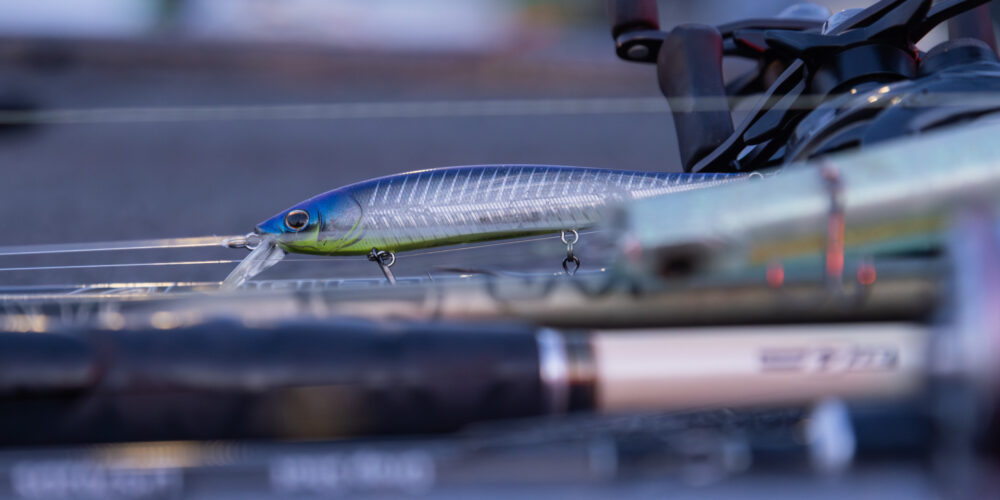
PLATTSBURGH, N.Y. – When weather forced the cancellation of Day 3 of the Toyota Series Presented by Phoenix Boats Northern Division opener on Lake Champlain, it cut short a fantastic tournament. The Top 10 pros were as close in weight as can be, and, were it not for 6-footers creaming into Cumberland Bay, it’d have made for a phenomenal final day. As was the case last year for the Tackle Warehouse Invitationals event in June, postspawn smallmouth were the ticket, and some anglers did impressive work on largemouth and spawning smallmouth for some checks as well.
Here’s what worked best on Champlain.
1. Minnow and a Ned do the work for Smith

Finding smallmouth that were a little farther removed from the spawn than in other areas, Tucker Smith was able to catch a slightly better grade of fish and edge ahead. Focusing on flats and the edges, he hunted down bass feeding on alewives.
As you’d expect, the Alabama pro used smallmouth staples for his catch, namely, a minnow and a Ned. For his minnow, he used a 5-inch Yamamoto Shad Shape Worm, with 1/4- and 3/16-ounce Picasso heads. He also used a Yamamoto Ned Senko with a Picasso Rhino Ned Head. For his minnow, his setup of choice was a 3000-sized Shimano Vanquish spinning reel and a 6-10, medium light G. Loomis NRX+ spinning rod.
2. Fields also leans on a minnow
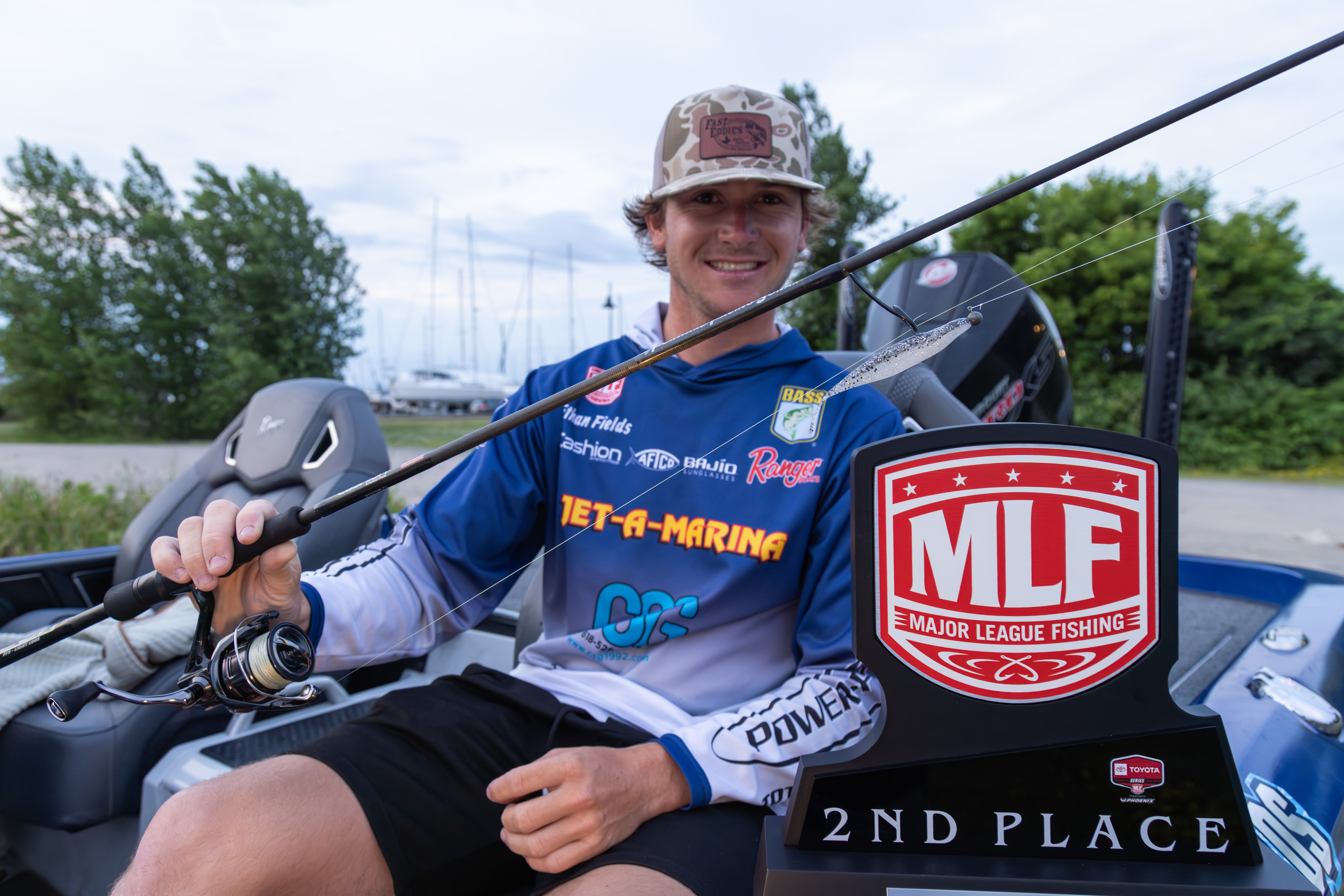
Continuing to mix collegiate fishing with the Toyota Series very well, Ethan Fields earned another Top 10, this time a ways north from his Illinois and Tennessee River stomping grounds.
A minnow did most of the damage for Fields, a 5-inch Deps Sakamata Shad in his case, paired with a 5/16-ounce Keitech Tungsten Super Round Jig Head. For his setup, he used a 7-4, Cashion ICON Forward Facing Sonar Rod, a Shimano Vanford and 10-pound braid with a 12-pound Seaguar Tatsu leader.
“In practice, I was catching pretty much everything from 15 to 20 foot, and I thought that’s what I was going to be doing in the tournament,” Fields said. “The first two days I got there, I thought I was going to win the tournament. I was just destroying them. It was incredible. And come the tournament, I go to what I thought was my best area, there had been fish just crawling around on the bottom. And I ended up not seeing a bass. The first hour, I didn’t catch one.”
From there, Fields adjusted masterfully – he ran to a grass clump, found it and the area loaded with bass, and spent the rest of the day whipping up 19 pounds in less than 10 feet. On the second day, he returned to the grass for one good fish, and then had to scramble again.
“I made a run back up towards the Alburg Passage and started catching some suspended fish,” Fields said. “And I got up to around 18, 18 1/2, but never could go over that mark. And I remembered from last year over by Malletts Bay, I had a school of them, and it popped into my head. I was like, ‘Screw it, we’re going to run all the way down there. Hopefully, I catch one big one to get closer to 20.’
“I figured that would probably be it; because last year, if I caught one, none of the other ones would bite. So, I ran down there, first cast, catch a big one. And, obviously, I didn’t just leave without making another cast. So, I throw back in there, catch another one. Then I catch another one. Then I catch another one, and it just kept on going and going and going.”
3. Wagner minnows and throws topwater

Fishing shallow and deep, Emil Wagner plied a minnow and a topwater for most of his fish.
A Berkley J-Walker did the trick for his topwater, and he used a 5.3-gram head and Berkley PowerBait MaxScent Flatnose Jerk Shad to tempt the smallmouth. For the minnow, he used a 6-9, medium light Fenwick World Class walleye rod with a 30-size Abu Garcia Revo Rocket. For his topwater, he used an Abu Garcia Revo LTX with a 7-1, medium power, moderate Fenwick World Class stick.
“The main deal I started every morning doing and the way I caught a lot of my big, big ones was throwing that minnow around breaks in Malletts Bay,” Wagner said. “And then every evening, I ran up north, and I had some grass that I was catching them on that topwater with. Both days, it was freaking mayhem when I went up there, and my biggest regret is not doing it earlier, especially the second day.”
4. Campbell knocks out another great finish at Champlain

A dead fish penalty on Day 1 cost Brody Campbell a share of the lead, and he was as ready as anyone in the field to send it out into the waves on Day 3 in pursuit of his second Toyota Series win of the season.
As you’d expect, postspawn smallmouth and a minnow did the dirty work for the Ohio pro. Campbell relied on a Deps Sakamata Shad in 4- and 5-inch sizes, thrown on a Bird Dog Rods 862S spinning stick.
“I found this area in practice,” Campbell said. “I pulled in and, I caught, you know, 21 pounds, almost 22 pounds, in just a quick time. And I knew it was kind of a special area because it’s hard to find 4-pounders on Champlain. I just hunkered down in that zone. And, I lost the big key fish the first day, it broke my line actually in the air when it jumped. It was like a 100-yard stretch where there were two big clumps of grass, and they were just hanging around those clumps of grass out there. They were a lot bigger average fish. You could go a quarter-mile either way, and the fish were just smaller.”
5. Another impressive outing for Quilatan

As usual, young Dylan Quilatan showed out, earning his second check in as many trips to Champlain.
Fishing offshore, he stayed on the move the entire event.
“I started in the Inland Sea, I went to fish a bunch of schools that I found in practice, and most of them left,” Quilatan said. “But, I caught a 4-pounder by 8 o’clock, and then I ran down the lake, about mid-lake and started looking for pelagic fish on the alewives, anywhere from 10 to 40 feet deep, and I caught the rest of my weight down there.
“I felt like all the fish I had found in practice were just leaving me,” he added. “I didn’t really feel that I could replicate that day again. The next day, the wind changed, so I went to the schools in the Inland Sea to see if they’d show back up or bite better, and they didn’t. So after, like, 7:30 a.m. the second day, I just ran new water in on the New York side and ended up fishing mostly 15 to 25 feet of water. Just anything I could find. And, I caught all my fish off different places.”
Using a few minnows, Quilatan went fairly heavy, using jigheads from 3/8- to 1/2-ounce. He used two minnow rods he built himself with components from Get Bit Outdoors – both medium-light models, one being 6-10 and the other 7-1.
6. Ti run puts Mitchell in contention

One of the surest bets for a Top 10 in any Champlain event, Kurt Mitchell made the run to Ticonderoga this time and weighed mostly largemouth. Diagnosed with cancer in January of 2024, he’s now past treatment and back on the tournament trail.
“I was running south, I was starting on some bridges and some rocks to start the morning, with the glide on the alewife spawn,” Mitchell said. “Then later in the day, I would fish deeper grass.”
At Ti, he caught some fish on grass with a jerkbait, and did a lot of damage with two glide baits he handmakes – a War Panda Nug and a War Panda prototype he designed especially for this event.
7. Patrick makes hay on current smallmouth

Fishing a pinch point on the lake, Kyle Patrick racked up huge numbers of smallmouth both days.
His primary bait was a minnow – he used an X Zone Rally Shad and a Deps Sakamata Shad on light Gamakatsu Horizon Heads. He also used a Strike King Sexy Dawg. For the minnow, he used a Douglas XMatrix 744XF, and he used a Douglas XMatrix DCX 744F for his topwater, spooling everything up with Sunline.
Patrick figured out his best spot on the last day of practice, though he didn’t really plan his event around it.
“I was leaving a marina, and I was just tossing my jig around the posts and looking,” he said. “The sun was high on the last day of practice, and the water was clear and there was no wind. And I looked down, and I saw, like, five smallmouth on one post. And their heads are all facing towards the current, up against the post. I’m like, ‘Oh my God.’ So, I picked up my jig and I pitched it there, and it literally fell 1 inch in front of their faces. And they did not even turn down at it. I think they might have blinked, and that’s it.”
Then, he tried a minnow.
“I was like, ‘All right, this is the dumbest thing ever, because I’m going to get hung up, but let me just throw this minnow,’” he said. “And, dude, I tossed it out and caught a 4.87 smallie.”
In the event, Patrick tried to mix in largemouth every day, but ultimately, all his weight came from smallmouth.
8. Kicker largemouth key for Harris
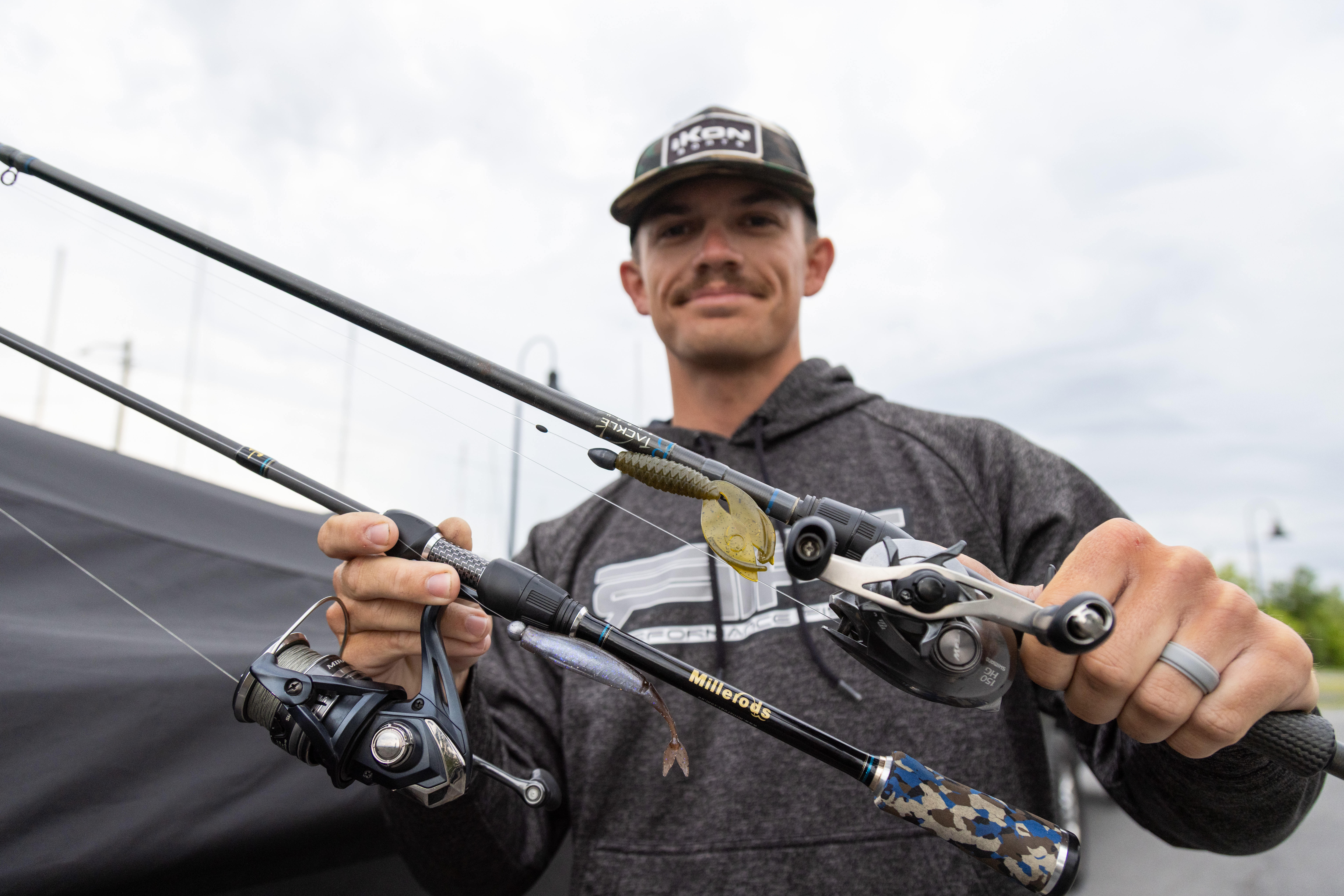
Super dialed in Texas these days, Riley Harris headed north to some smallmouth action and looked right at home.
Weighing mostly smallmouth, Harris did his best work with a 6th Sense Ozzie in wakasagi, and he flipped up some largemouth with a 7/16-ounce weight and a 6th Sense Bongo.
“I was targeting smallmouth that were on balls of bait and on rock piles,” Harris said. “And then when I would go up shallow for largemouth, you could see hundreds of little 2- to 4-inch perch swimming everywhere. So, I just grabbed that little Bongo, and I started flipping the reeds with it. And, man, in practice, when it got super hot, I was really wearing them out on it. We had that little cold front come through, I waited each day of the tournament for it to warm up before I went and started flipping. My last stop of the day on Day 2, I ended up catching one that was almost 4 1/2 that jumped me up there.”
9. Super ‘Scoper Carr stays steady
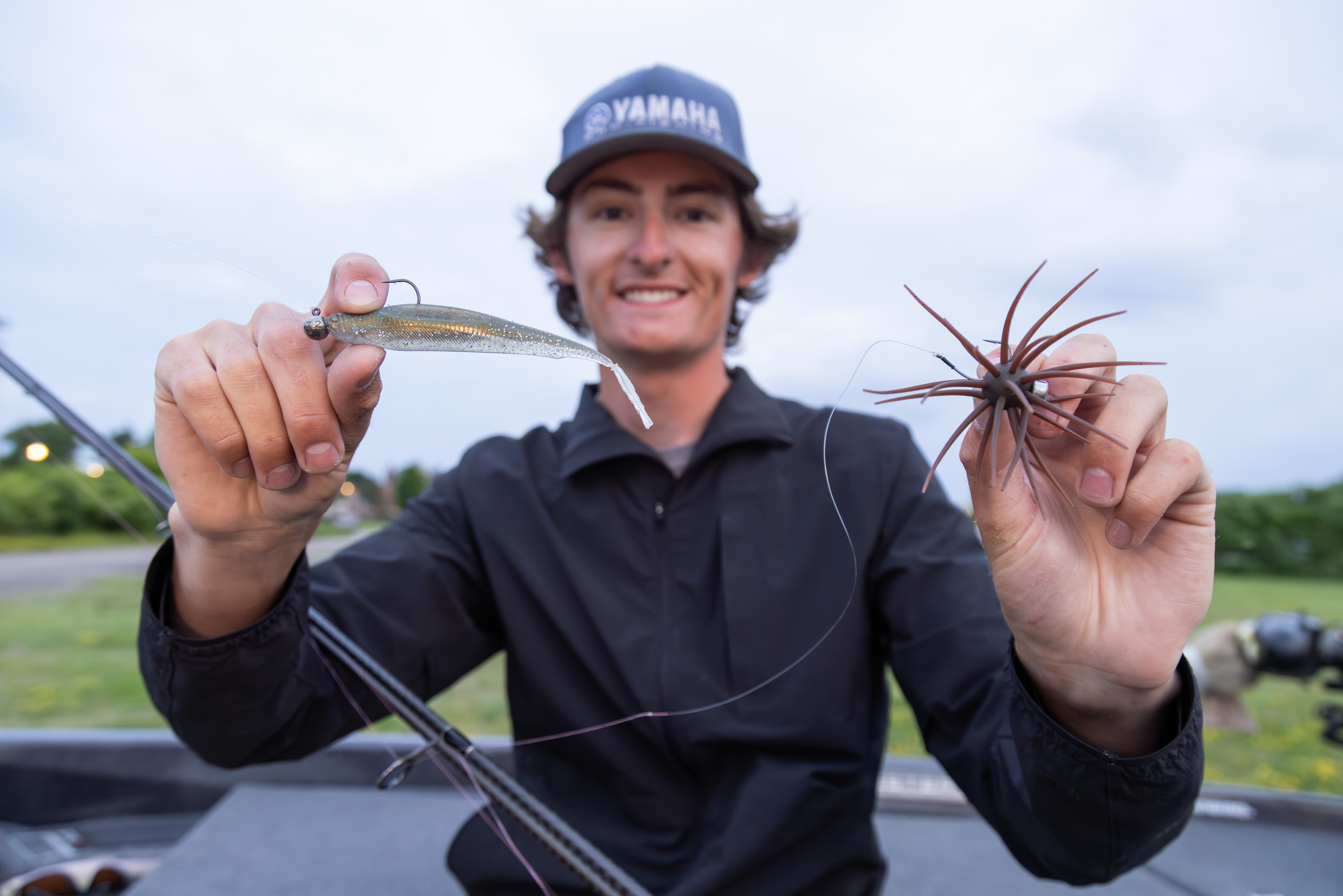
Tagging bags more than 19 pounds both days, Ethan Carr caught all smallmouth on the week.
Carr said his best baits were a 1/4-ounce Queen Tackle Jig Head with a 5.25-inch Beast Coast Seduce Minnow, and an unnamed dice-style bait with a 2/0 Ryugi Talisman and a Decoy DS-15 Coil Sinker in 3.5 and 5 gram sizes.
Carr started every day in one zone, and then ran boulders and isolated cover pieces after that.
“I found a special zone in the Inland Sea,” he said. “I rolled over it in practice, and when I side-scoped through the zone, I found, like, that there was a fish every 30 seconds for about a quarter of a mile, and it was almost like a stair step ledge. So, each morning of the tournament, I started there.”
From the sounds of it, Carr had pretty fun mornings.
“The fish were really active,” he said. “They would run at the boat at Mach 90. And then I would literally drop my bait either, like, 40 feet out or right on the trolling motor, and they would meet it halfway up in the water and bite instantly. Day 1 of the tournament, I caught a 4-pounder, and in the same head shake, he spat up a perch and an alewife, right at the side of the boat. And I picked them both up and was like, ‘Wow, these fish are really gorging themselves on this spot.’”
10. Shallow smallies key for Berlinsky

While almost everyone in the Top 10 had some great days of fishing, Tripp Berlinsky had himself an absolute time on Champlain.
Throwing a Clutch Eco glide and a minnow on a 1/8-ounce head, the young Alabama angler caught a pile of bass.
“It was my first time there,” Berlinsky said. “I went up a little bit early just to try to familiarize myself with the lake. It was a blast, I never caught so many smallmouth in my life.
“The secondary points were the best stuff I found out of anything,” he added. “Whether it had a good grass line on it or it had rock, it just really seemed to be about those secondary points, with fish schooled up in about 8 to 12 foot of water. I was throwing a 1/8-ounce minnow, just because they could see it so well there, and I was fishing so shallow. I mean, I was getting at least five to blow up on it every day. So, they were just really aggressive fish, you didn’t need to get it down to them.”