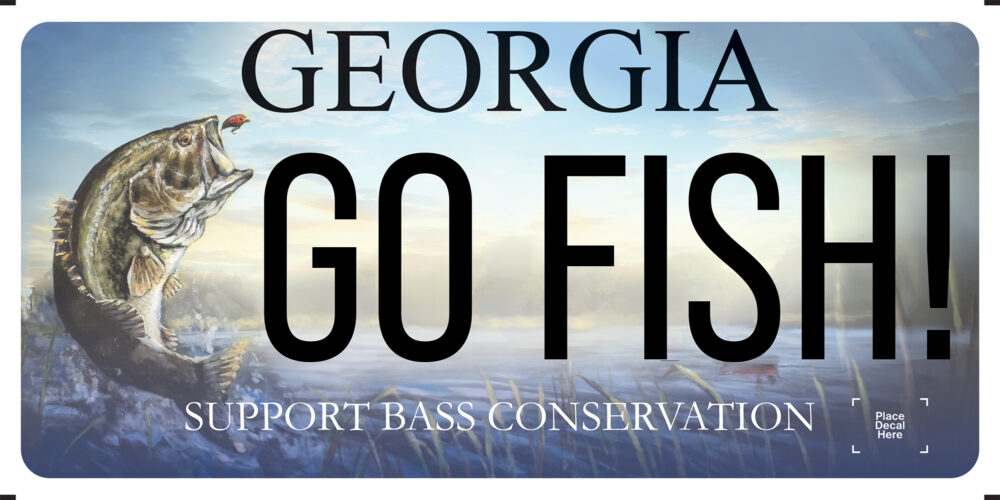
Georgia’s Department of Natural Resources’ Wildlife Resources Division (WRD) just announced a new way to support fisheries conservation in the state.
The State of Georgia’s new Black Bass Conservation license plate will directly support WRD fisheries programs, including habitat enhancement, stocking efforts, research and monitoring of black bass species within the state. Georgia residents can now request the Black Bass Conservation specialty plate at their local county tag office or purchase it online through the Georgia DRIVES e-services website.
The plate costs $45 each year – just $20 more than standard plate fees. Nineteen dollars of the extra cost goes back to black bass conservation the first year, and $20 each year after that.
Similar programs have proven to be successful throughout the country.
Florida essentially wrote the blueprint for conservation plates when it launched the Save the Manatee plate in 1990. Driven by high-profile advocacy from Jimmy Buffett, this plate proved that drivers were willing to pay a premium (roughly $25 extra) to display their support. The manatee plate’s massive success turned license plates into a reliable, “voluntary fundraiser” for wildlife protection, specifically funding manatee rescues and habitat restoration.
Taking inspiration from Florida’s success, Maine launched its iconic “loon plate” in 1993. This was a pivotal moment because it moved the concept from a single-species focus to a broader environmental mission. While the loon was the face of the plate, the funds were split between the Department of Inland Fisheries and Wildlife and State Parks. It showed that rural, outdoors-oriented states could use these plates to fund the management of vast wilderness areas and non-game species.
In 2002, both Texas and Arkansas launched plates featuring the largemouth bass, marking the true beginning of the fisheries-conservation plate. The Texas Parks and Wildlife Department used the largemouth bass plate (and later the Texas Rivers plate) to fund over $1 million for inland fisheries management and habitat restoration, and to expand access to public water.
Arkansas followed a similar largemouth bass path, and eventually turned this into a series of plates, adding species like rainbow trout and smallmouth bass to ensure that fans of different types of fishing could fund the specific habitats they frequented.
Georgia plates continue trend of funding by anglers
The history of fisheries funded by anglers actually aligns closely with the Dingell-Johnson Act of 1950, which established a sophisticated “user-pay, user-benefit” financial system. The Act imposes a 10% federal excise tax on fishing equipment such as rods, reels, and lures that’s collected into a dedicated national fund held by U.S. Fish and Wildlife. In 1984, the Wallop-Breaux Amendment significantly expanded the Dingell-Johnson Act’s reach by including taxes on a wider range of boating gear and fuel.
These funds are then apportioned to state fish and wildlife agencies based on a formula considering the state’s land/water area and the number of paid fishing license holders. The law includes a strict provision where states only qualify for these federal dollars if they legally mandate that all revenue from fishing license sales also be used exclusively for fish and wildlife management. This creates a powerful incentive for states to continually improve and protect their fisheries resources while promoting the purchase of fishing licenses.
By purchasing the Black Bass Conservation plate, Georgia drivers are directly upholding the “user-pay, user-benefit” legacy established by the Dingell-Johnson Act. These voluntary funds bypass general state coffers and go straight into the water – financing habitat restoration, stocking, and the scientific monitoring required to manage the state’s diverse bass species. It’s a practical investment in Georgia’s status as a premier fishing destination, ensuring that the infrastructure and fish populations remain healthy for the next generation of anglers.