The modern era of professional fishing has changed the way the world sees “local” lakes. When the Bass Pro Tour brings its broadcast to a body of water like Lake Waco, it doesn’t just show a tournament; it introduces a hidden world-class fishery to the viewers. This spotlight effect can be outstanding for local tourism and instantly increases tournament participation.
As we have for the past four years the MLF Fisheries Management Division and Kubota Tractor Corporation partnered to give back to this community and ensure that their fishery continues to improve with this newfound attention.
Lake Waco was originally impounded in 1930 to provide flood control and water for a growing Central Texas, the reservoir was reborn as an 8,500 acre fishery in 1964 with the completion of the new dam. In those early years, the lake was a jungle of flooded timber, but today the Texas Parks and Wildlife Department’s management plan reads “limited flooded timber.”
Over the decades, with the relentless up and down cycle of the water the timber began to rot, settle into the silt, and eventually disappear. Habitat loss is the silent predator of aging reservoirs throughout the country and the Texas droughts doesn’t help the process. TPWD has taken action to restore habitat using brush piles, homemade artificial structures, and MossBack Fish habitat. Since 2021 they have placed 75 artificial structures into the lake.
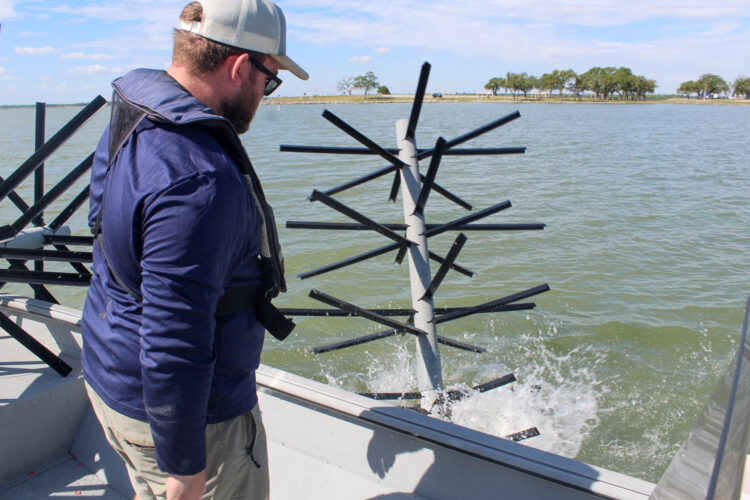
On April 8, from the Airport Beach boat ramp the MLF FMD and TPWD increased the number of artificial habitats in the lake beyond 100. By utilizing an existing TPWD habitat site near Airport Beach Park, the team installed a Tournament Recovery Zone of MossBack Fish Habitat. These structures mimic the complexity of natural timber and reed beds. These Recovery Zones act as an underwater sanctuary where fish can immediately find vertical cover, shadows to hide in, and an abundance of baitfish to kickstart their recovery. It’s the final, critical step in the chain of modern fish care.
For years, the angling community has focused heavily on what happens inside the boat — using advanced livewells, oxygenation, and cooling to keep fish healthy. However, the MLF FMD is now looking at what happens the moment the fish leaves the angler’s hand. In many tournaments, fish are released at a centralized location, such as a park or a boat ramp. For a bass that has spent the day in a livewell, being released into barren, open-water provides no shelter to recover or simply to acclimate.
A project of this scale requires more than just good intentions; it requires serious muscle, planning, and mapping. The expertise of the TPWD Inland Fisheries Waco District staff ensured that the habitat was placed in the most biologically advantageous locations. Local private fisheries management company Texas Pro Lake Management provided real time topographic mapping of the site using Lowrance units and BioBase software. Meanwhile, volunteers from Texas B.A.S.S. Nation and the Waco Bass Club worked alongside Bass Pro Tour pro Alton Jones Jr., MLF anglers Gary Klein and Kelly Jordon to construct the habitat. To move the massive bundles of MossBack structures and the heavy concrete anchors required to keep them in place, WC Tractor of Waco provided two Kubota SVL 75-3 Compact Track Loaders.
Perhaps the most important aspect of the day was the commitment to transparency. Every structure deployed was strategically GPS-mapped. These coordinates aren’t being kept in a vault; they are being shared with the public. By doing so, MLF and its partners are encouraging a new generation of anglers – from bank-fishing kids to weekend hobbyists – to engage with the lake in a way that is both productive and sustainable.
As the sun set over the Lake Waco project, the team looked toward the next stop as this project is part of a multi-lake restoration tour across Texas this month, with a similar build scheduled for Lake Brownwood on April 22 in partnership with Berkley Labs.
The work at Lake Waco serves as a blueprint for the future of fisheries management. It proves that when the professional fishing industry, world-class equipment manufacturers like Kubota, and state agencies like TPWD join forces, the result is a legacy that lives beneath the surface — waiting for the next generation of Texas anglers to cast a line.