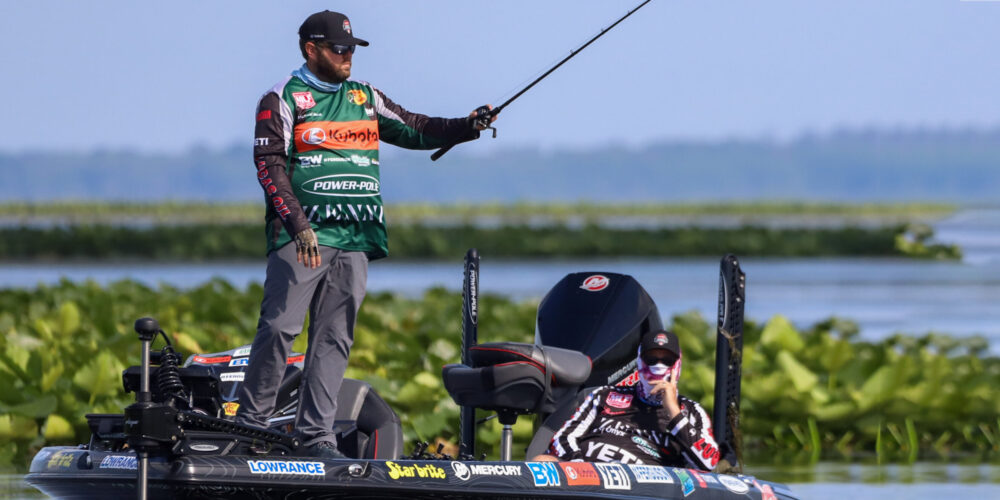
OCALA, Fla. – Now that Orange Lake, Florida, has caught your attention – 10- and 11-pound largemouth worth $10,000 apiece will do that – it’s time to look down the road at the next four days of competition at Kubota Heavy Hitters Presented by Bass Pro Shops.
Heading into the week, Florida-based Mercury pro Terry Scroggins was quietly rubbing his hands together in delight and anticipation. For good reason: His home in San Mateo is only an hour away from Ocala and Orange Lake, and “Big Show” has fished this big-fish oasis multiple times over the years. Scroggins’ experience on the lake showed on Day 1 of qualifying, as he paced the fish with 62 pounds, 3 ounces, with an 8-9 big fish to fill out his day.
Scroggins averaged 4-6 on his 16 fish, almost a pound better than the rest of the 16-man field (3-9). A couple of other anglers racked up better per-fish numbers (Colby Miller had a 6-10 average, for example), but none could keep pace with Scroggins’ 1-2 punch of size plus numbers.
And that, according to Big Show, is the key to the rest of his week at Orange Lake.
“It’s a little bit of a crapshoot, to be totally honest, because the water is so low and the lake is fishing pretty small. But I don’t think you can count on catching just big ones – you’re not going to catch the numbers you need (to win),” he said. “My key this week is clean water, and in order to find that, you have to get behind the grass. I’m sure there’ll be guys catching big ones out in the middle, but I just don’t think that’s a move I want to make.”
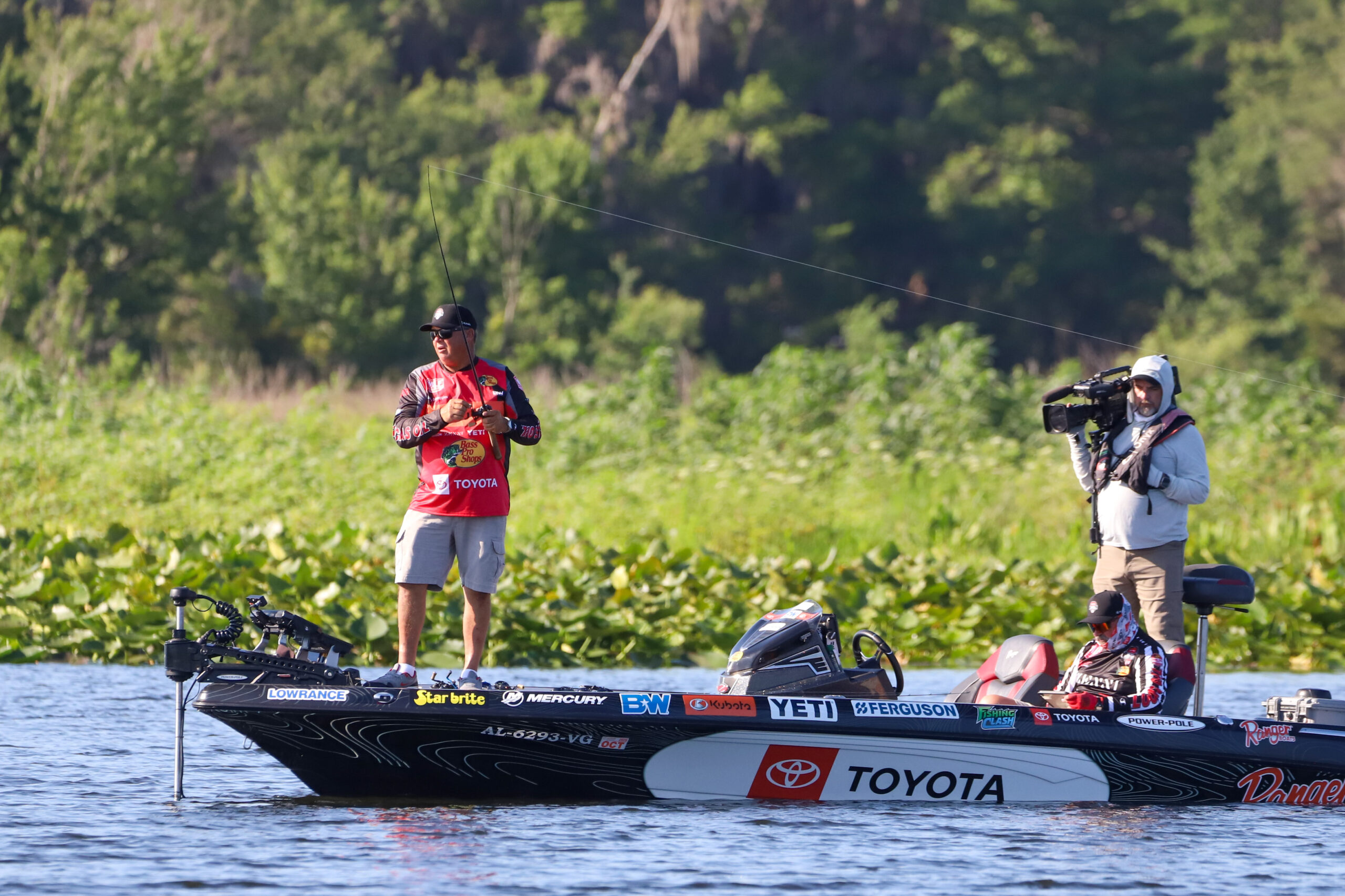
Not that Scroggins is a stranger to ridiculous big-fish days on Orange Lake. His biggest largemouth here is 13 pounds and he’s caught “a bunch” of 10s (including a day he and a buddy’s five biggest fish went 52 pounds … yes, that’s a 10-pound average).
“That’s a pretty wild number, isn’t it?” Scroggins asked. “I also had some friends fish a tournament where they caught 31 pounds, including an 11-pounder, and they didn’t win either tournament money OR big-fish money that day. The biggest bags went 46, 44 and 41, or something like that.”
Neal ready to roam
By all appearances, Tennessee pro Michael Neal was in the catbird seat following Group B’s opening day of competition. Neal racked up 53-8 on nine fish, including the biggest fish ever caught in Heavy Hitters competition (an 11-0), an 8-3 and four 6s. His best five weighed 38-13. But despite being the textbook definition of a “heavy hitter” his first day on the water, Neal plans on making adjustments the rest of the way that mirror Scroggins’ keys.
“The mistake I made in practice is I tried to make the fish be too far out,” Neal admitted. “I really wanted them to be out on the edges of grass, and I messed up by not spending enough time in clear water like I was in (Sunday). I think I feel safe enough (making the Knockout Round) that I can spend most of my second day practicing. I think if a guy can get a legitimate three-period practice day, you can cover the majority of (what you’re looking for).
“I have to find something else,” Neal said. “I don’t think I can do the same thing (all week) in a different area. I’m going to have to change tactics when I change areas. I feel like I’m pretty safe, so I have to go practice.”
Sprague still evaluating
Jeff Sprague enters the second half of the week in a familiar position at Heavy Hitters – in position to contend for the win, and around the kind of fish that could win him another $100,000 big-bass reward (he already has two from previous Heavy Hitters). The Texas pro feels right at home on Orange Lake – “I grew up fishing grass lakes in East Texas, I’m comfortable in Florida lakes,” he said – and finished his first day of qualifying in third place in Group B with 37-3. Sprague didn’t catch any major difference-maker fish on Sunday (his biggest was 5-9), but broke off at least one giant and believes that he’s fishing around potential big-bass-award winners.
“If I’m around 5s and 6s, there are going to be bigger fish there, too,” Sprague said. “I don’t think the way I’m catching them is a big-fish technique – I’m moving around a lot and fishing pretty fast; you probably need to flip to them and really slow down to get those big ones to bite. I can either try to win big fish or win the overall tournament, it’s a two-pronged deal. I think I’m just going to keep fishing and evaluate as we go along. If I’m doing good enough that I feel safe (to advance), I might mill around and try to win a big-bass check. The fish are there, it’s just a matter of connecting.”