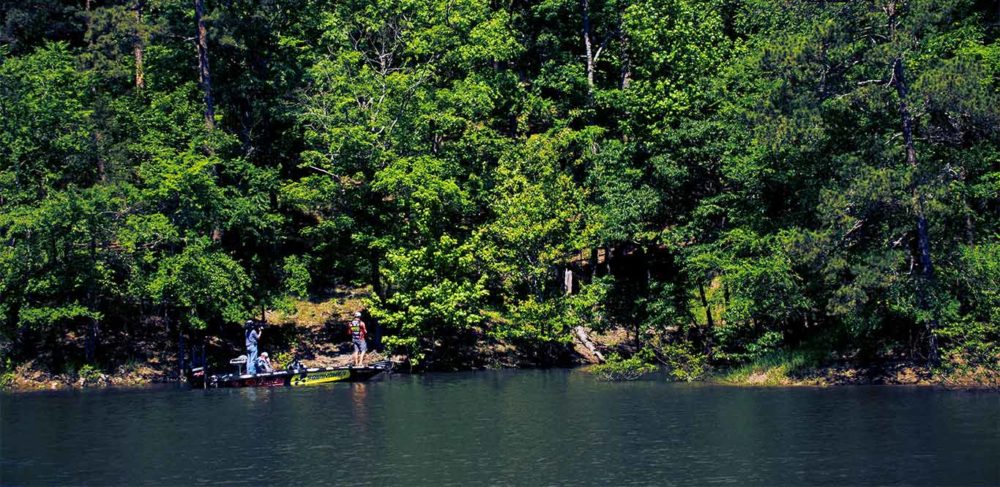
It took second-year Major League Fishing Select
And he made it look easy: Birge finished 13th in his first Tour event (on Lake Toho in Florida), and then followed that up with a sixth-place finish on Lewis Smith Lake in Alabama and an eight-place finish on Lake Eufaula two tournaments later.
Three tournaments into his pro career, Birge sat third in the Angler of the Year race.
“It wasn’t quite that easy,” Birge jokes. “I think I did pretty good that first year, but this whole schedule of fishing all over the country is a learning curve. I’ve really had to broaden my horizons as far as different types of fishing situations go.”
Birge grew up in Mayflower, Arkansas and was a self-admitted “Arkansas River rat” until the age of 13, when his family moved to Oklahoma. That move expanded his fishing geography to include more varying water conditions, and it prepared him to compete on the college level when he entered Oklahoma State.
From there, Birge’s learning curve picked up speed as he competed on the Carhartt College Series – he and his tournament partner won the 2012 National Championship – and transitioned into BFLs and FLW Costa Series schedules, which took him to places like Kentucky Lake, Lake Amistad, Lake Sam Rayburn and Toledo Bend Reservoir.
“Fishing the Costas gave me the chance to fish some different things that we don’t have at all in Oklahoma,” Birge says. “East Texas grass, for example. It just helped me expand a little more each year, kind of gave me a bigger base of knowledge.”
“Jumping Into the Deep End”
Birge eventually parlayed that knowledge into a first-place finish in the 2014 Costa Series Championship on Alabama’s Wheeler Lake. His $50,000 cash winnings from that tournament funded his rookie year on the FLW Tour in 2015, where he jumped into the proverbial deep end with tournaments on Lake Toho in Florida, Smith Lake, Beaver Lake in northern Arkansas, Lake Eufaula in Alabama, Lake Chickamauga in Tennessee, and the Potomac River in Maryland.
From shallow, grassy, Florida-strain largemouth to deep, clear Ozark Mountains spotted bass to tidally influenced Northern-strain largemouth.
“I learned pretty quick that those Florida-strain fish are real temperamental,” Birge admits. “They get a lot pickier, depending on the weather. They like it hot – a 10-degree difference in the air temperature and they stop biting. That just something new that I had to learn how to deal with.”
He dealt with it just fine: Birge caught 44-4 of tight-lipped Toho largemouth to finish 13th in his FLW Tour debut, and then logged his first career Tour Top 10 two weeks later on the deep, clear water of Smith Lake.
“When I first showed up at Toho that year, I knew that most guys throw a Gambler Big EZ; they punch mats and throw big baits,” Birge says. “None of that was really working for me, so I just went back to what I’m good at: I threw spinnerbaits and swimbaits around shell beds and didn’t spend much time at all fishing the grass. It worked out pretty well.”
And he’s applied his ever-expanding diversity well in MLF competition.
Birge caught the most fish (35) in his first-ever Select Elimination Round (in 2017 on the Grand Glaize Arm of Lake of the Ozarks near Osage Beach, Missouri), and then finished second to Ott Defoe in the ensuing Sudden Death Round on the Niangua Arm.
He followed that up with another second in his Elimination Round, and a third in his Sudden Death Round in the 2017 Challenge Select in the smallmouth-ridden waters around Alpena, Michigan.
More new water, and more success.
“I found out fast that the Great Lakes are a blast,” Birge says. “You’re fishing for fish that don’t see a lure for four to six months of the year because the lakes are covered in ice. One that thaws, those fish are crazy-active and hungry, especially smallmouth.”