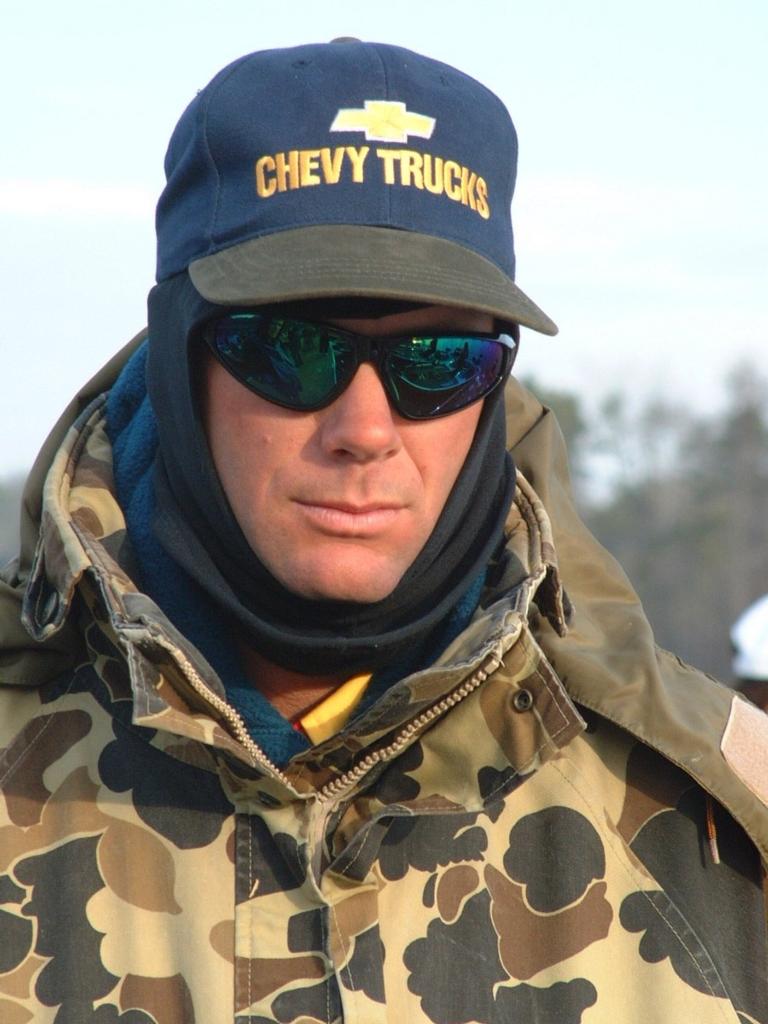
How does he do it? This is the question that often follows any mention of the name Kevin VanDam. Three B.A.S.S. Angler-of-the-Year titles, a current FLW Angler-of-the-Year reign and a recent BassMaster Classic victory have many more asking: How does he do it?
I wanted to find out. Recently, Kevin was kind enough to let me on board to observe him during practice.
____________________________
It is Monday, March 11. Kevin is practicing for the Lake Ouachita FLW Tour and a chilling Ouachita Mountain rain has lowered the air temperature to about 40 degrees, the day’s high.
Despite the weather, I am excited about fishing with the world champion. Kevin has never laid eyes on Ouachita until yesterday, his first practice day. He has given himself only three days to figure out how to catch Lake Ouachita bass. I am eager to see exactly how bass fishing’s top performer works his magic.
Finally, I will get to see Kevin’s secret techniques, his secret spots and, most importantly, those secret baits. I have my pad, pens, camera and film. We get started at daylight. Little do I know, this will be the warmest part of the day.
On Kevin’s deck are five rods. The two rods on the right side of the deck are rigged with Strike King spinner baits; the three rods on the left side are tied with crankbaits.
I soon learn that crankbaits will be the order of the day. Kevin remarks that the 43-degree water temperature is a little cold for spinner baits. The crankbaits are a Diamond Shad lipless crankbait, a Strike Series 4 crankbait and a flat-sided wooden crankbait made in Tennessee. All of these baits run 4 to 6 feet deep and they are all colored in various shades of red.
Within the first hour, the rain begins and it hinders my attempts to make notes. My first real observation of the day is how much colder Arkansas rain is than Florida rain. My mind entertains a burning question: Why did I not wear my waterproof boots?
VanDam begins his day in the upper portion of Lake Ouachita where there is some color to the water. He explains his game plan: “Right now I am fishing where the fish should be if it warms up during the tournament. These fish are ready to move up; they are just waiting on the right conditions. So I am really not expecting to catch a lot of fish today. I just want to get a feel for the water up here.”
VanDam continues to explain that Ouachita should be a great pattern lake. In the spring, fish are constantly moving and he wants to intercept them in their migration route during the tournament.
“It is critical to keep up with the fish’s movements, especially in these cut formats. Returning to the same places that you fished in practice for four tournament days is not the way to win cut tournaments in the spring. You have to know where the fish are going and be prepared to fish that water. Look at how Nixon won Wheeler.”
Between 8 and 9:15 a.m., Kevin catches four fish on a Diamond Shad. One is a 16-inch keeper.
The rain picks up and my notepad is already soaked. It is so cold. I can’t believe it is not snowing. I actually wish it would snow. At least snow does not soak into everything.
Despite the rain and cold, Kevin’s fishing pace is blistering. His toe stays glued to the trolling motor pedal. His casts are crisp and sharp. Each cast makes a mean “phtchsssss” sound and then a puff of vapor blasts from his reel and floats into the air like an exploding Black Cat firecracker.
He casts and retrieves with the deliberate rhythm of a carpenter driving nails. His casting and reeling drive right through the pitter-patter of the rain. Phtchsssss. Splash. Wind, wind, wind, wind. Phtchssss. Splash. Wind, wind, wind, wind.
By 12 o’ clock my gloves are no good. They have become so soaked and cold that I just take them off. My hands itch, burn and sting all at the same time. I am shocked at the sight of my fingers; they look like swollen sausages. I look at Kevin’s hands. They show no signs of exposure. Phtchsssss. Splash. Wind, wind, wind, wind. Phtchssss. Splash. Wind, wind, wind, wind.
“What ratio reel is that?” I ask.
“Five-to-one,” replies VanDam without hesitation.
I am surprised. I figured him for a six-to-one ratio for speed.
“I have to wind it so fast that it keeps me warm,” he jokes.
At 1 o’clock Kevin moves into clearer water. “I have been fishing up in the stained water where I think the fish will be when the sun comes out. But if it stays cloudy and rainy, this clearer water is going to get better.”
 Kevin picks up the flat-sided wooden crankbait and begins cranking. Within 10 minutes he catches four bass from the clearer water. All are close to being keepers and one makes the 16-inch mark.
These fish stir something in Kevin. He now fishes with more tenacity than before. He is a man on a mission.
But I do not understand the method to his madness. By 2 o’clock I have watched him crank a crankbait for eight hours, covering miles of bank. To me, it all seems so random.
“Kevin, what are you looking for?” I ask.
The answer is one I am not prepared for; I can’t write very fast on a sponge.
“I am looking for water color changes. I am looking at how the bank slopes. I am looking for bank composition changes. How the bank slopes and its composition affect the height and width of the inside grass line. Is the grass elodea? Is it hydrilla? Is it green or brown? Where are the contours of the inside grass line? Where are the irregularities?”
As Kevin explains, I begin to realize that Kevin is not just fishing, he is exploring. He is exploring the underwater world with the crankbait – his underwater eyes. Every turn of the reel handle transmits some bit of information into Kevin’s million-megabyte-bass-brain. He stores every cast in his mental database. During the tournament, when he catches a bass off a certain piece of cover, his processor will go to work, recalling other similar places the probing crankbait revealed.
And just when I get excited about the precise science of bass fishing, Kevin throws me a cautionary curveball. “But you can’t overanalyze things either. Sometimes it is as simple as fishing wind-blown points.”
By 2 o’clock my feet are numb as stones. My tired, wet tennis shoes have long ago given up the fight to keep my feet dry. I stick my hand in the water – it feels like warm bath water. I look at the water temperature reading: 43 degrees. Maybe I could stick my feet in the water.
I stand up to let some blood flow down to my feet and to empty all of the pooled water off my rainsuit. A shivering sigh turns to steam as it exits my mouth.
“So what do you think about the glamorous life of a bass pro?” Kevin asks.
I pass on the question. I don’t want Kevin to hear chattering teeth in my response.
Kevin continues to crank the bank, probing inside grass lines in 4 to 6 feet of water. The bill on the crankbait breaks. He actually sits down (for the first time) to tie on another bait. He discovers he is out of the red-colored baits so he takes a can of Spike-it red dye and sprays the chartreuse crankbait red.
Yes! A secret is revealed! Kevin uses red spray dye as an expedient coloring process!
At 3 o’ clock Kevin fishes within sight of one of the more popular boat ramps on the lake. Two guys are taking out and the parking lot is empty. I think of somewhere – anywhere – that is dry. I look at Kevin’s rod locker and secretly entertain the possibility of fitting myself inside it.
“Most sports have a rain delay. Not fishing,” notes Kevin aloud.
I begin to wonder what fuels Kevin. Is it the money? Is it the competition?
At 4:10 I get my answer. A sudden melee jolts me out of my hypothermic coma: Kevin has a big fish on. He fights it to the boat and lets me hoist it from the water.
The fish is a beauty, 5 or 6 pounds.
“That was awesome!” exclaims Kevin. “He just annihilated it.”
Kevin’s face beams from his rain-soaked hood. His eyes glow with excitement. His energy warms the boat. I forget about my wet feet and raw hands.
 At 6 p.m. we finally return to the ramp. As Kevin walks up to retrieve his solitary truck, I reflect on the day. I go back over my list. Secret spot? There were about 20 miles of secret spot. Secret baits? Nope. Secret colors? Red – from a can. Secret techniques? Casting and reeling.
There were no secrets. No magic bass-finding pill. Kevin cranked a crankbait for 11 hours straight. Considering he went on to make the finals, Kevin actually cranked a crankbait for about 60 hours during the week.
During that time he learned a tremendous amount about Lake Ouachita’s shallow cover. When the fish made a move (as he had predicted) to the shallows on the last day, he was there to intercept them.
On the final day of the tournament Kevin made a victory charge with 13 pounds, 5 ounces, his best stringer of the event. Despite his efforts, he finished second. As he accepted his $40,000 check in the glow of the spotlight, I heard those around me whispering, “How does he do it?”