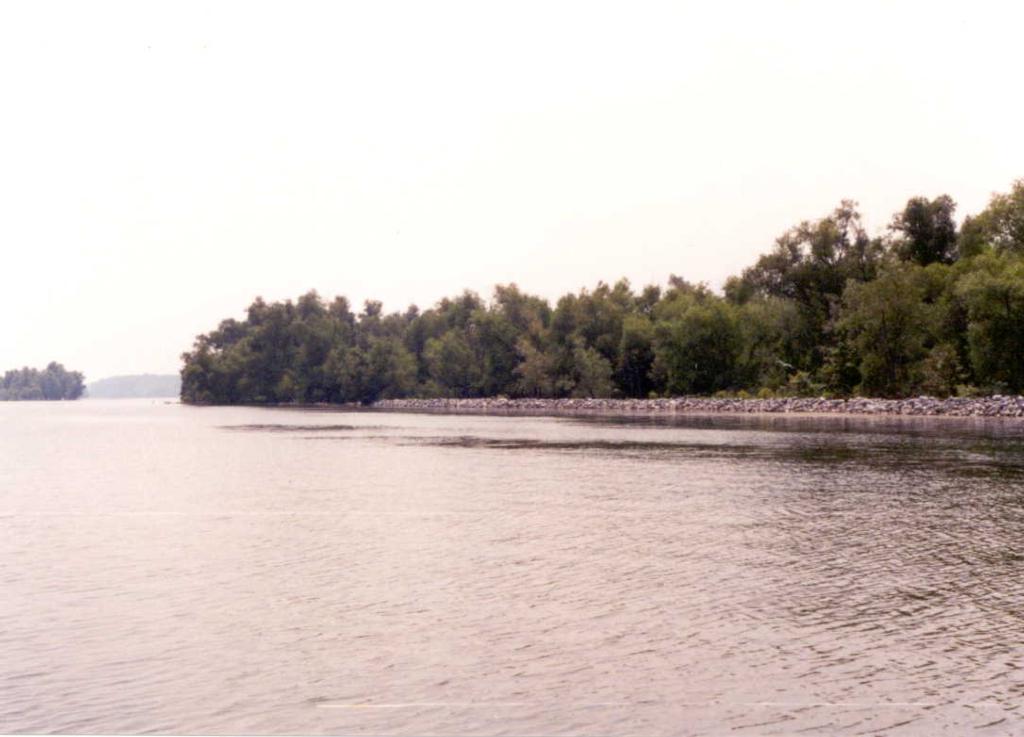
Contribution to help save island acting as shield for bass habitat
FLW Outdoors will help keep a Kentucky Lake island from eroding away, fortifying valuable fish habitat in the process.
In the past, a barrier island in Kentucky Lake – the site of a recent FLW Tour tournament – has helped to shield a fish-rich wetland. The long stretch of shallow water is inhabited by bass, among other fish, and it is navigable for anglers fishing from boats. Over the years, natural dynamic processes and commercial navigation have greatly eroded the shoreline, causing the dissolution of the larger landmass into several smaller islands, now known as the Patterson Islands.
According to Paul Rister, fisheries biologist for the Kentucky Department of Fish and Wildlife Resources, the islands will eventually be lost to erosion if unprotected. Not only would they turn into barren mudflats with little habitat value, but their important role in shielding adjacent wetlands from siltation would also be jeopardized.
“For the fish, what is important is the area behind the islands,” Rister said. “This island acts as a reef to keep the wetland area from eroding … to save the area behind them from the full force of erosion.”
The state began planting trees along the edge of the island about 20 years ago in an effort to protect the islands, Rister said, but erosion has laid waste to those efforts. Island No. 4 among the eight Patterson Islands has been deemed the most crucial part of the chain in terms of barrier value.
“You can use the trees as an example of how quickly these islands are eroding away,” Rister said.
 Through the FishAmerica Foundation, the conservation arm of the American Sportfishing Association, FLW Outdoors has donated $5,000 to the Patterson Islands shoreline stabilization and restoration project being conducted by the KDFWR. The donation – in conjunction with matching funds from the state, Federal Aid in Sport Fish Restoration Act and the Tennessee Valley Authority – will give the state enough money to finish the project for island No. 4.
Riprap, a man-made slope of rocks placed along shorelines for erosion control, is being used to anchor island No. 4. While much more effective than planting trees, the process is also more expensive. The U.S. Army Corps of Engineers has estimated that stabilization of all of the Patterson Islands could cost as much as $1.2 million.
“It is a very expensive project … and this donation from the FishAmerica Foundation and FLW Outdoors, along with matching funds, will allow us to finish the final 1,600 feet of riprap on the main island,” Rister said. “That’s our goal: to finish this island and protect the shallow-water habitat area behind it.”
The riprap has an added value besides battling erosion.
“The rocks also add habitat to the islands … doubling the benefit,” Rister said.
The surface area and crevices created by the riprap provide attachment surfaces and escape habitat for a variety of aquatic invertebrates, small fish and amphibians. The riprap provides feeding and staging areas for many sport fish such as bass, crappie and catfish, Rister said.
As it has in the past, FLW Outdoors is donating $5,000 at each of its seven Wal-Mart FLW Tour events as well as at a variety of its other sanctioned tournaments. In 2000, FLW Outdoors announced its partnership with the FishAmerica Foundation. Since then, FLW Outdoors has directly donated nearly $200,000 and helped to generate more than $1 million for local conservation projects.
Links: