
While the FLW Tour’s big guns are duking it out rod to rod for $500,000 at the Jacobs Cup in Richmond, Va., 48 co-anglers will be in their shadow in the back of the boat casting for a top prize of $25,000.
Though $25,000 is a far cry from half a million, you can bet that the 48 co-anglers who qualified for the Jacobs Cup will not be deterred in the least by the deficit – they will be fishing just as hard as the pros for the co-angler title.
Unlike the pros, who will be trying to survive a bracket-style elimination format, the co-anglers will be fishing FLW Tour’s standard cut format. Instead of the top 10 finalists vying for the co-angler purse on the last day, the field will be cut to 24 co-anglers to fish for the $25,000 first-place prize.
Co-anglers have no control over where or how their pro partners fish. Each day they must adapt to different fishing situations and work with what the pros leave them. To say that one particular co-angler has an advantage over another is difficult given the extreme variables involved.
The James River, however, is a one-of-a-kind bass fishery. Given its uniqueness, local knowledge of the James could play into a co-angler’s favor at the Jacobs Cup. Co-anglers who know the James’ peculiarities in terms of tides, bass behavior and proper lure selection are likely to be far ahead of the game.
Two co-anglers in the Jacobs Cup who are in such a position are Darrell Stevens of Roseland, Va., and Greg Lineberry of Galax, Va.
Not only are both anglers experienced on the James, but they are talented co-anglers as well.
Stevens could be considered a veteran co-angler on the FLW Tour. He has been picking up leftovers behind pros since 1997 to the tune of nearly $90,000. He has one FLW co-angler title to his name and has qualified for five FLW Tour year-end championships.
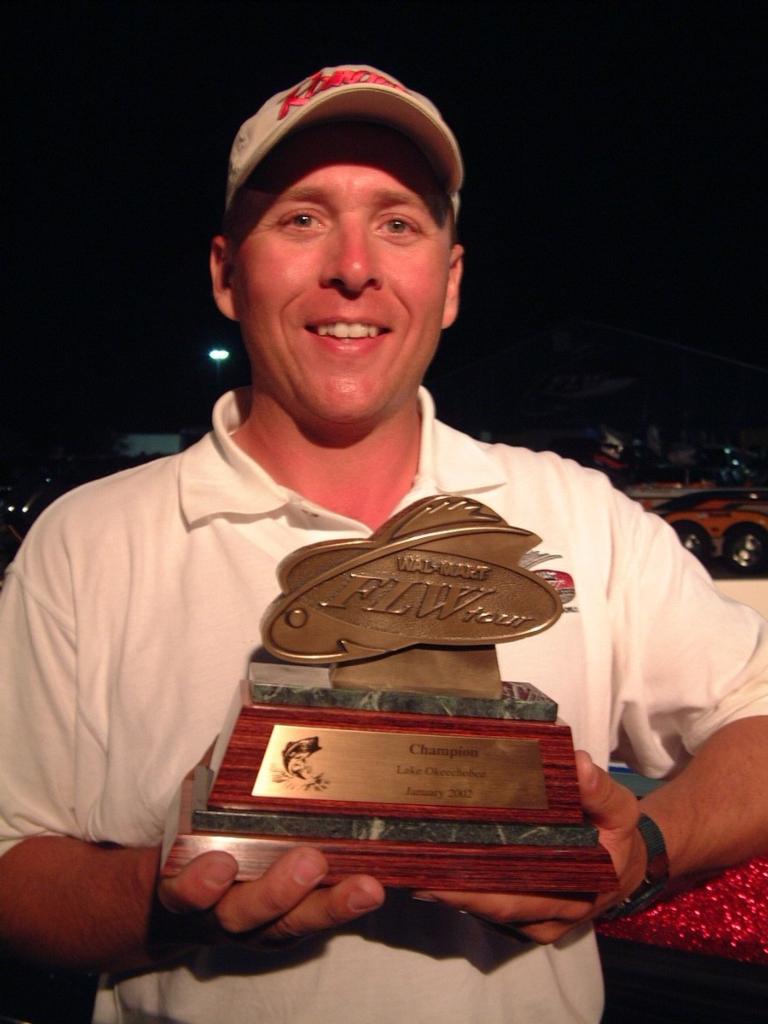
Lineberry won the first FLW event he fished as a co-angler on Lake Okeechobee in 2002. Since then he has qualified for two FLW Championships and finished second in the Co-angler of the Year race in 2003.
Stevens lives about two hours from the James River while Lineberry has to put in about four hours’ drive time to get to Richmond.
Both anglers have spent some time on the James over the last 15 years, and they like their chances of claiming the title in the their home state.
The automatic advantage both Virginia anglers have is their knowledge of what the rivers and creeks on the James River system look like.
The James River encompasses the Chickahominy River and the Appomattox River as well as dozens of creeks that dump into all three rivers.
“It’s not like I fish there a bunch,” said Lineberry. “I’ve been going to the James several times a year since about 1992, and I’ve seen most of what the place has to offer. I know what to expect once my pro tells me where we are going.”
Stevens has been fishing tournaments on the James since the mid-1980s. He knows how each tributary differs from another.
“All three rivers are a bit different in their own way,” Stevens said. “The predominant cover in all three rivers is wood on the bank. The Chic (Chickahominy River) has more green vegetation – mostly lily pads – than the other two rivers. The James has some rock jetties, barge pits and water discharge areas in it. So when my pro tells me where we are going, I’ll have a pretty good idea what to tie on right off the bat.”
In addition to being able to visualize what their area is going to look like, both anglers also have a good grasp on past productive baits for the James. This makes them more efficient in the bait-elimination process when compared to someone fishing the river for the first time.
“I basically have four baits that I have a lot of confidence in there,” Lineberry said. “I’ll probably commit to those four baits for the entire tournament. I’ll let water movement and what my pro is throwing determine exactly which one of the four I’ll throw at any given time.”
 Lineberry suggests that moving baits work better in moving water and slower bottom bumpers like jigs and worms work better in the still water. Also, he will purposely avoid throwing what his pro is throwing.
“Even if he is throwing something that I’d like to be throwing, I’ll go to something different unless he is just catching them one after another,” he added.
Both anglers also have a good feel for how to fish the tides on the James. Although they cannot physically run the tides with the boat, they can run the tides with lure selection and presentation.
“It’s pretty well known that the first two hours of the incoming and the last two hours of the outgoing are the premium tides,” Lineberry said. “That’s when you want to be fishing the best stuff you have.”
Stevens has found the same thing to be true on the tidal system.
“The water on the James is always moving,” Stevens said. “We get a tide change every six and a half hours. It fluctuates 2 to 3 feet depending on where you are and the conditions. The water is constantly shifting back and forth, and that positions the fish in different ways, depending on the current’s directions and speed. The last couple of hours of the outgoing and the first little bit of incoming are best. So being aware of what the tides are doing and what that means to the fish helps.”
Both co-anglers also agree that the pros will likely be employing one of two strategies on the James in September. One is the run-with-the-tide approach and the other is the wait-them-out game plan.
On the tidal run-and-gun plan, pros will try to synchronize their fishing efforts with the tidal changes for an entire length of the river.
For instance, a pro may run far south to Jamestown Island early and utilize the last few minutes of the prime outgoing tide by fishing one stretch of cover for just 20 minutes. Then the pro may run 15 minutes back up the river to catch that same, small window of tide in another portion of the river and then run again to catch the same window of tide farther up.
The focus here is not so much the area, but the premium tide window – trying to catch fish in a feeding frenzy.
Other pros will have more faith in one or two key areas rather than in a certain tide window. They will try to stick it out in one productive area through all the tide changes.
“I’d rather have a pro that’s going to stick it out in one area,” Lineberry said. “It gives you a chance to get a feel for the area and make the necessary adjustments throughout the day.”
“That run-and-gun deal is a hard act to follow,” Stevens agreed. “Especially when they are fishing just isolated targets – single laydowns or duck blinds – on the tide. With the run and gun approach a co-angler sometimes never gets a shot at the target. The pro blitzes it with 10 pitches and runs to the next object.”
Optimally, both anglers would prefer a draw that would be spending the tournament day in the barge pits near Richmond.
“Those pits are like barge graveyards,” Lineberry explained. “They are pits dug in off the river, and old barges have been left there. There’s plenty of underwater cover in the pits and they hold a lot of fish.”
“Sunken barges are in the pits, and it really opens up your lure options instead of pitching visible cover behind pros,” Stevens said. “I fished a BFL as a co-angler down there in July, and my pro spent the day in one of those pits. I caught three bass that weighed about 8 pounds and finished seventh. A little over 10 pounds won it on the co-angler side.”
Regardless of their draws, both anglers feel confident about their chances of doing well in the Co-angler Division of the Jacobs Cup.
“Even if I get a pitcher and flipper, there’s usually plenty of targets on the bank to hit – tiny current breaks and undercut banks,” Lineberry said. “I’m going to try to remain confident no matter who I draw.”
“I’d like to win it,” Stevens said. “I know this sounds strange, but the creek that runs in front of my house eventually flows into the James, so it would be special to me for that reason. Overall, I feel pretty good about it.”