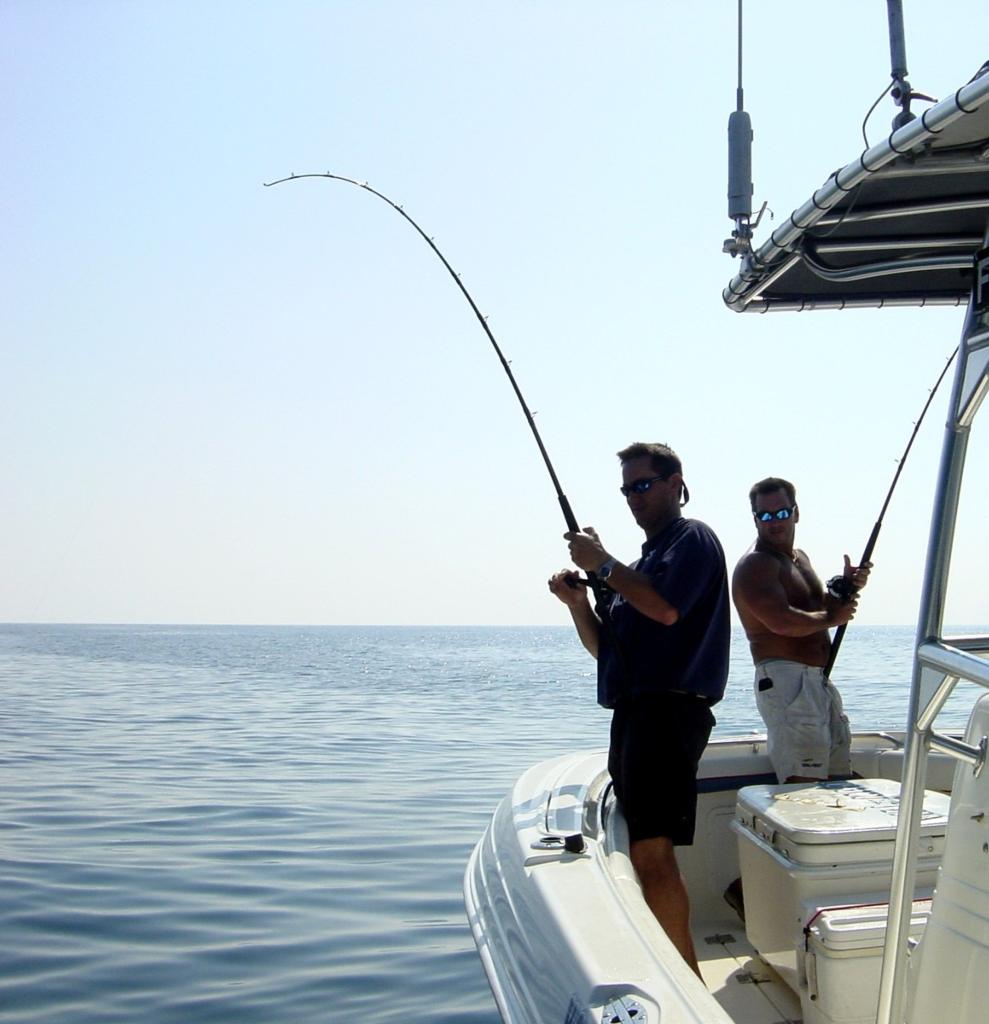
FLW Outdoors is set to make its maiden voyage into professional offshore fishing with the impending launch of the Wal-Mart FLW Kingfish Tour.
In its 27th year of administering freshwater tournaments, FLW Outdoors has entered uncharted waters in 2005 with the introduction of two saltwater trails: the Wal-Mart FLW Redfish Series, an inshore circuit that debuted earlier this month, and the FLW Kingfish Tour, which kicks off competition April 1-2 in Fort Pierce, Fla.
Worth its salt
FLW Outdoors officials say they are ready to meet the challenge of establishing the new offshore circuit as a tournament trail of the highest quality, much like the Wal-Mart FLW Tour was developed into a premier bass-fishing league. If there was ever any doubt about the demand for such a circuit, king mackerel anglers laid those fears to rest by filling the tournament fields a day and a half after registration began.
FLW Outdoors CEO Charlie Evans said he believes his organization’s standing in the freshwater sport-fishing industry carried over when it entered the saltwater market.
“Our goal was to establish 100 boats as the ideal tournament field, and we filled that up real fast,” Evans said. “That’s very gratifying; it says a lot about the reputation of our company. I think those people knew we put on quality bass tourneys, so they knew FLW would put on a quality (kingfish) event.”
Regarding the big picture, Evans said he believes FLW Outdoors can contribute to the growth of the sport by boosting its exposure. But he said the first priority is to build the framework for a rewarding tournament experience through well-organized events with lucrative cash purses and “a fair playing field.”
“We’re going to do our best to let (the anglers) know that their trust in us was not misplaced,” he said.
 Royal history
Dan Grimes, tournament director of the FLW Kingfish Tour, said competitive fishing for king mackerel got its start in North Carolina about 25 years ago. With the emergence of the Southern Kingfish Association about 10 years ago, the professional side of the sport began to develop.
“Most of the kingfish tournaments are benefit or charity-type events. Some of them got to be major events,” Grimes said. “The popularity of the sport has grown. There’s a pretty big demand for professional kingfish circuits.”
With $1.7 million up for grabs in its inaugural season and a solid field of 100 boat teams, Grimes said he believes the FLW Kingfish Tour will provide a desirable level of competition and tournament payouts.
“I think we’ve got some of the very top names in the field,” Grimes said. “We’ll also build our own heroes and build names in professional kingfishing.”
Dieter Cardwell of Winston-Salem, N.C., has been on the trail of kingfish for about 25 years, wracking up many distinctions as a competitor essentially since the dawn of the sport. Cardwell, who was a charter member of the SKA, will captain a three-man team entitled Tideline on the FLW Kingfish Tour, and he said FLW Outdoors has “brought some legitimacy” to the sport.
“It’s going to be a banner year for king mackerel fishing,” Cardwell said. “You’re going to see excited growth with it; you’re going to see a lot more people wanting to come out and do this.”
Kings’ allure
King mackerel are a migratory and schooling class of fish that are found both near shore and farther off shore in the Gulf of Mexico and along the coast of the southeastern United States. The streamlined bodies of these silvery fish commonly reach weights of about 20 pounds when mature, but competitive anglers train their sights on larger hogs for tournament wins, with some of the heaviest catches on record weighing in the 50- to 70-plus-pound range.
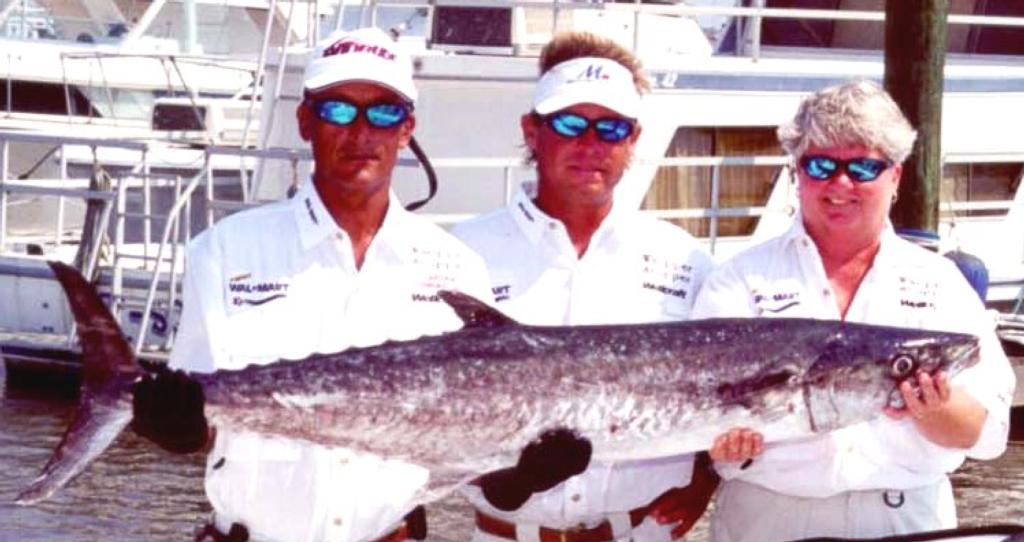 But it’s not just the sheer size of the salty beast that attracts anglers to the sport, it’s also the action that ensues after one is hooked and the battle to land it, said Neptune Beach, Fla., pro Conrad Lau, who captains the Koolau team.
“It’s the first run a kingfish makes, the ferociousness of a strike … the `screaming reels,’ as they say,” Lau said.
Hooking a good-sized king can seem like tethering a torpedo as it makes its initial submarine run of as far as 200 yards in a matter of seconds.
“Generally speaking, they make one to two runs, the second being about half the distance of the first, depending on the strength of the fish,” Lau said. “After that, it’s a matter of finessing the fish back to the boat.”
This process can last anywhere from five minutes to an hour, with an average time of about 15 minutes to land a king. Anglers typically use large, free-standing rods with live baitfish on 15- to 20-pound-test line to catch kings, but boats are also outfitted with downriggers for deeper fishing.
Lau said his favorite moment is “when they come skyrocketing out of the water with your bait in their mouth,” frequently flying as high as 10 to 15 feet above the sea’s surface.
King quest
It’s not uncommon for anglers to make 100-mile runs, one way, in search of their marine quarry. The 2005 FLW Kingfish Tour schedule will have competitors skimming the wide seas of the Atlantic Ocean during three regular-season tournaments and in the Gulf of Mexico for another qualifying event as well as the championship.
Lau – who has fished for years in the SKA, including a third-place finish in that organization’s 2003 championship – said, “I think the locations are excellent.”
Lau said the variety of venues will increase the level of difficulty for competing teams in terms of consistent performances throughout the season. With two events in Florida – both on the East Coast – one in Louisiana, another in North Carolina and the season-ending championship in Mississippi, a home-water advantage for any team will be short-lived.
Both Lau and Cardwell said some kingfish pros decided not to fish the nascent FLW Kingfish Tour this year, opting to wait and see how the season played out before committing to a full schedule. However, they both said that the field still represents a tough group of competitors and is likely to become even more ambitious in subsequent years.
“Don’t anybody be mistaken that it’s not a strong field,” Cardwell said.
 Running a tight ship
New rules and guidelines come with the advent of any new tournament circuit. But for FLW Outdoors officials organizing the company’s first-ever offshore tour, this also means considering new concepts of fishing.
Kingfish anglers will fish as teams on a single boat, unlike most FLW Outdoors tournaments where co-anglers are initially paired with pros based on a random drawing. Grimes said the “checks and balances” built into the draw system will not apply on the Kingfish Tour, so team captains will submit to polygraph tests after tournaments to ensure that rules were followed by competitors.
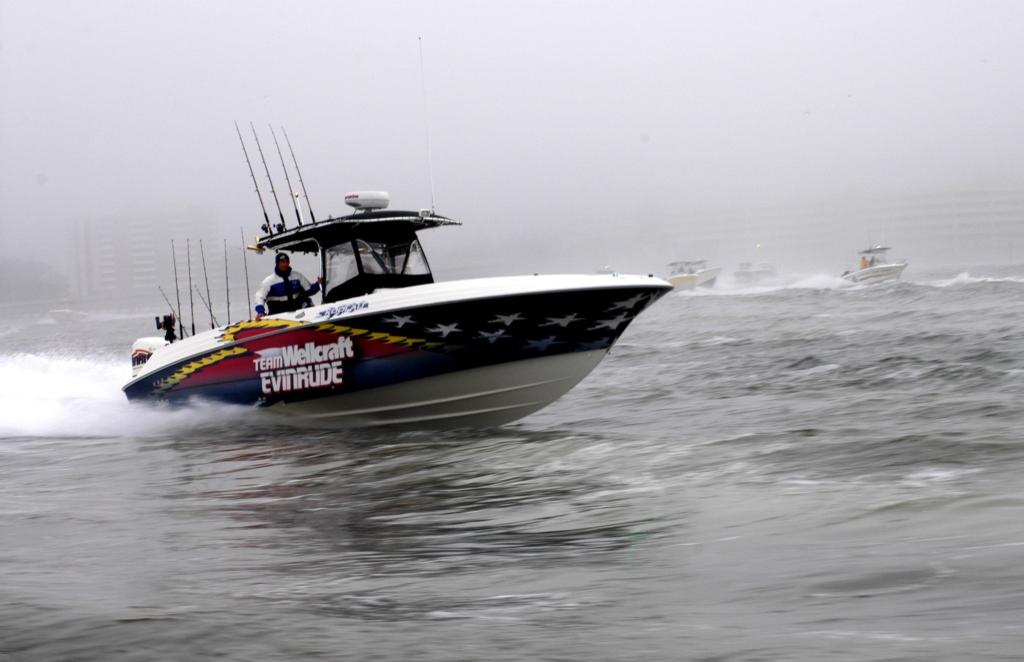
The boats used for offshore fishing are much larger than those in a typical FLW Outdoors fleet. In fact, to maintain anglers’ safety, all boats on the FLW Kingfish Tour must be a minimum of 22 feet long, seaworthy and outfitted with U.S. Coast Guard safety equipment. Boats must operate using only factory-installed fuel tanks, and any additional fuel needed during competition must be purchased from a public retail station.
Another striking difference in the kingfish rules compared to its freshwater counterparts is the use of radios for communication during competition. Grimes said each boat must be equipped with a radio for safety reasons, but they can also be used to relay messages among boats in any given tournament, which will factor into the competition.
“It’s certainly going to play into strategy because you can talk to other boats, as long as they’re registered for the tournament,” Lau said.
Kingfish teams may work together to locate kingfish or even fresh schools of baitfish, but registered anglers cannot communicate with noncompetitors in any way during tournament hours.
Teams will fish for two days during qualifying events, but only the single heaviest king mackerel weighed by a team will count toward the results. Each boat is limited to fishing with six or fewer lines at any given time, and any king brought back to shore for weigh-in must be in edible condition and not mutilated.
“(Weighed king mackerel) will be sold to a fish market, and then that money will be donated, either to the FishAmerica Foundation or the charity of our choice,” Grimes said.
Waves of opportunity
With a magazine, Web site and nationally distributed press releases serving as constant avenues of publicity, FLW Outdoors anglers have the ability to raise their profiles in the world of competitive fishing. And with each FLW Kingfish Tour event being televised through the “FLW Outdoors” show on Fox Sports Net, mackerel anglers benefit from the opportunity for maximum exposure.
Evans said he hopes the Kingfish Tour broadcasts will entertain viewers, but also educate them about the sport and increase national interest.
“We hope to get a lot of people excited and enthusiastic about, `Hey, I can do that too,'” Evans said. “The great thing about angling is it’s a worldwide, universal language … whether they choose to pursue bass or walleyes or reds or kings. There’s a driving competitive spirit.”