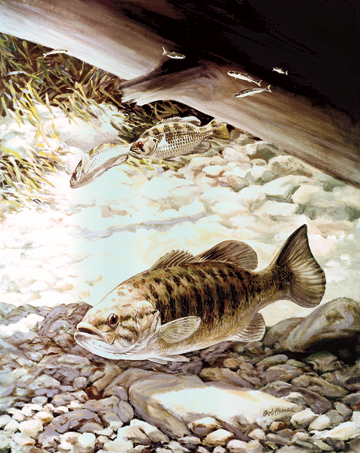
Dion Hibdon stood on the bow of his Ranger boat and put his rod down in frustration. “I can’t catch those smallmouths,” he said, shaking his head.
The Stover, Mo., pro was tapping his toe on his trolling-motor pedal, cruising quietly through the middle of Lake Champlain, the long, ribbon lake that divides Vermont and New York. Here he was, one of the most successful pro bass anglers of all time, fishing on one of the best smallmouth bass fisheries in the world, unable to coax a bite out of a smallmouth.
“I just cannot fish for smallmouths,” Hibdon said. “Every time I go to a lake with smallmouths, I fish for them. Just when I think I’ve got those little brown fish all figured out, they move. They’re like striped bass, you know, swimming to wherever they can find food.”
Hibdon, of course, is right. After they’ve spawned along rocky shores in late spring, smallmouth bass have a nasty habit of heading to deeper water to spend the warm summer months, a move that can frustrate anglers looking for them.
Another bad smallmouth habit: Once they move out of the shallows, they don’t stay in one place. Canadian researchers in Ontario’s Algonquin Park found that as summer moves along, smallmouths move too, establishing home ranges as large as 600 acres and covering up to seven miles a day.
Tournament anglers like Hibdon can curse the “here today, gone tomorrow” ways of smallmouth bass, but those who take the time to find and pattern summertime smallmouths often end up being the ones cashing checks. Once anglers understand where and why smallmouths move, there can be satisfying rewards at the end of the line. A 4-pound bronzeback walking on its tail, thrashing its head from side to side and making your reel sing out in an ear-pleasing song is a perfect midsummer experience.
Away they go
Smallmouth bass are most vulnerable to being caught before summer arrives and again when summer’s on the way out the door.
When spawning in the spring or early summer, smallies are easy to find, usually guarding nests in protected bays with rocky or gravel bottoms.
Before winter’s arrival – when colder water temperatures arrive and smallmouths nearly cease, or at least severely curtail, their eating habits – they embark on a feeding binge that makes them easy pickings for anglers.
But after spawning and before the autumn feeding spree – about the time most of America goes on vacation – smallmouths scatter in search of two things: water temperatures between 65 and 73 degrees and, of course, food. A little current doesn’t hurt either, something to remember when fishing in impounded rivers or in lakes fed by underwater streams.
It’s common to find ideal water temps and adequate food supplies a long way from the spawning beds smallmouths were ferociously guarding in the spring.
 “Come summer, when I’m looking for smallmouths, I’m doing all of my fishing pretty far offshore,” said FujiFilm pro Joel Richardson of Kernersville, N.C. “They can be frustrating. It takes a lot of electronics and graphing to find them, and when you do get them, the bait has to stay there. If the bait moves, they move.”
Crayfish connection
Typical midsummer smallmouth structures found offshore are humps and rocky reefs, anywhere from 18 to 30 feet deep. These rocky outcroppings are almost always near cooler, deeper water, because smallmouths are less tolerant of heat than largemouths and slow their feeding activity when temperatures get much above 75 degrees. Another key feature: These summer hot spots are often rich with juvenile crayfish, a staple in the diet of smallmouths.
“By late July,” said author Will Ryan, who unearthed volumes of bass feeding studies when he wrote a book about fly-fishing for smallmouth bass, “smallmouths are really tuned in to the crayfish, mostly because the crayfish are growing by shedding, or molting, their skin, and that puts them at the optimal size, right when they’re more vulnerable to predation.”
Ryan cites a number of scientific studies to reinforce his observation, including a study about the New River in West Virginia, a study conducted about streams and rivers in Ohio and another about the Current and Jacks Fork rivers in the Ozarks of south-central Missouri. All three studies clearly indicate that smallmouths’ summer feeding routines rely heavily on crayfish in the 1- to 2-inch range – roughly the size that young-of-the-year crayfish reach in July and August.
Smallmouths, however, aren’t fussy. If an angler can find them offshore, say, on a crayfish hot spot, almost any bait can work, and not just for the stray fish or two cruising past.
“When you get on them, you can catch 15 to 20 fish,” Richardson said. “Finding them is hard, catching them is not.”
A midsummer dream
Ryan, who honed his smallmouth-catching skills on Lake Ontario, likes to point out that in all the feeding and behavioral studies of bass he’s looked at, none of the researchers noted they had ever pumped out a pepper-flaked, pumpkin-colored worm from a bass’ stomach. Yet any number of soft-plastic baits in color schemes similar to that routinely entice big smallmouths to bite, even when the fish are feeding on something else.
“That’s what’s great about smallmouths,” Ryan said, “they don’t need lures that imitate the foods they’re feeding on. You just have to present them with something they want to eat and can catch. They are opportunistic feeders.”
 Hibdon proved that point the same day he moped around the bow of his Ranger, lamenting his inability to catch smallmouths on Lake Champlain.
After firing up his outboard and running south for about 30 miles, Hibdon proceeded to catch six smallmouths in 25 minutes. Every bass he caught weighed more than 3 pounds, and they fell to a Carolina-rigged lizard, even though Hibdon was pretty sure the smallmouths were coming up out of deep water, chasing shiners.
Carolina rigging and tube jigs, or other baits that can be fished deep and slow, are often top producers for warm-water smallies.
“My No. 1 technique for summer smallmouths is a tube jig with a 3/8-ounce leadhead in about 20 feet of water,” Richardson said. Color matters little, although watermelon, citrus and green-pumpkin are among his favorites.
On Champlain, where Hibdon struggled with smallies until he found the magic spot, local anglers fishing summer tournaments are fond of slowly dragging Carolina-rigged green-pumpkin lizards over deep-water humps. They are catching bass that clearly have been feeding on small crayfish – they regurgitate them while in the livewell – with a bait that looks nothing like a young crawdad.
Deep-running crankbaits, ones that can be fished slowly, work too, but it all comes down to finding the fish before any type of lure is thrown.
“It can be a challenge,” Richardson said, “to learn to fish slow and deep and to find places far from shore that hold smallmouths. But once you find them, man, it sure is fun. I love catching smallmouths.”
Aggressive, not effective, eaters
When Dr. James Henshall at the turn of the 20th century declared smallmouth bass were “inch for inch and pound for pound the gamest fish that swims,” he was writing about the tail-dancing, head-shaking antics the pugnacious fish pull once hooked.
Henshall also could have been talking about the hard-hitting feeding habits of smallmouths, fish that are game enough to chase – and try to eat – almost anything.
Smallies prefer to dine on sculpins, crayfish, leeches, hellgrammites, aquatic insects and virtually any baitfish. But here’s a secret: While smallies will chase almost anything that swims, they aren’t the most successful eaters around.
“Smallmouths are aggressive, but not all that effective feeders,” said Will Ryan, who studied copious amounts of bass biology research papers when writing his 1996 book “Smallmouth Strategies for the Fly Rod.”
“Smallmouths don’t ambush prey like largemouths do; they aren’t good cruisers like trout and salmon; they are not good bottom grinders like some panfish,” said Ryan, who grew up catching smallmouths on Lake Ontario. “They’ll chase anything, and they’ll eat anything they can catch.”
Ryan figures smallmouth bass tend to travel in schools in an effort to overcome their feeding shortcomings.
“They catch more bait working in packs,” Ryan said. “That’s why you’ll often see two or three other fish following the one you’ve hooked into the boat. They’ve seen that bait and worked together on it.”
 Crayfish crazies
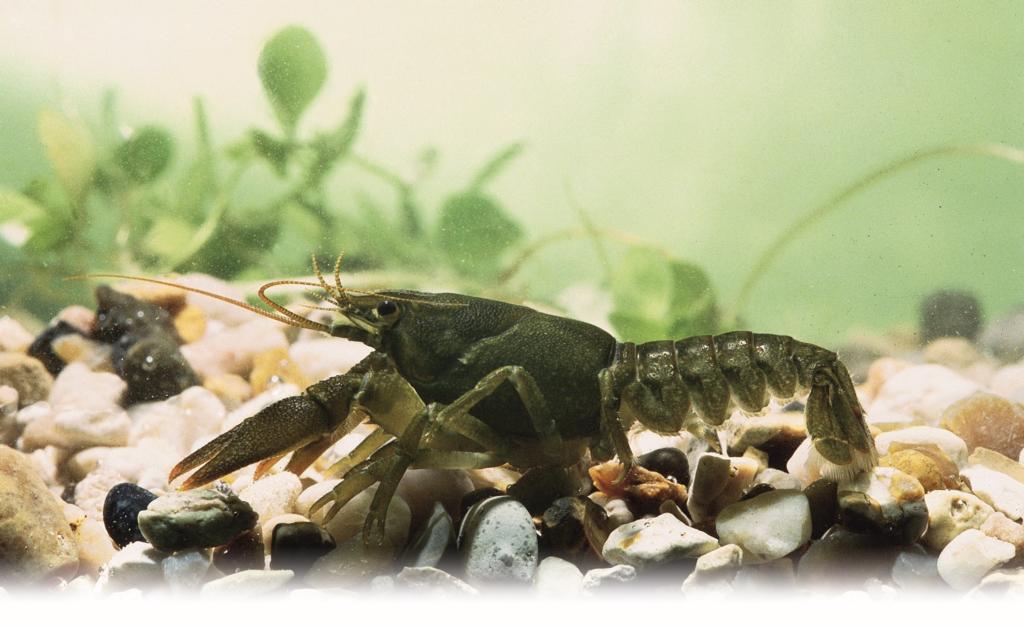
While a good number of fish prey on crayfish (one Missouri study found that more than 100 fish species eat them), smallmouth bass are notorious feeders on the little lobster-like buggers.
Study after study has confirmed smallmouths’ affinity for crayfish, with multiple research projects showing that crayfish can make up to 90 percent of the diet of an adult smallmouth bass.
Since crayfish are so important to smallmouths, it pays to know a little bit about them.
Here are five crayfish facts to keep in mind when looking for smallmouth hangouts:
• The one habitat requirement that all crayfish species share is the need for shelter in the form of rocks, logs or thick vegetation in which to hide from predators. Some crayfish species burrow in gravel bottoms.
• Crayfish can be found at a wide variety of depths, but generally spend their lives in 20 feet of water or less.
• Crayfish are most active at night, and smallmouth bass will feed on them during the peak of their activity in the low-light situations.
• Feeding studies of smallmouths indicate they begin to feed in earnest on crayfish only after their second or third year, meaning anglers are likely to find big, mature fish where there are crayfish.
• The optimal water-temperature range for crayfish is between 40 and 75 degrees. Temperatures above or below this range trigger crayfish to become inactive and stop feeding.