To judge the success of your practice rounds before a tournament, you need to know the bass potential for that particular body of water. You can get this information by checking past tournament results from the lake or river you’ll be fishing, especially events that took place during the time of year you’ll be competing. This gives you a strong indication of what weights it will take to win.
For example, if you’re planning to fish Lake Guntersville in March, you’ll have to find bass that average 4 pounds or more because 20-pound limits are commonplace. If you’ll be fishing the Markland Pool of the Ohio River, which flows past Cincinnati, a limit of bass that averages 2 pounds will put you in tall cotton anytime.
Life would be grand if all bass fisheries abounded with 20-pound limits. The hard reality is that most never will. Frustrated fishermen who live near lackluster bass fisheries often blame their local fish departments. These anglers seem to believe that if only the right regulations were implemented, they could have the equivalent of Lake Fork in their back yards. Such expectations aren’t reasonable.
 It takes more than length limits, slot limits and stocking bass – Florida strain or otherwise – to bring about a fishery that teems with trophy largemouths. The deciding factor is usually the environment in which the bass live. Bass in Southern states tend to put on pounds faster than those in the North because they benefit from a warmer climate and a longer growing season. But, even bass fisheries in southern climes will be poor if they have insufficient food and cover.
Dave Bright, southeast Ohio’s fish management supervisor, makes a farming analogy. He points out the richness of the soil from one region to the next determines how many bushels of corn the land can produce per acre. Likewise, a nutrient-rich lake that supports an ample forage base will produce more and bigger bass than a nutrient-poor lake that sustains limited forage.
“Just as agricultural output is influenced by the soil, the potential productivity of a lake is a reflection of its watershed,” Bright said.
The amount of nutrients carried into a reservoir determines, to a great extent, how much bass have to eat. A reservoir that has a high exchange rate of water, such as Kentucky Lake, is continuously replenished with nutrients. Lake Mead, by comparison, has an extremely low exchange rate and is relatively lacking in nutrients. Cover, including aquatic vegetation, stumps, flooded trees and rocky bottoms, also figures into bass productivity.
“Cover provides escape mechanisms for bass fry to survive,” Bright says. “This assures you have multiple year classes of bass surviving year to year. Cover also provides ambush points for bass. If the cover is especially dense, it can even prevent over-exploitation by anglers.”
The same requirements are just as important, if not more so, to the forage fish of the lake. Common sense says that the larger the forage base, the larger the bass.
Bright and other Ohio fisheries biologists are saddled with the challenge of providing worthwhile fishing in small reservoirs. Most Ohio lakes measure from less than 100 to 3,000 acres, and they receive more fishing pressure than most lakes in the nation. Bright uses creel limits, minimum length limits, slot length limits and trophy bass limits as tools to tune-up bass fisheries. He applies them on a lake-by-lake basis.
Creel limits: A creel limit prevents anglers from removing too many bass from a fishery on a daily basis. These are better implemented during key spring fishing times when bass move shallow and are most vulnerable to angling pressure. Now that catch-and-release practices have become so widespread among bass addicts, creel limits have less impact on bass fisheries than in the past.
Minimum-length limits: Two primary factors cause Bright to consider a minimum-length limit. One is a fast growth rate for bass. The other is high bass mortality due to heavy fishing pressure. A fast growth rate doesn’t necessarily mean the lake has a strong forage base.
“You wouldn’t need much forage if the bass densities were low, and most of the bass were fairly young,” Bright says. “Bass grow fast in these conditions because they have little competition for the available food.” This is more common in lakes with heavy fishing pressure.
Slot-length limit: Conditions calling for a protected slot-length limit are nearly the opposite of those for a minimum length limit. Many lakes that implement a slot limit have exceptional potential for trophy production, such as Lake Fork. The slot allows bass – that may otherwise be kept as a trophy – to be returned to the water to reach their full potential.
“We encourage anglers to harvest bass below the protected slot limit,” Bright says. “By harvesting those below the protected slot, you, hopefully, reduce the competition for food and permit the unharvested fish to grow more rapidly and get into the protected slot range.”
Bass fishermen tend to hamper slot limits because they habitually release every small bass they catch. To them, the thought of killing any bass is unacceptable, let alone a puny bank runner. But, you’ll actually improve the fishing if you take those underlings home and transform them into tasty, deep-fried fillets.
Trophy-bass limit: A trophy-bass regulation is nothing more than a long length limit. In Bright’s district, he imposed an 18-inch minimum on 200-acre Tycoon Lake. He decided on the trophy regulation when the growth rates at Tycoon remained strong after a 15-inch limit was first implemented there. After a minimum-length limit is put on a lake, growth rates usually slow because more bass are allowed to remain in the lake, resulting in more competition for food.
“When growth rates stay strong, as they did at Tycoon, it’s an indication that the lake has enough nutrients to support a higher biomass of predators,” Bright says.
Stocking bass: Though Bright doesn’t rule out stocking bass, it would take an unusual situation for him to consider it. He once took part in a study by the Ohio Division of Wildlife in which largemouths were stocked into a lake. The study examined the contribution of stocked bass compared to the lake’s natural reproduction. The bottom line was that stocking wasn’t cost-effective because it couldn’t compete with nature. If a lake has suitable habitat and proper length and bag limits, the bass will do a fine job of replenishing their own stocks.
 Lake Champlain, N.Y.: Natural lake, closed spring bass season, clear to stained water, cool climate, abundant aquatic vegetation and rocky bottoms, deep with shallow bays, northern-strain genetics, average nutrient levels, average forage levels (smelt predominant), very plentiful northern-strain largemouth population that average 2 pounds.
 Norman Lake, N.C.: Reservoir, slightly stained water, mild climate, no aquatic vegetation, ledges, boat docks, planted brush, deep with large flats, good nutrient levels, very good forage base that now includes blueback herring, abundant Northern-strain largemouths that average less than 2 pounds.
 Potomac River, Md.: Tidal river, stained water, shallow, cool/mild climate, northern-strain largemouths, abundant and varied aquatic vegetation, ship wrecks, bridge pilings, high nutrient levels, high forage levels, extremely plentiful bass that average 2 pounds or more.
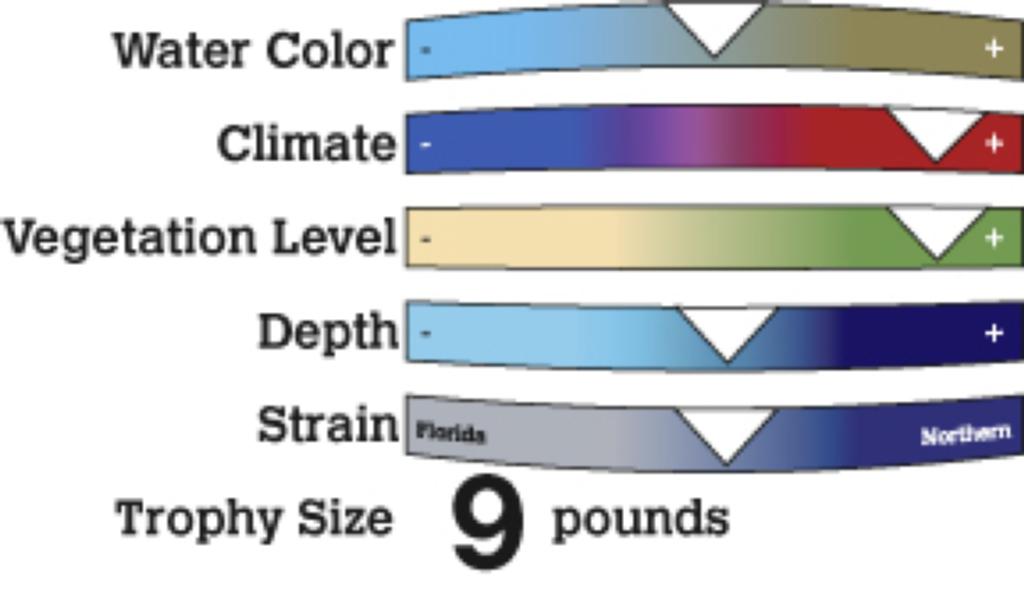 Sam Rayburn Lake, Texas: Reservoir, clear to stained, warm climate, northern- and Florida-strain bass, copious hydrilla, standing timber, flooded bushes, medium-high nutrient level, some deep water with plentiful shallow habitat, excellent forage base, very plentiful bass that average 2 1/2 pounds or more.
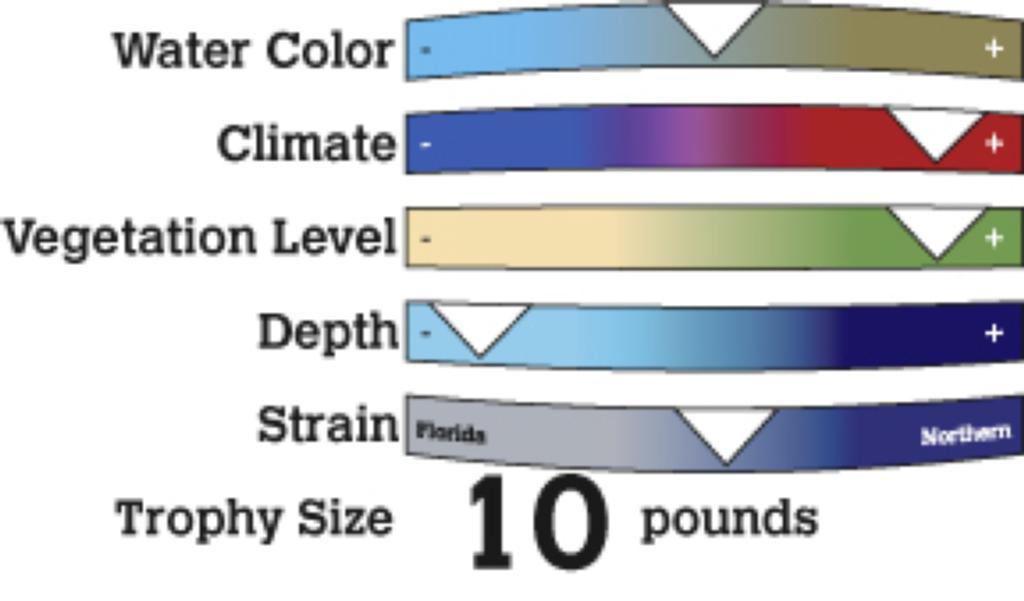 Seminole Lake, Ga.: Reservoir, clear to muddy, warm climate, plentiful aquatic vegetation and standing timber, northern- and Florida-strain bass, good nutrient level, shallow, good forage level, fairly plentiful bass that average 2 1/2 pounds or more.
 Table Rock, Mo.: Reservoir, clear to slightly stained water, almost nonexistent vegetation, steep chunk-rock banks, deep water, northern-strain genetics, mild climate that allows abundant threadfin shad, average nutrient levels, good numbers of bass 15 inches and longer.
 Lake Mead, Nev.: Reservoir, ultra-clear to slightly stained, deep, warm climate, virtually no cover in present low-water conditions other than rocky shorelines and bottom structures, low nutrient level, northern-strain bass, fair forage level, low largemouth population with average size of 1 to 1 1/2 pounds.
 Kentucky Lake, Ky.: Reservoir, slightly stained to stained, shallow bays with deep main channel, rock and wood cover with scattered vegetation, northern-strain genetics, mild climate, abundant forage, average to high- nutrient levels, high number of bass that average 2 1/2 pounds.