Autumn bass fishing techniques receive about as much attention as those spelling bee contests that air on ESPN. Why? Both topics will bore you to death.
After all, what are the primary patterns in the fall? Other than the ever-present spinnerbaits and crankbaits, the go-to baits are often topwaters of some kind. Clear, deep, muddy, shallow, lakes, rivers, north, south, largemouths, smallmouths, spotted bass, it doesn’t matter the location or bass species – topwaters produce in the fall.
Topwater fishing, by nature, is not complicated. Just find the action that excites a bass on a given day and run around the lake throwing over any structure or vegetation. Most bass, including open-water spotted bass, can usually be found in the backs of bays or on shallow bars and points in the fall chasing shad and enjoying the comfortable water temperatures before the onset of winter.
Rather than discuss what everyone already knows – how to use topwaters – let’s break down the finer details of topwater-bait construction.
Zara Spooks, and other similar baits, are popular and very effective throughout the year, but especially for schooling fish in the fall. They are simple and easy to work. Available in a variety of colors, the lure line-up has three basic sizes – Super Spook Jr., Spook and Super Spook. They range from 3 1/2 inches long to 5 inches. Simply match the size of the bait to the average size of the bass in your fishery. Then match the color to the conditions. Spooks are fish-catching machines.
Then there are other topwaters, including Jitterbugs, soft-plastic frogs and prop plugs.
But one of the most commonly used autumn topwater baits is the buzzbait – the topic of this discussion. Not quite as complex and varied as crankbaits or even spinnerbaits, buzzbaits, while easy to use, come in various forms, weights and colors. What makes certain features more desirable in certain situations?
As most bass anglers know, other than weight and color, buzzbaits have four primary differences – angles of wire arms, type (or number) of prop, shape of head and, on some baits, sound-making devices, such as clickers and clackers. The editors at FLW Outdoors Magazine decided to test an assortment of 10 buzzbaits to assess the significance of various design features. To make the test as accurate as possible, all buzzbaits (except two) were 3/8 ounce and were used with the same rod and reel with 15-pound test Berkley Big Game monofilament.
The buzzbaits selected for the test were made by both well-known national companies, such as Booyah, Strike King and Terminator, and by lesser-known regional lure companies.
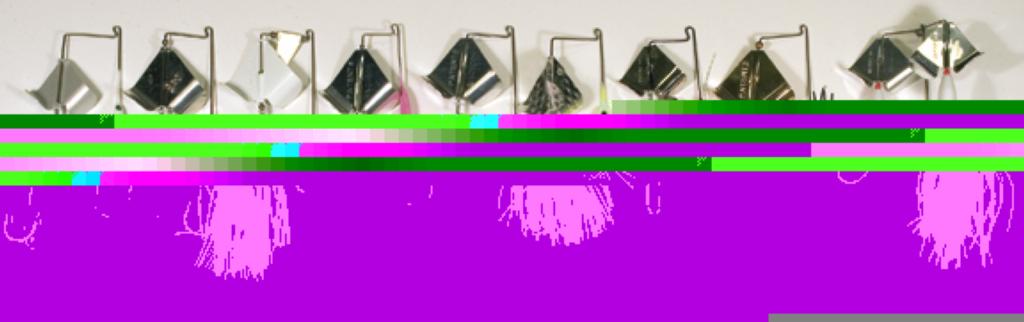 The selected baits were all slightly different. So which baits were the loudest, ran the straightest, ran the slowest and ran the most upright (head underneath the prop)?
Without taking the time to break down the pros and cons of all 10 of the tested baits, here is what we found:
Wire Angles: Some buzzbaits have wire arms that are parallel, while others have more open angles. According to our tests, we surprisingly determined that wire-arm angles had no noticeable effect on the action of the buzzbaits. But does a hook that runs more horizontally in the water, rather than angled down, offer a better hook-set position? That’s a good question that we can’t answer. Parallel wire arms and/or baits with upward bends in the wire at the front of the head allow hooks to run more horizontally. Buzzbaits with more open wire-arm angles often pull the hook through the water at about a 45-degree angle.
Head Shape: Head shape also had no noticeable effect on the action of the buzzbaits we tested. Numerous new models of buzzbaits have “boat-hull-shaped” heads, which are flat and wide. The argument that the flat head assists with lift appears to be a marketing ploy.
Sound: We like plain `ole metal props. Paint/coating on props muffles sound, which is generally wanted with a buzzbait. Put an uncoated metal prop on any buzzbait, and it’s louder. Furthermore, clickers and clackers aren’t necessary to create great noise. The Strike King Buzz King (the only three-bladed prop we tested) made very little artificial noise but produced excellent bubble/gurgling sounds. Other, more-traditional buzzbaits with two-bladed props that lacked clickers/clackers actually sounded better than most of the clicker/clacker baits. The screeching sound of the prop rotating around the wire arm made outstanding noise by itself in the simple designs.
Prop: Once again, we like plain `ole metal props. Painted/coated props did not seem to spin as freely and easily because the prop was heavier, and the paint appeared to cause increased friction between the prop and wire arm. Larger props produced more spitting action, especially at slow speeds, and we like that. Clickers attached to prop blades didn’t impress us and didn’t really work as advertised.
Slow Presentation: Many buzzbaits can be worked fast, but fewer can maintain an attractive presentation at slow speeds. The three-bladed prop (Strike King Buzz King) worked best. It could be reeled slowly and produce a very good sound. A double-propped bait also looked impressive when worked slowly, but we still like single-prop baits better – call us old fashion. Buzzbaits with clickers or clackers generally required more speed to get the bait to work correctly.
 Fast Presentation: For some situations, a fast-moving bait is better. But not all buzzbaits can properly run at both fast and slow speeds. The ability to maintain good sound and surface action is crucial. Buzzbaits with smaller props and/or more drag – caused by clickers/clackers or more prop-on-wire friction – usually require faster retrieves for proper presentations. And not all buzzbaits that run well at slow retrieves work well at fast retrieves. The Strike King Buzz King worked well at slow speeds, but was a poor choice for fast retrieves, as it was actually quieter and tried to jump out of the water when reeled faster. A heavier bait, obviously, would require increased speed to keep the bait in proper position on the surface.
Pull: The natural tendency of a buzzbait prop is to pull to one side, and as a result, the head is pulled out to the side. That can be advantageous in some situations, but a truer-running bait is generally desired. Furthermore, truer-running buzzbaits also tend to run vertically (the head under and inline with the prop). Vertically running buzzbaits also appear to be more effective in hook sets because of hook position. On the models we tested, baits with heads the greatest distance behind the prop typically ran the most upright.
Although we’ve mentioned the Strike King Buzz King several times, we’re not really evaluating individual buzzbaits, but one bait in particular, the Booyah Dancin’ Buzz, is something we should dwell on for a moment.
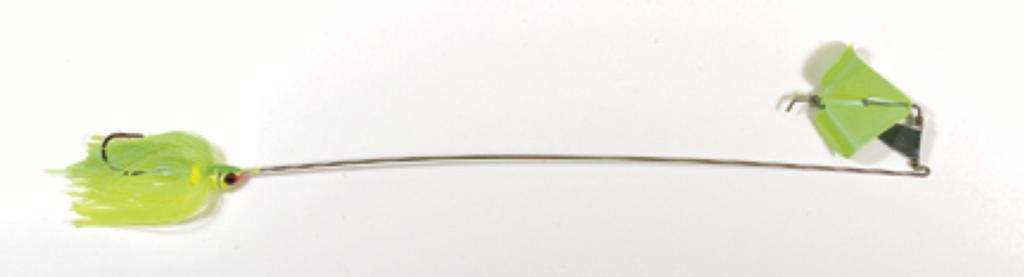
First of all, at about 15 inches in length, the bait is crazy looking. It feels like a short Carolina rig when casting it, which is awkward. The long wire arm could easily bend when reeling in big fish. It has no outstanding characteristics regarding sound or running speed. And the head runs anywhere from 3 to 6 inches below the surface.
With all that said, although we have not extensively used the bait, it looks much more appealing in the water as compared to out of the water. Although we’re not going to buy it, we no longer look at the bait as a total freak, just a half freak.
So with all that evaluation, what kind of buzzbait would we buy? We’ll describe it from the prop to the head.
Get rid of the all the clickers and clackers and give us a simple prop configuration. The metal screeching and bubbling sound on many of the simple baits was very good, even superior to other baits with clickers and clackers. Start with a metal spacer at the end of the prop arm, followed by a two-bladed prop. If you’re fishing through vegetation, get a bait with a bead in front of the prop to prevent debris from clogging it. If you’re fishing “clean water,” the bead isn’t needed.
The only additional prop configuration we would recommend would be using a three-bladed prop, such as the one found on the Strike King Buzz King, for the slowest buzzbait presentations.
Now comes the wire. We prefer, for better or worse, a more horizontal-running hook, so we suggest a buzzbait with parallel arms. Furthermore, one bait we tested, the Cumberland Pro Lures buzzbait (top center photo), had an upward bend in the wire at the front of the head, which resulted in the most horizontally running hook on any buzzbait we tested.
Concerning the head, no need to get fancy with shape, colors or eyes. A standard round or bullet-shaped head with a simple paint job is more than satisfactory.
In researching buzzbaits, we found many of the more well-known buzzbait models were too “fancy” and did not work as well. The small, regional lure manufacturers typically offered the simple designs we found most effective.