——————————-
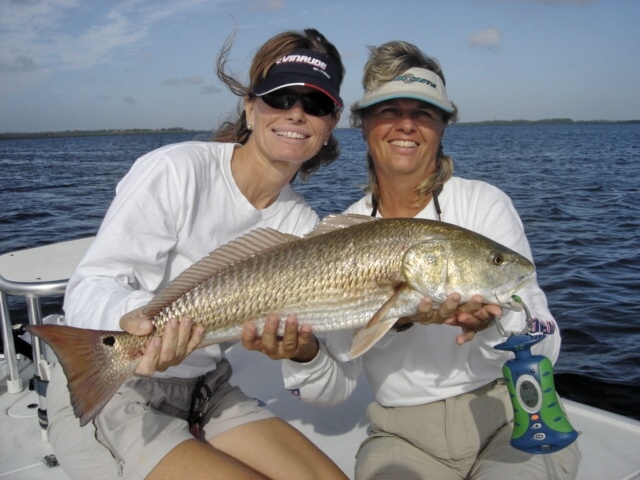
Editor’s Note: FLWOutdoors.com writer Jennifer Simmons spent a day on the water with FLW Redfish Series teammates Leiza Fitzgerald and Merrily Dunn while they prefished for a tournament held near Sarasota, Fla. In addition to providing material for this feature article, the day also marked Simmons’ foray into the sport of redfishing.
——————————-
On a cloudy Wednesday morning in Sarasota, Fla., Capt. Leiza Fitzgerald makes small talk with a fellow redfish pro while her teammate, Capt. Merrily Dunn, readies the boat for a day of prefishing. All have converged on the Sunshine State for a redfish event that will begin two days later, specifically on the Sarasota Bay.
Fitzgerald and Dunn, the highest-ranked all-female pro redfishing team in the Wal-Mart FLW Redfish Series, are the first out of the gate. As we speed away, Fitzgerald notices the competitor from the dock keeping a keen eye on their trajectory. “He’s watching us,” she says. Dunn decides to head to a “decoy spot,” and the maneuver works. Within a few minutes, the competition is long gone.
This scenario is common in competitive fishing, but as females in the male-dominated redfishing world, Fitzgerald and Dunn stand out. They know they’re different, but they are smart enough to know how to make that an advantage.
“We have a benefit in that we’re a rarity,” Fitzgerald said. “Sponsors like it that we’re a female team. It’s a uniqueness, like twins.”
Over the course of three and a half years of fishing together as a team, the two have developed a fascinating – and often humorous – way of communicating and working with one another on the water, a style I watched that Wednesday when I spent an entire day on the water with the two of them.
Witty remarks are bandied about between them like balls on a tennis court, but when it comes to their fishing, it’s clearly evident that they are serious about it, using each other to the best of their advantage to try to bring redfish into the boat.
“I love it because each of us has our respective responsibilities,” Fitzgerald says of the team dynamic.
“Leiza has good eyesight and can spot a fish,” Dunn said. “I’m on the propulsion end of the boat.”
“She’s my MacGyver,” Fitzgerald remarks.
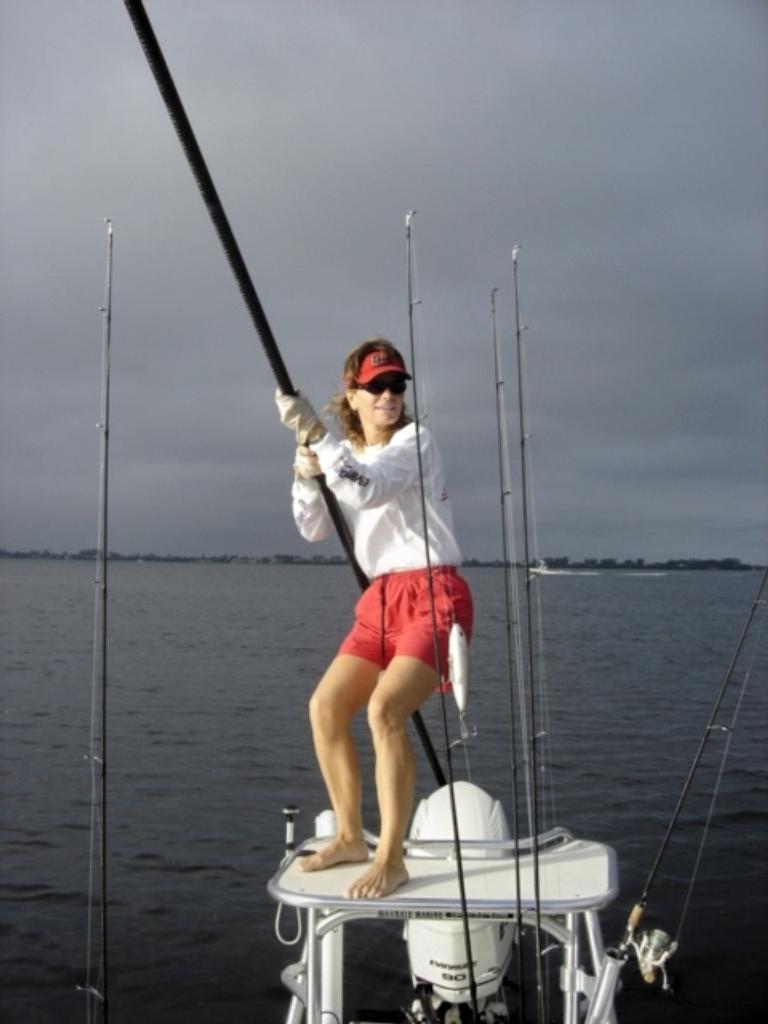
Indeed, Dunn is mighty handy with a push pole while Fitzgerald can be heard throughout the day making remarks about the status of the fishing hole: “See where that just went? See that?”
“I have binocular vision,” she says. “Or at least I think that I do.”
She made a believer out of me – in more than eight hours on the water, Fitzgerald spotted things I could never see, even in polarized sunglasses. Her skill is impressive.
“I like the team dynamic,” Dunn says. “We play off each other – `Why don’t you think the fish are here?’ One can be using one bait and one can be using another to figure out what is working better. You save a lot of time that way.”
Starting fresh in saltwater
The team identity is something that I, primarily a bass-fishing reporter, find most intriguing. When Fitzgerald approached me about writing a story about redfishing women, I had never been redfishing. In fact, I had never even covered a redfish tournament. The whole experience was a new one for me.
Since bass was my background, I couldn’t help but notice the similarities – the two women offered plastic lures from the front and back of a Ranger boat. The biggest difference is they hoped to bring in two fish worth 15 pounds – a dream day for a bass pro.
In fact, both anglers have bass fishing in their backgrounds, and Fitzgerald has also dabbled in the professional kingfish arena as well.
“What’s interesting is I wasn’t really interested in redfish tournaments, but I was in the bass,” Dunn said. “I was watching Hank Parker and fishing mostly freshwater when I came back from Tampa. It seemed like the ladies were just getting started, back in ’92 to ’93. But it mostly focused on the guys.”
 As for Fitzgerald, her path to redfish was paved by a woman named Patty Sunderland.
“I saw her at a boat show, and she was fishing for Ranger Boats,” she said. “She was in her fishing attire, and I said, `Aha!’ When I saw her, I knew I wanted to fish the redfish tour. I went to Ranger Boats, and they were the first sponsor I had. It seemed to get better and better. We were getting a lot of publicity, and there was a huge trend of women wanting to fish. It became a great way for sponsors to reach a new demographic that didn’t have what they needed to fish with.”
Fitzgerald originally approached Dunn to be her teammate after she turned down an offer from another female to hit the redfishing tours together. After hearing good things about Dunn through the grapevine, Fitzgerald approached her about teaming up for the redfish tours.
“She discussed it with her fiance, and he thought it was a great idea,” Fitzgerald said. “We realized it was not as easy as we thought it was going to be. It’s hard to get sponsors, but we do have access to a market that the men don’t.”
Indeed, in all of competitive fishing, the female market appears to be on the brink of explosive growth – a niche market for which Dunn and Fitzgerald, with her marketing degree, see unique opportunities.
“We get lots of exposure,” Fitzgerald said. “I go into (the grocery store) for my mother, and the butcher says, `You’re that professional fisherman.’ I give out fishing tips at Radio Shack. We get recognized.”
Working for the weekend
Fitzgerald and Dunn both work off the water, although Dunn’s jobs as a substitute teacher – as well as her guiding business – allow her plenty of time and flexibility for her redfishing pursuits. In fact, when Dunn fishes a tournament, she’s actually in danger of losing money because she could be out chartering. Why do it, then?
“We’re hoping to get the grand prize,” Dunn said.
“It’s the risk versus the reward,” Fitzgerald explains. “It’s a gamble, but it’s a calculated gamble. You’ve just got to hope and pray that you’ll have your fish and someone else won’t.”
“Sponsors – that’s why we’re wearing the clothes, throwing the lures and fishing the boats,” Dunn says.
Just like in any other professional angling pursuit, sponsorship is the bread and butter for these women, and that’s why they are always concerned about delivering for their employers, so to speak. Fitzgerald, though, does have an angler-friendly job as vice president of membership development at an upscale hunting club in Florida. Fishing time for Fitzgerald is part of her employment agreement.
“That was part of the allure for them, that I worked in the outdoors and had a lot of contacts,” she said. “They’re basically one of my sponsors, allowing me to fish.”
It’s a mutually beneficial relationship in a lot of ways – in addition to hunting for redfish on our day out, Fitzgerald was also trying to boat a snook for her boss.
Family life
The fact that a professional fishing career takes a toll on the family back home is not news. That’s where Dunn has it made. Her longtime fiance, Terry Simmons, is her redfishing partner when Fitzgerald has to work in the office, and Dunn has no children. Fitzgerald, however, is a recently divorced mother of two sons.
“They prefished last year quite a bit,” Fitzgerald said of her boys. “They’re both in school now. My younger boy, Garrett, runs the trolling motor, and my older boy, Logan, stands on the pole platform and scouts them out for me. When we win money, I always give them $25.”
“Put one on the bow and one on the stern,” Dunn wisecracks. “They’re boys.”
“Yeah, you can’t put them together,” Fitzgerald concurs.
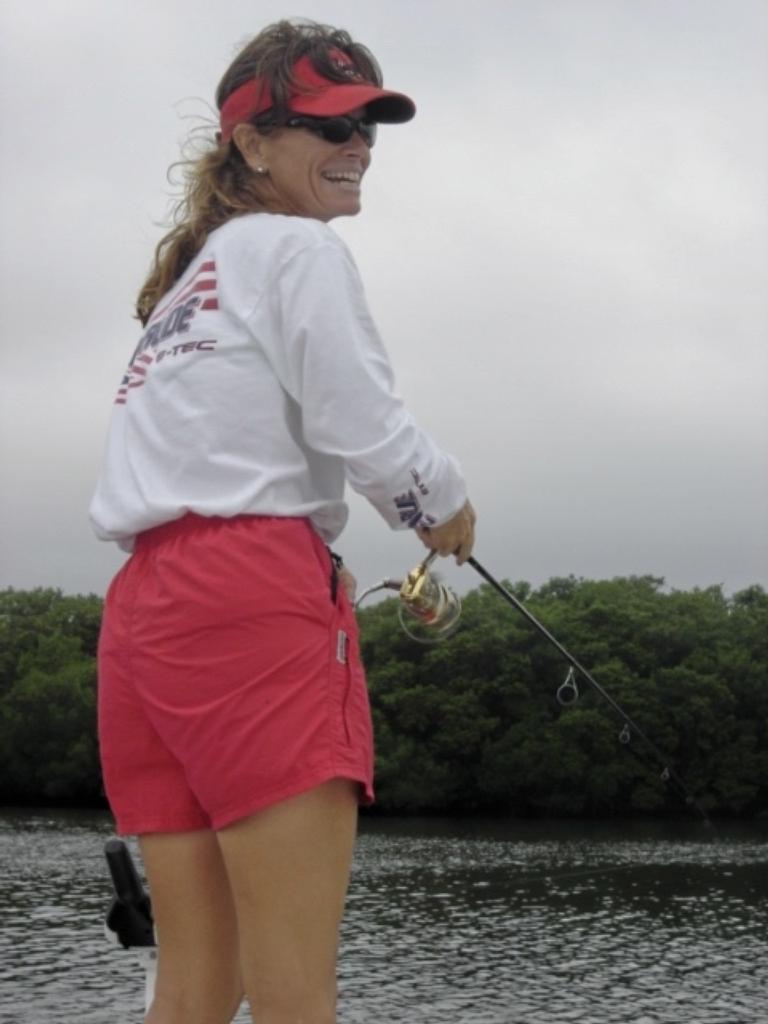 All joking aside, the boys are the biggest reason why Fitzgerald is not a full-time redfish pro.
“I want to be able to keep my current profession, and (the company) has allowed me to do that with the time off,” she said. “I have two boys I have to take care of. I have to have a full-time job.”
Dunn’s teaching ambitions are a bit less intense.
“When I’m not occupied (with tournament fishing and guiding), I spend a few days filling up the pocketbook,” she said of her substituting gig. “I’ve got to make some playtime money.”
Dunn recognized early on that she would never be the kind of woman who could spend hours every day holed up in an office, and she wisely planned her career accordingly. Her other jobs have included managing an outdoor-outfitters store and working at a one-hour photo lab.
“I always wanted something I could do out of the office environment,” she said. “Don’t stick four walls around me; I’ll go crazy. I’ve always loved the outdoors. I’ll take the outdoors no matter what the weather is, really. It’s where I’d rather be. Me against the fish. How smart are you, Mr. Fish? How smart am I?”
R-e-s-p-e-c-t
Speaking of the weather, the rain that was forecasted to fall on us all day has given way to a blazing sunshine that naturally brings out the onlookers. At this point, we’re fishing an area surrounded by large on-the-water homes, and a driver heading down the nearby road calls out to Dunn just as she fails to hook a redfish.
“You made me miss him!” she genially hollers.
Good natured or not, catcalling is simply a fact of life for women who choose to make a go of it in professional fishing. There may be more women than there used to be, but female pros remain a rarity, and sometimes, the men still don’t know what to make of them as competition.
“I love being a woman angler,” Fitzgerald says. “Look at me as your competition, but treat me with respect. Treat me like you’d want your sister or wife to be treated. Don’t treat me like your girlfriend.”
“It can be challenging to be a woman,” Dunn says.
“We are women,” Fitzgerald continues. “We do get our feelings hurt. We want (the men) to remember that we are women.”
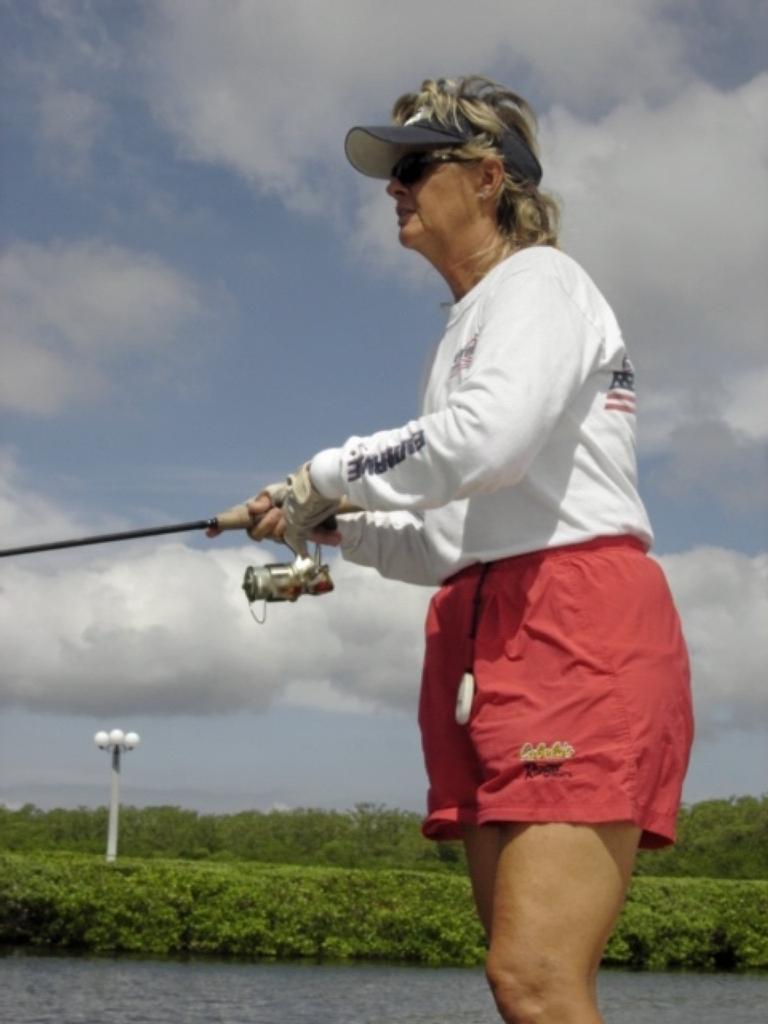 “We aren’t your beer-drinking girlfriends,” Dunn says.
“When we first started, we were the girls, and the guys were willing to tell us what baits were working and where the fish were,” Fitzgerald remembers.
“Not that we needed the help,” Dunn is quick to point out.
“Now they don’t want to share,” Fitzgerald continues. “They’re proud of us, but they don’t want to be beat by a girl.”
Dunn replies that there are men who say they don’t care where they finish as long as it’s ahead of her and Fitzgerald.
“Sometimes they really can’t take it,” Dunn says. “But we can’t rub it in. I want to be perceived as an angler and a woman too.”
The women’s remarks are not at all indicative of the entire male redfish field but rather a few here and there who are threatened by female success in a male-dominated world. As a whole, Fitzgerald and Dunn have found the professional redfishing environment to be more like a family.
“I love the thrill, the challenge and the camaraderie,” Fitzgerald said of tournament angling. “You have a lot of talented people who fish the tour, and they become your family. We look out for one another.”
Breaking new ground
 This past July, Dunn made redfishing history by becoming the first woman to finish in the top five at a professional event. As significant as that was for her, she regrets she couldn’t share the honor with Fitzgerald.
“I wish Leiza and I had done it together, to be the first woman team to make the top five,” said Dunn, who achieved the feat alongside her fiance instead. “But at least he and I did it, and it was fun.”
However, the women are far from done, and the opportunities to break new ground continue to present themselves to Fitzgerald and Dunn. Just as the past three and a half years have yielded a certain kind of familiarity with each other, they hope the coming seasons will continue that trend, helping to solidify the two as a top-notch redfishing team.
“It’s hard to learn a person,” Fitzgerald said of the two-person team dynamic that defines professional redfishing. “I’m very difficult in that I don’t complete my sentences, and Merrily is not as excitable. She is focused on one thing. We’re learning each other’s quirks.”
“When you prefish a week together, eat meals together and share a hotel room, you start to learn someone gradually,” Dunn says. “It’s a little bit like sisterhood, and that’s different from brotherhood. Sisters are more understanding and willing to learn. Some of these teams are thrown together on a whim, and egos get involved. We learned how to work with each other.”
Over time, Fitzgerald and Dunn have been amazed to see up close the impact they are having as females in the sport. Just as Fitzgerald is recognized at the grocery store, they’re also looked up to by little kids that remind them of themselves as young children.
“There’s little girls out there fishing with Daddy just like Leiza and I did,” Dunn said. “I can’t tell you how many boys and girls have come up to us and wanted our autograph.”
Says Fitzgerald, “It’s very unique to have people who look at you in a way you’re not accustomed to being viewed.”
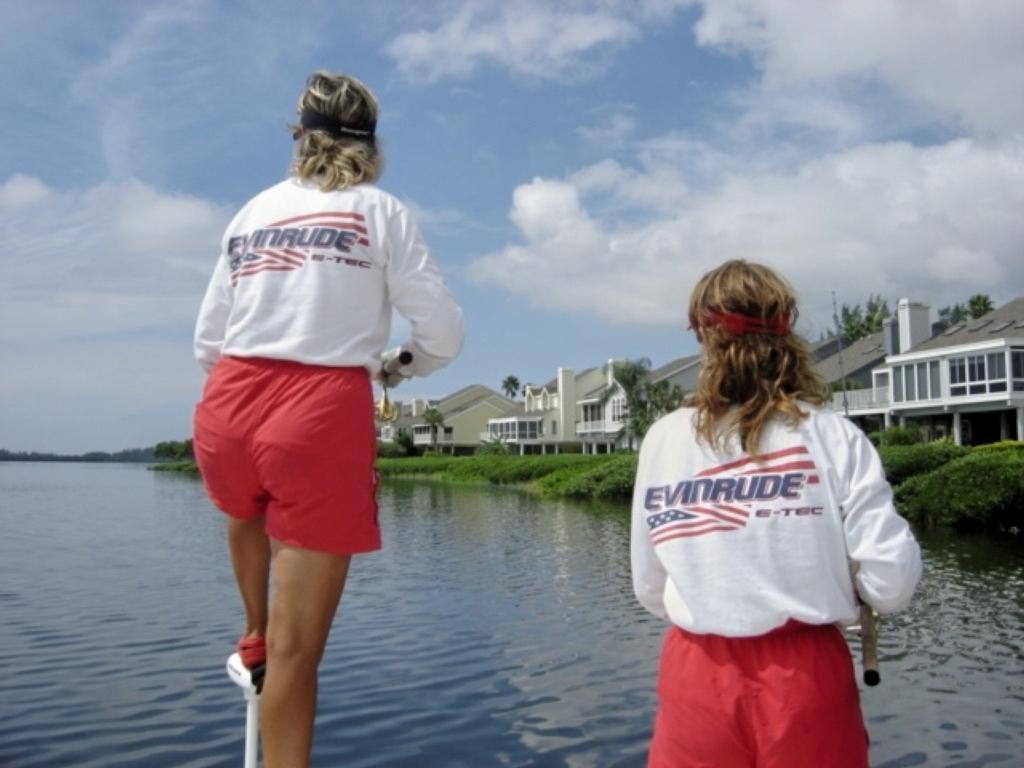 It’s similar to the way Fitzgerald and Dunn regard the trailblazing women that went before them – with abundant admiration and deep respect. Though the two are excited about being a part of the new generation of women anglers, they have never forgotten that a fish is still a fish.
“Yes, we’re fishing against guys, but it’s you against the fish,” Dunn said. “It’s all about learning your quarry, the redfish, and the elements. It’s whether our choices are right, it’s the luck of the draw, it’s your location. It doesn’t matter if you’re male or female. It’s all your tools working right.”