
Not many offenses draw the ire of experienced kingfishermen like an “I” speech. You know the deal – “I did this,” “I did that” or “I caught the winning fish.”
Obviously, the guy or gal who winds in the tournament’s largest king plays a very valuable role. But so does every other person on the boat who clears the brush, paves the path and employs just the right action at just the right time to ensure a positive outcome.
Has anyone ever caught a big king on a solo mission? Sure – it’s entirely possible to catch and rig live baits, drive the boat, handle the rod and stick the fish all by your lonesome. But throw in a tablespoon of rough seas, a pinch of double-header disaster, and a sprig of cluttered deck stumbles and suddenly this briny bouillabaisse overflows with more burden than one person can stir.
 That’s why this sport is a team sport. As such, the synergy of collective effort is infinitely more potent than the most skilled individual.
Team duties
Disorganization plus egocentric selfishness equals mishaps and missed opportunities. Kingfish rarely announce their strikes. Therefore, when the moment of truth suddenly shatters the boredom, disciplined consistency is your only hope of converting opportunity into success.
“You’ll usually see one guy driving, then another, then another. Or you see a captain grabbing a rod when it goes off,” said Alex Leva, captain of the Tampa, Fla., based Team Snickers. “If you were playing baseball and you had a guy smack the ball to first base, the third baseman wouldn’t run for the ball and run over the pitcher in the process.”
When it comes to dividing up the work, opinions vary, but experience level is usually the biggest consideration. On Team Snickers, Jim Ladner mans the helm, while Troy Nelson, Allen Winchel and Leva divide the rigging and deck maintenance. Each of the latter is tasked with manning the rod closest to him and clearing lines when a teammate fights a fish. All are comfortable with gaff duties.
After more than a decade of fishing together, Leva’s team members are comfortable with their flexible plan of action. However, he believes it’s best for new teams to have designated jobs, as only experience can build confidence and competence. Multitasking is good, but overtaxing any member can create a weak link in the chain.
Regardless of how the work is divided, the responsibility starts early. At check-out, he said, all eyes should make a final bow-to-stern scan.
“When you leave the dock in the morning, everyone looks around and double checks one another. You can think that you have everything secure, but there can be a rig dangling, a loose downrigger ball or something else that could cause a problem.”
 The same thoroughness should precede each relocation. Moreover, throughout the day, the more eyes watching for bait pods, breaking fish, bird activity and other fishing boats, the greater your chances of finding the sweet spot.
United by a goal
Danny Mathis of Gonzales, La., captains one of the most successful teams in professional kingfishing, Team Cat Daddy, which won the inaugural Wal-Mart FLW Kingfish Tour event in Ft. Pierce, Fla. Joined by his brother, Rusty, Steve Shook, Bob Clement and Guy Koontz, Mathis fields a team with a lot of experience – and a lot of input.
You don’t get good at what you do without becoming opinionated, but much of Team Cat Daddy’s success stems from team unity and Mathis’ leadership. As evidenced on the FLW Outdoors” television show on FSN that covered the team’s Ft. Pierce victory, smooth execution, perfected through hundreds of repetitions, can make boating a 56-pound kingfish look easy.
As Mathis said, the whole deal must start with a common vision. “Everyone has to be on the same page,” Mathis said. “There should be no jealousy when everyone’s working for the same goal. Once you get everybody on the same page, you can maximize your opportunity.
“We’ve all fished so long together that we usually come up with the same plan. You’re going to  occasionally have different points of view, but it has to come down to the captain’s decision. You try to respect everyone’s opinion, and if everyone knows that they’ve had their voices heard and considered, then it’s generally OK.”
Now, rare is the mortar that can hold a team together for more than a couple of seasons. Those who nurture such bonds have the advantage of familiarity – the intangible ally that often nudges teams through challenging situations.
“Experience means you’ve made enough mistakes to overcome the same circumstances when they happen again,” Mathis said.
For example, when a helmsman fails to respond to an angler on the bow requesting more speed to run down a hot fish, the battle swings decidedly in the fish’s favor with each yard of waning line. But when the guy on the wheel learns to anticipate what his angler’s personal style entails, adjustments become instinctive.
Key assignment
 When establishing team duties, Leva advises putting the most technologically competent angler on the helm. No problem if another crew member wants to drive while running from spot to spot. But once you’re in the target zone, leave the surgery to the surgeon.
“Electronics these days do about 500 things; most anglers know how to do three or four,” Leva said. “Let the guy who knows how to maximize the potential drive the boat. The helmsman is fishing by sonar, GPS and radar, whereas his teammates are fishing with rods.”
As Leva notes, all tasks are important, but a designated helmsman must understand the job’s demands before committing to the position.
“No. 1, the concentration factor there is intense,” Leva said. “You can drive the boat all day long and just concentrate on not tangling lines. But you really need to be maximizing all of your resources. You need to be aware of any productive waypoints you have that are nearby.
“Also, you need to monitor every strike, know where it occurred and mark the location. You also need to know what bait the fish hit and make sure the rigger is aware so he knows what to put out.”
 A good helmsman keeps an eye on the baits and alerts the riggers when one line runs funny or picks up weeds. He’ll also prepare the team by advising them of when sonar indicates a show of fish, bait or promising structure. In return, teammates should take care of their helmsman by providing food and beverages during long sits.
Calming camaraderie
Teams that get along well typically perform better. That’s because human nature makes us behave irrationally when we’re upset with one another. Tournaments are inherently stressful, and tense moments are practically inevitable. The underlying current of respect and admiration can overcome a few white caps.
“You want to have a lot of enthusiasm on the boat,” Mathis said. “Especially when you have a long day, and you’re not getting a strike. We could fish all day and have 10 minutes left in the tournament, and we’ll still believe that we’re going to catch the winning fish.”
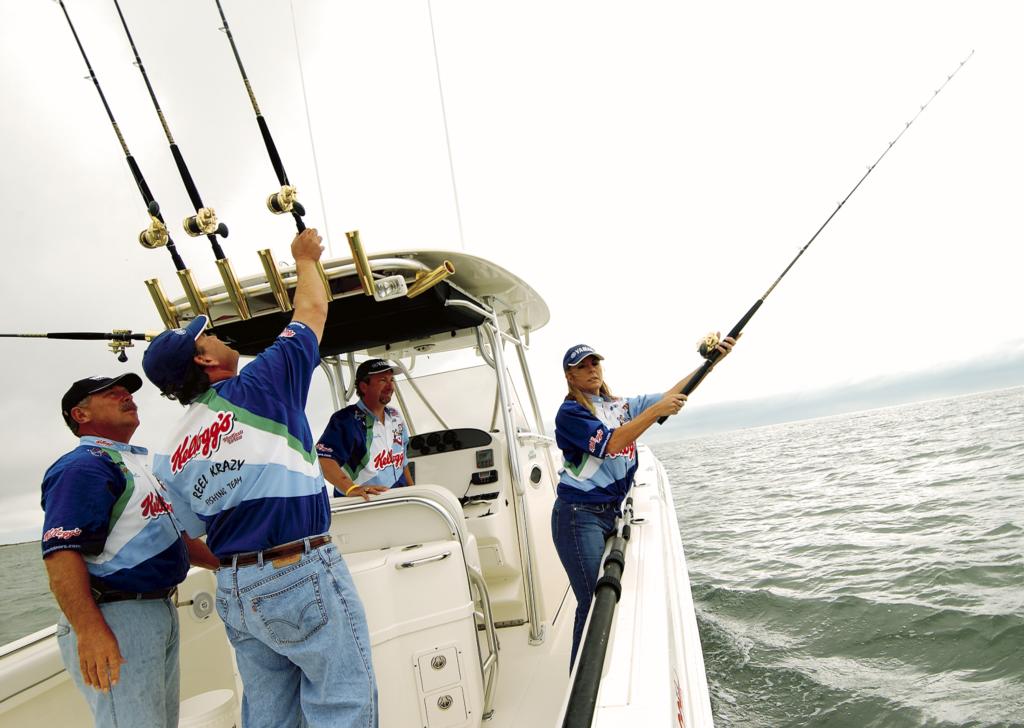 Unrelated anglers can do just fine, but family teams always seem to have an edge, at least in terms of on-the-water relationships. Captain Kevin Crofton of Wesley Chapel, Fla., leads the Team Tyson crew of DuWayne and Darin Crofton, Casey King and Jerry Franks. All but Franks are related, but he’s considered family. Having fished together for about 15 years, this close-knit unit exemplifies the intuitive interaction of a team that has long since rounded off its edges.
“Being a family team is special because you know everybody’s personalities, and you know how to get along,” Crofton said. “Because we’ve done this as long as we have, we all kind of know our roles. There are certain things that certain team members do, so in the heat of the battle, we just take our positions. I think what makes a good team is everybody knowing what their role is but no one demanding the spotlight.”
Ultimately, it matters not whether or not you spend Thanksgiving with your kingfishing teammates. The important thing is whether or not you can integrate your skills and abilities for a couple of days of hard fishing.