Face it: The high, cold, muddy water typical of late-spring river conditions is about the toughest situation walleye anglers face during the year. Proverbial wisdom once suggested fish shut down feeding activity in muddy water because they can’t see. Drop the temperature of both the water and their bodies, and fish suffer a double-whammy: They not only can’t see, but they can’t respond aggressively to the presence of forage (or lures), even if they pass right under their noses.
It’s a good theory – sounds logical, almost profound. “Wait until the river clears, and you’ll catch fish again.” True. But why wait when you can still catch them now, despite the murk associated with late-spring runoff, high water levels and low water temperatures?
The answer lies in using tactics that appeal to the walleyes’ other senses besides sight. Specifically sound, vibration, smell and taste. Even if walleyes can’t see your bait coming, they can hear and feel its approach. And at the moment of truth, if walleyes can further smell and taste it, so much the better.
Need proof? Time to get loud, obnoxious and perhaps even stinky.
 Handlining
My initial trip to the Detroit River late one April was a real eye-opener. I’d heard about the local tactic called handlining for trolling pencil plugs and crankbaits in the swift 3- to 7-mph current. The trolling part made sense. But handholding a wire cable attached to a wire shank (what the heck is that?) with multiple attachment points – used to simultaneously present two or three long leaders and lures without tangling – all the while clunking a 1-pound weight along bottom, would take some convincing – particularly when no fishing rod was involved. Instead, you wear a chamois glove to grip and hold the cable, pump the weight on and off bottom, and when a fish hits, hand-over-hand the whole works back into the boat while a self-retracting, gunwale-mounted reel winds up slack cable. Pretty wild! Who thinks of this stuff?
Well, it didn’t take long to convince me. The water was chocolate-milk muddy, and almost no one was catching anything jigging. But I watched a pair of handliners use their small outboard to creep and weave their way upstream through a pack of 100 boats that were all jigging while drifting downstream. In short order, the handymen hooked and landed 20 walleyes to win a local tournament. Final score: handliners 20; jiggers 0.
The positive aspects of handlining are:
1. Slow upstream movement, even hovering at times, allowing lures to wobble and flutter in the walleyes’ faces for an extended period, compared to a jig drifting swiftly downstream before they’re able to respond.
2. The wobble, flash and vibration of three crankbaits per angler, one following close behind the other, simulating a school of baitfish moving upstream.
3. Each of the three different-length leaders and crankbaits following a slightly different path as the boat weaves along contours on its way upstream, or as you gently move back and forth to cover the upstream face of a wing dam.
4. Minimal snags compared to drifting jigs downstream through frequent obstructions ranging from rocks and boulders to the carcasses of ancient Studebakers.
5. The loud, obnoxious thunk-thunk-thunk of the 1-pound weight pounding bottom on its way upcurrent, clearly alerting walleyes to its approach. Kind of like the impact tremors of an impending tyrannosaurus rex in Jurassic Park.
Don’t get me wrong. When the water’s clear on the Detroit River, jigs catch loads of fish. But when the wind and runoff on Lake St. Clair sends a torrent of mud downstream through the Detroit, it’s hands-on time. Because despite the lack of visibility, fish still respond to handlining. And respond well!
So, if this handlining deal works so well on the Detroit, wouldn’t it work elsewhere, particularly in muddy conditions? Absolutely.
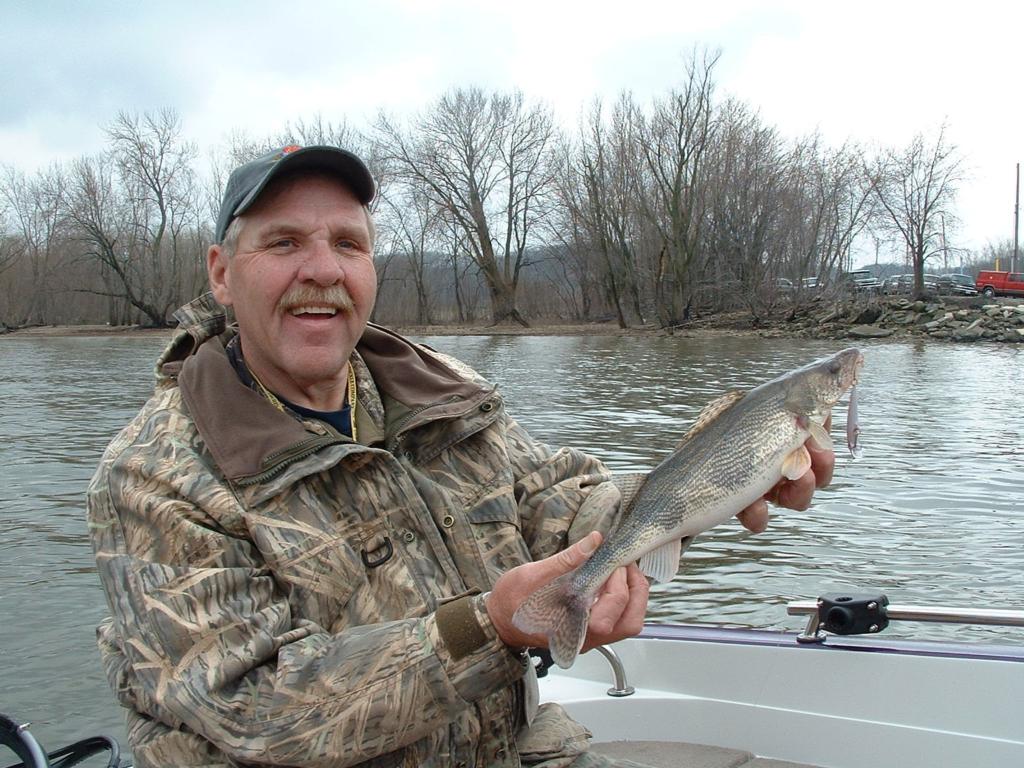 But it took astute tournament pros on tour to other destinations to transplant, test and refine the tactic even further. Wal-Mart FLW Walleye Tour pro Rick LaCourse of Port Clinton, Ohio, is a case in point. LaCourse has used the handlining technique to great effectiveness on rivers everywhere from the Mississippi to the Missouri to the Illinois to the Ohio.
“Anytime we encounter muddy river conditions on the tournament trail,” LaCourse said, “I always break out the handline during the practice period – even if local regulations limit me to using one line and lure. And I’ll use it during the tournament if applicable. The technique offers a combination of great bottom feel plus precision boat control to both fish small spots and cover water, no matter how strong the current.
“Besides, you know the fish hear the heavy weight and lures coming. There’s no way they could possibly miss it! And you can hover in place and let your lures wiggle in their faces for an extended period to trigger strikes. Under the right conditions – really tough, muddy water – it is the absolute deadliest method you can use for walleyes.”
Some folks, however, just plain don’t like it, or think there’s something fishy going on when they see someone hauling big walleyes over the transom two or three at a time. My observation is if it’s muddy, anglers would be well served to give it a try. Handlining is a finely tuned, precision technique that turns the tables back in your favor when Mother Nature clouds the big picture. And should some anglers still refuse to go hands-on, they might consider the following heavy-handed alternative.
Polelining
That same fateful day that I watched the handliners clean the clocks of 100 fishless jiggers, the wheels and gears began spinning between my ears. Not having the weird array of reels and cables and weights and such at my disposal, how could I match the loud, pounding presentation of a handliner creeping upstream?
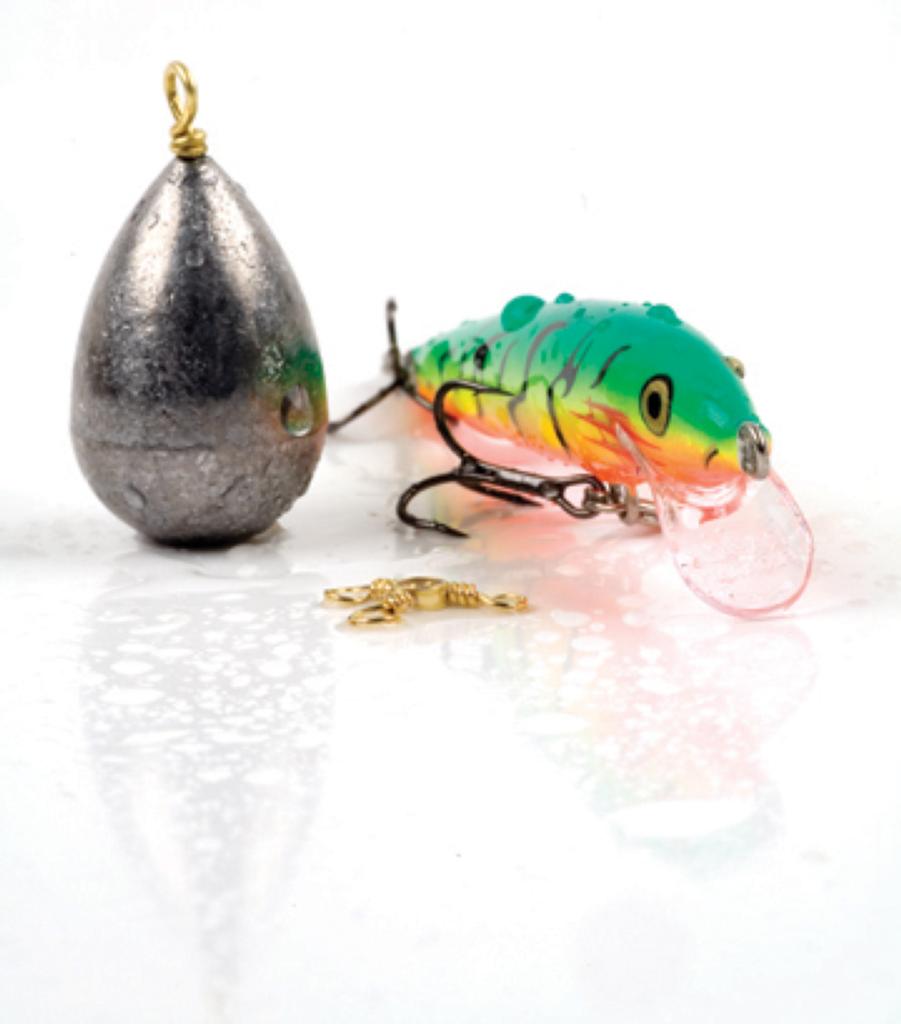 Rummaging through my tackle, I picked out the biggest (6-ounce) bell sinker I had, tied up a three-way rig and a Rapala Minnow and heaved it over the side. It felt like my casting rod might buckle and break every time I lifted and dropped the 2-ton rig on and off bottom. Yet even when limited to heavy, stretchy mono as opposed to no-stretch sensitive wire, I could clearly feel the thunk-thunk-thunk of the bouncing weight. It only took somewhere between 60 and 90 seconds before a 9-pounder slammed the lure. Just think what tripling the number of lures and increasing the tonnage and thunkage might have accomplished that day.
I make no claim to inventing this heavy-duty three-way rigging gig, because it wasn’t long afterward that the polelining technique arose among pro walleye anglers like Bill Ortiz. Basically, it was the same deal, often with wire line, although incorporating a short, stiff, muskie-rod-type setup to take the strain off both your forearm and tackle. The touring pros began plunking polelines into muddy rivers all across the country and, what do you know? They began ripping lips despite muddy conditions. It didn’t require the specialized equipment associated with the handlining technique. You could even use two three-way swivels to run two leaders and lures if desired.
Big jigs and leaping lizards
 Then there was the time up on the Rainy River, maybe 30 miles upstream from where it empties into Lake of the Woods, when Al Lindner, TV cameraman Rich Eckholm and I arrived about eight hours after an ice-jammed feeder river broke loose and a wave of mud came crashing downstream. “You should’ve been here half a day ago! They were really biting – a hundred fish a day!” Apparently, I’m getting better. Used to be, “You should’ve been here yesterday …”
We spent the morning drifting and jigging through our favorite walleye holes, garnering nearly one strike. Man, was it ever off! Undaunted, Al suggested we switch gears and tactics, anchoring in a known productive spot and casting to the fish that he just knew were there. “That’s where they live when they live there,” he proclaimed.
Al’s a big proponent of anchoring when the conditions are tough and there’s someone else along to lift and drop the anchor 30 to 40 times during the day. “Ooh, this next spot’s so good, I might have to blindfold you,” he promised. “Just get the anchor up and I’ll put you on fish. Lots and big! OK – drop the hook right about there, and tie it off while I get my bait in the water. No sense wasting time.”
Well, I’ve seen some miraculous turnabouts, but this particular April day was one for the record books. We anchored amidst a series of rolling sand dunes that crested at 7 feet and bottomed out at about 12, with pockets of calmer water between them as the current flowed over their tops and past their tips. As the anchor grabbed and the boat swung downcurrent over the deeper slot between dunes, the telltale bright band of a big fish appeared on the flasher, hugging bottom.
We cast out jigs and minnows, let them fall to bottom and tumble with the current. They were tumbling pretty fast. So we beefed up to heavier jigs that would barely roll, then held them. Pumped them once or twice. Paused 15 seconds. Shook them. Paused again. Thump – a bite! And a big one. Then another. Something was cooking.
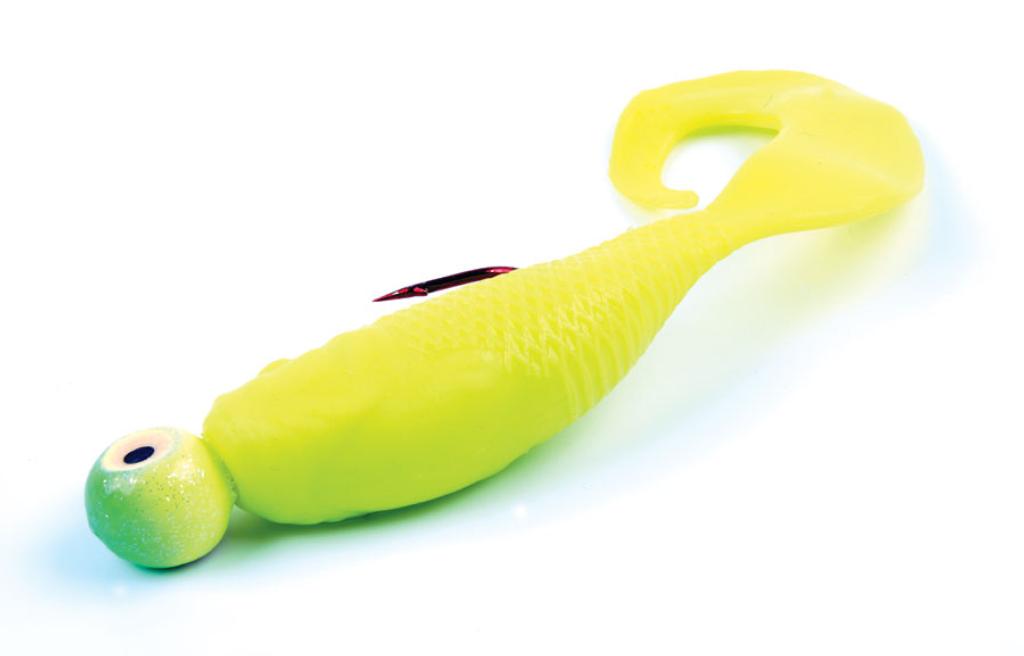 The rest of the day was spent experimenting. We went to bigger and bigger (1/2- to 5/8-ounce) jigs pounded on the bottom below the anchored boat, interspersed with long pauses when walleyes would move in, locate the bait and bite. We added rattles to our jigs. We upsized from small Fuzz-E-Grub jig bodies to larger 4-inch Power Grubs to, horror of horrors, 6-inch Berkley Power Lizards in wild, bright colors – plus a minnow or two on the hook for good measure! It seemed the bigger, bolder, louder and more obnoxious the presentation, the better it worked. Just as long as it was barely moving or literally held in place for a long duration, allowing fish sufficient time to find the lure via smell, sound, vibration, radar, voodoo or whatever.
All I know is we caught nearly 40 walleyes from 4 to 7 pounds, plus a few larger ones, in a couple of hours, from a handful of anchored positions. And the best we could tell, all the other boats on the river combined for a grand total of two or three little stinkers, because, after all, the fish simply weren’t biting.
Al firmly believes the fish are always biting, even in poor conditions. He thinks they just aren’t responding to the way you’re fishing. I used to argue with him, but not anymore; I’ve seen him pull the rabbit out of the hat too many times, just as I’ve often seen one or two tournament contestants blow away the field during tough conditions when you swore there were no catchable fish to be caught. Somebody dared to experiment or go contrary to ordinary, and it paid off.
The last resort
 Despite these loud and often obnoxious tactics for overcoming muddy water, sometimes the conditions get so bad there’s no shame in sending up the white flag for walleyes. If so, here’s another tip: Saugers tend to bite better in muddy water than walleyes and are often present in the same areas as walleyes – only deeper. And saugeyes bite even better than saugers when things get down and dirty. Saugeyes – the hybrid cross between walleyes and saugers – have such light-sensitive eyesight that they actually seem to relish wallowing in and feeding in mud. In the middle of the day with high sun, they’re right up there sucking on a drainage pipe where muddy water flows into a lake or reservoir. So if saugeyes are stocked in a reservoir near you, muddy water actually becomes a good thing. Here’s mud in your ‘eye!
You can switch tactics. Switch species. Even switch rivers or reservoirs – unless you’re in a tournament and stuck with the muck. If so, adaptation is the key. The fish are still there. But sometimes they just need to be plunked on the head, with patience and persistence, until you pound out a limit. So pump up the volume and slow down the pace. They’ll hear you coming. Just give them the opportunity to respond.