
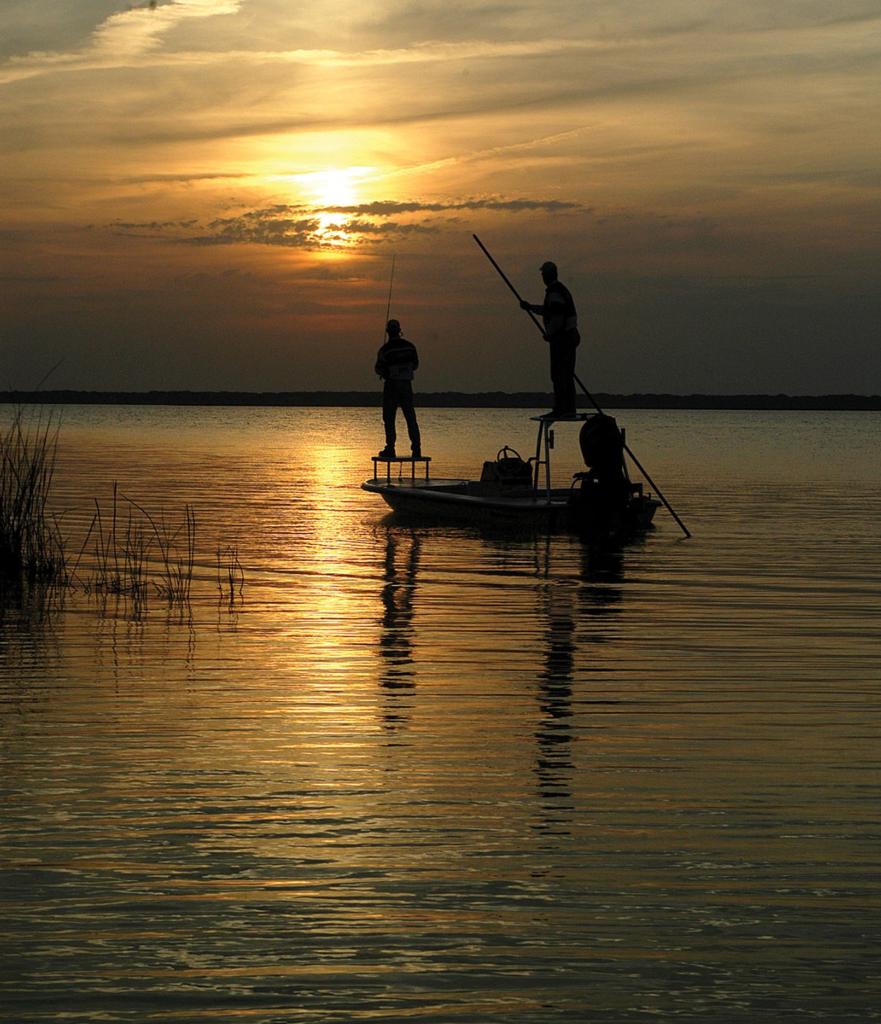
We waited silently, studying the water. An instant before, a pair of pale, pinkish-colored tails had punctured the surface. Just as suddenly, they were gone, disappearing in the grass and totally camouflaged in 18 inches of water. The tails popped up again and sank out of sight. Captain Andy Thompson cautiously eased the boat forward, trying to get me within casting range. A stealthy approach is paramount.
This is one-on-one; you and the fish. There are no excuses. The first cast has to count. Second chances prove to be a luxury. Sight-fishing for reds in skinny water offers an unparalleled angling challenge, demanding total concentration and attention to details.
A subtle wake indicated the fish were moving away, so I had to cast. The lure landed too close, and that pair of reds swirled with authority, leaving distinctive puffs of mud in their wakes. Nothing is more final than the hasty, unplanned departure of a redfish.
There are those who insist redfish have poor vision, but when you frighten enough of them before your lure even hits the water or by waving your rod in the air, you begin to change your opinion. If a redfish has its nose down, it may not see what is above it, but when its head is up and its body parallel to the bottom, a redfish is just as wary and wily as any other creature prowling the flats.
When you fish the flats, you face six different situations, including tailers, free swimmers, waking redfish, those that remain motionless, mudding fish or a school that flashes in the water. If a flat has potholes, you may very well find one or more lying in the depression with the hope of finding food. Learning to spot fish under these different scenarios takes practice.
 Nothing is more positive on a calm day than a redfish tail on a flat, waving back and forth like a flag. It doesn’t always happen that way. At times, only the very tip of the tail extends above the surface, or you may see the tip of the tail and the dorsal fin. When a red swims near the surface, it leaves a wake, and that, too, can be spotted fairly easily. On a windy day, reds tail less, and picking out a wake can be challenging.
Feeding redfish often create puffs of mud, or marl, that show for a brief period before the tide sweeps them away. It’s a telltale sign to the trained eye. Skippers like Captain Rob Gorta search for schools of reds by looking for mud puffs or being able to discern the underwater flashing of fish in a school as they move. With a school of redfish, Gorta is extra cautious. He slips an anchor over the side, rather than sticking the end of the push pole in the bottom, and then casts at maximum distance so as not to alert the fish.
The toughest challenge is finding redfish that are lying motionless with only part of themselves showing. If there is a key to success, it centers on not looking for a whole fish. You have to focus on parts, such as a head or tail. That’s why it’s essential to concentrate. When you fail to see one, you’ll know it in a hurry when the red blasts out of there. Researchers tell us that a spooked snook only moves off a short distance, but reds travel much farther and tend not to return.
Shallow-water fishing requires a delicacy in presentation. You don’t want a bait or lure to slam into the water, but rather enter it silently and suddenly appear in front of the fish in a natural manner. Veteran flats fishermen rely on sidearm casts that keep the rod and the lure low to the water. Once the red knows you are around and becomes alert, fooling it is increasingly difficult. It can be done, but your chances diminish dramatically even if the fish doesn’t move away.
 Before you make the first cast, try to identify the eating end of the fish. This may sound basic, but it isn’t always easy to figure out. Wait until you are a comfortable distance from the fish and try to place the lure in front of and beyond it. The idea is to make the lure look as if it is trying to escape. Remember that no predator expects to be attacked by its prey. If the lure comes right up to the redfish, you can almost bet your target will know something is wrong and flee the scene. Sometimes, however, a redfish has its head down and just doesn’t see the lure. In that case, reel in and quickly cast again.
Redfish react almost instantly and strike without hesitation. Their broad tails enable them to whirl and pounce on anything that swims within reach. A basic rule of flats fishing states that you can’t make a good cast out of a bad cast. If you miss your target and the preferred landing zone for the offering, don’t retrieve it with the hope that the fish will change course and find it. Instead, reel in as fast as possible and try to get off a second cast. The window of opportunity on the flats doesn’t last very long. It becomes a game of read and react.
There are a couple of caveats that might help. With tailing fish, you want the lure to appear just as the red finishes rooting. If it sees the lure at that instant, it thinks it flushed something out of the grass and usually strikes without hesitation. When you see a wake coming toward you or crossing, remember that the disturbed water is trailing off the dorsal fin near the middle of the back. The head is well forward of that. Too many anglers use the V of the wake as the target and make a poor cast. The same goes with puffs of mud; the fish are usually forward of that mud by the time you are ready to cast.
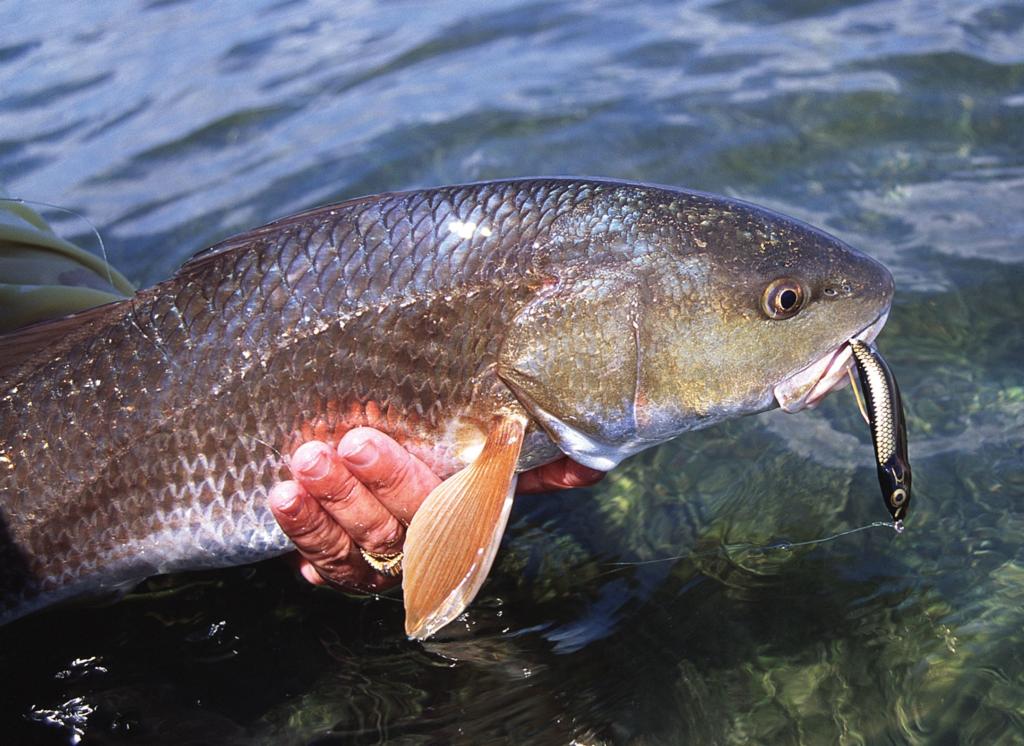 Tides and currents play an essential role in where the fish will be and the best way to present a lure. Redfish generally face into the flow of water. When they are moving, they tend to feed into the flow for a number of reasons, including the fact that any tasty morsel moving about will come toward them. Working into the current helps them to tail and to ferret out goodies from the bottom because the mud is being carried away behind them.
The stage of the tide can be critical in determining where on a flat a redfish will be. If you don’t know the area, start on the first of the incoming tide and follow the flow of water farther and farther up on the flat. This early tide is ideal for tailers as is the last of the outgoing tide. When the tide is falling, you have to be careful not to get stranded as the water gets shallower. A miscalculation will prove memorable.
Sometimes, redfish don’t move up on a flat as fast as you would think, and they can linger longer on falling water than you want them to. As you scan the surface for tailing reds, waking fish and mud puffers, be sure to occasionally look behind you to make sure you haven’t overrun the fish. Sharks offer a good barometer of where redfish are going to be. They are usually in the area where the action takes place. If you’re not finding fish, look for the sharks and stay at about the same depth that they are patrolling. It may pay off.
No matter what tackle you choose to use, stalking redfish on shallow flats ranks high on the list of angling challenges. As a word of caution, it can become addictive very quickly, but it’s a nice habit to cultivate.