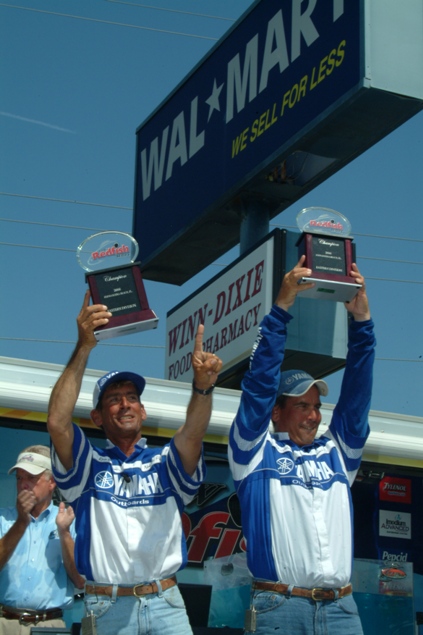
FERNANDINA BEACH, Fla. – For those who don’t believe that little old redfish can make grown men’s voices quiver and their eyes well up with tears, proof of it could be found at the Fernandina Wal-Mart Saturday as brothers Ron and Chris Hueston took their first professional redfish victory at the FLW Redfish Series.
Actually, “little” redfish might be a bit of a misnomer as the brothers sacked two large redfish weighing 11 pounds, 14 ounces to win the Wal-Mart FLW Redfish Series Eastern event by 4 ounces with a three-day total of 34 pounds, 7 ounces.
“I feel like a huge weight has been lifted off me,” Ron Hueston said after the team collected the $37,500 winner’s check. “Chris and I have been at this for six years, and we’ve been so close so many times. We’ve been consistent, but we’ve badly needed a big win to take us to the next level, and it’s finally happened.”
The Huestons put in their time in Fernandina to bring victory to fruition. For five weekends in a row, the team scouted areas very close to Fernandina Beach and Amelia Island to find winning redfish.
“We’ve been coming to the Jacksonville (Florida) area for years in other tours,” Ron Hueston said. “And everybody knows where the good spots are. When Chris and I started scouting here weeks ago, we came here with a plan to throw all those well-known places out the window and start from scratch, finding new places that no one else fishes.”
During each weekend of scouting, the team would spend entire tidal cycles in new areas around Amelia Island, determining if redfish were present, and the effort paid off.
“We found one place here where big redfish would stage on falling water,” he continued. “As soon as the high tide turned and the water started falling, the fish would collect on this set of oyster bars and grass points – and that turned out to be our ace in the hole.”
The team started each day by running to the Sisters Creek area near Jacksonville to secure a limit at low tide on Bass Assassin Saltwater Assassin soft plastics.
“We wanted to make sure we had two redfish first,” Hueston said. “Then we went after the big ones.”
 Then the team would run all the way back “near the ramp” to their big fish spot where they would stake down with a Powerpole and wait for the falling water to bring the bigger fish to them.
“The smaller fish in the Sisters Creek area came on soft plastics,” Chris Hueston said. “But once we got back up here, we went to a Rapala Skitterwalk topwater and a 1/4-ounce Booyah Samurai Blade spinnerbait to fish grass points and oyster bars where the fish were holding as they came out of the grass.”
“During the tournament, all of our bigger fish came from up here (Amelia Island area) on the topwater and spinnerbait,” Ron Hueston said. “Each day that place produced at least one big fish, which put us on top.”
Hendrick-Gamrot takes second
Finishing in the runner-up spot were Randy Hendrick of Clearwater, Fla., and Bret Gamrot of St. Petersburg, Fla., with a three-day total of 34 pounds, 3 ounces worth $11,000.
The team brought in the biggest pair of redfish of the day, weighing 12 pounds, 2 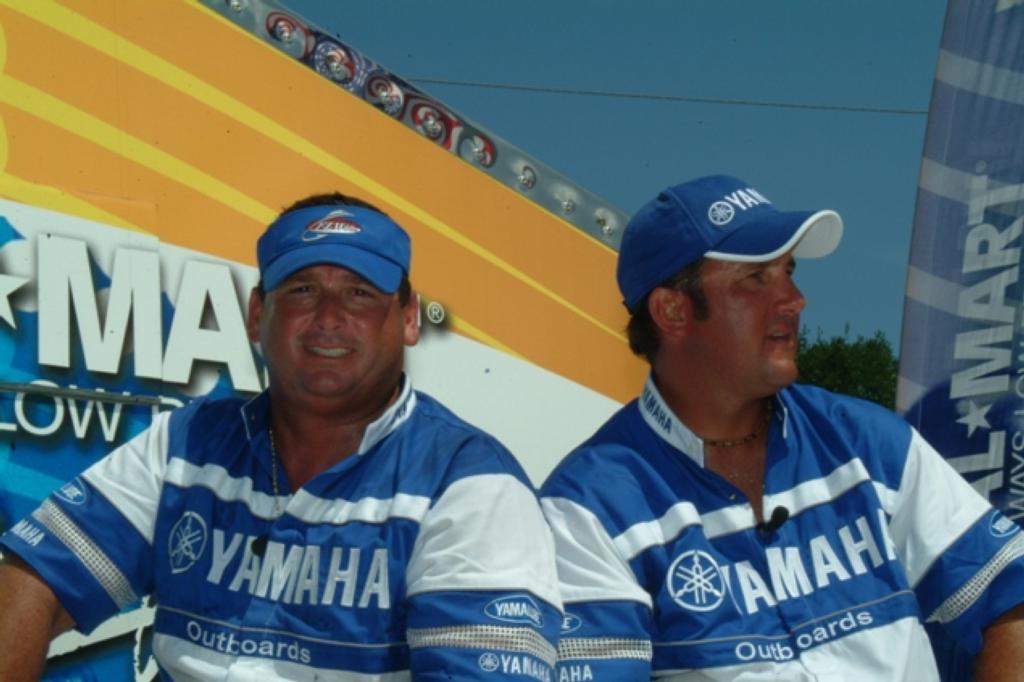 ounces, but it wasn’t enough to hold off the Huestons.
Hendrick and Gamrot fished along the Intracoastal Waterway in the Sisters Creek area near Jacksonville using Gulp Shrimp on a 1/16-ounce Mission Fishing jighead.
“We were concentrating on creek mouths that dumped out into the Intracoastal,” Hendrick said. “We would stake down at the mouth of a creek or small bay and fan-cast around for 30 minutes to an hour trying to intercept fish that were migrating in or out with the tide.”
Guthrie-Murphy comes up short of third RFS win
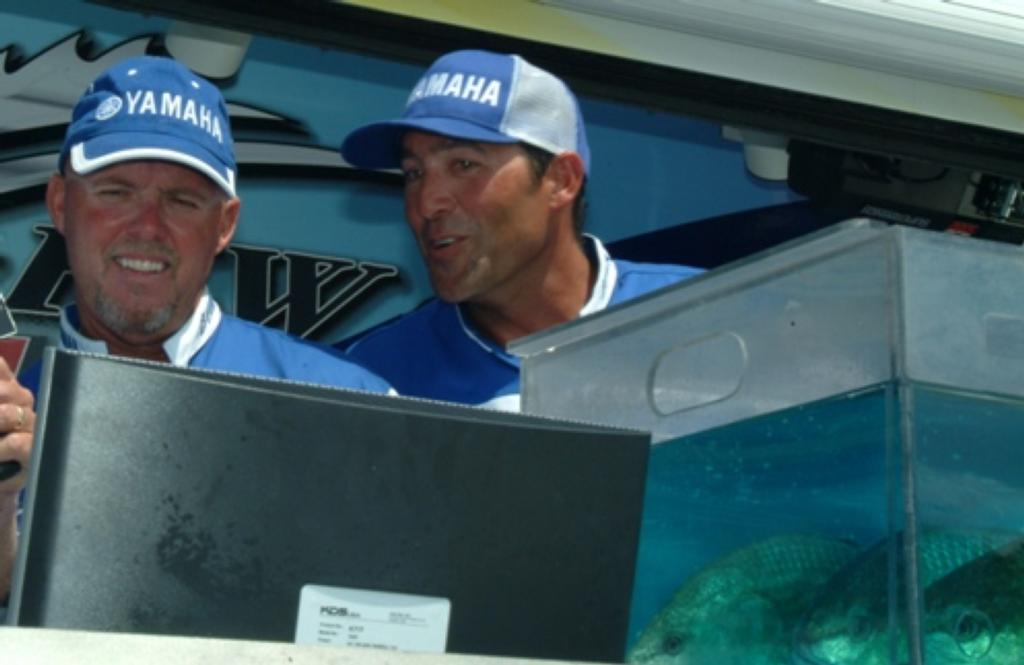 Two-time FLW Redfish Series winners Scott Guthrie of Jacksonville, Fla., and Rick Murphy of Homestead, Fla., finished third with a three-day total worth $5,624.
The team fished the Sisters Creek area, forcing their way back into creek ends by poling over nearly dry ground.
“Normally we sight-fish these areas” Murphy said. “But the water was so low, it had the fish congregated into little bowls and troughs, and we had to do more blind-casting than sight-fishing.”
On low tide, the team relied on Exude crabs and weightless RT slugs. But on high tide, they resorted to topwater Rapala Skitterwalks.
“A lot of people think topwater is just for mornings and evenings,” he said. “But once the tide got high over the oyster bars, we threw topwaters in the middle of the day, and it produced several of our better keepers.”
Girle-Harris duped by dolphins
Warren Girle of Long Boat Key, Fla., and Billy Harris of Bradenton, Fla., got a little  surprise when they arrived at their best fishing spot this morning.
Instead of sighting hungry redfish feeding on helpless shrimp, they sighted hungry dolphins feeding on their helpless redfish.
“It was such a shock,” Girle said. “We were way back in a tidal creek, and these large dolphins were up there in just a few feet of water having a field day, eating everything in sight. They were thrashing and slashing water 8 to 10 feet into the air. Even though we were not too happy about it, it was a spectacular sight. Our cameraman got a lot of it on film, so it should make for an exciting show.”
Needless to say, the team determined that even if the redfish had escaped with their lives, they probably were not going to be real hungry for a while, so the team moved on to a backup area and caught a couple small keepers to salvage the day.
Girle and Harris ended up fourth with a three-day total of 29-07 worth $5,624.
Hughes-Laramy take fifth
 Day-two leaders, Scott Hughes of Punta Gorda, Fla., and Mike Laramy of Tampa, Fla., dropped to fifth today with a three-day total of 28-12 for $5,250.
The team fished in the Intracoastal Waterway near Jacksonville.
“We had a high-water spot and a low-water spot,” Laramy said. “The low-water spot was basically a creek mouth that dumped out into the Intracoastal, and it was the best spot. The high-water spot was up in the St. Johns River, and it was basically a nice grass edge.”
When fishing the low-water hole, the team used a Berkley Gulp 3-inch shrimp, rigged weightless.
“A natural presentation was a big key there,” Laramy noted. “It’s a popular area, which receives a lot of pressure. Using a weightless presentation of that smaller Gulp Shrimp, drifting over the bottom with the current, looked more natural.”
On the high-water spot, the team relied on Exude Tubes and RT Slugs.