
A summer tournament with blazing heat, bright blue skies, 48 of the best bass pros in the world, the pressure of fishing for $500,000 and possibly the meanest bass in North America – Coosa River spotted bass – make for four extremely challenging days on the water. Add the fact that you must beat two different competitors in a bracket-style format to advance to the final round, where you must beat 11 other anglers, and you’re looking at a whole new degree of difficulty. You can’t just luck into a big school of bass, build up a huge lead and coast the last two days as your fish dwindle. You have to fish better than your opponent each day. Those were just some of the challenges facing competitors at the 2006 Wal-Mart FLW Tour Championship.
So who won this year? Brent Ehrler of Redlands, Calif., claimed the title at Logan Martin Lake near Birmingham, Ala. He won with a final-day limit of Coosa River spots weighing 15 pounds, 1 ounce.
How did he do it? The answer is with a little worm and a big stick. But everyone at the championship was throwing little worms on long spinning rods. So why did Ehrler catch larger fish?
The arsenal
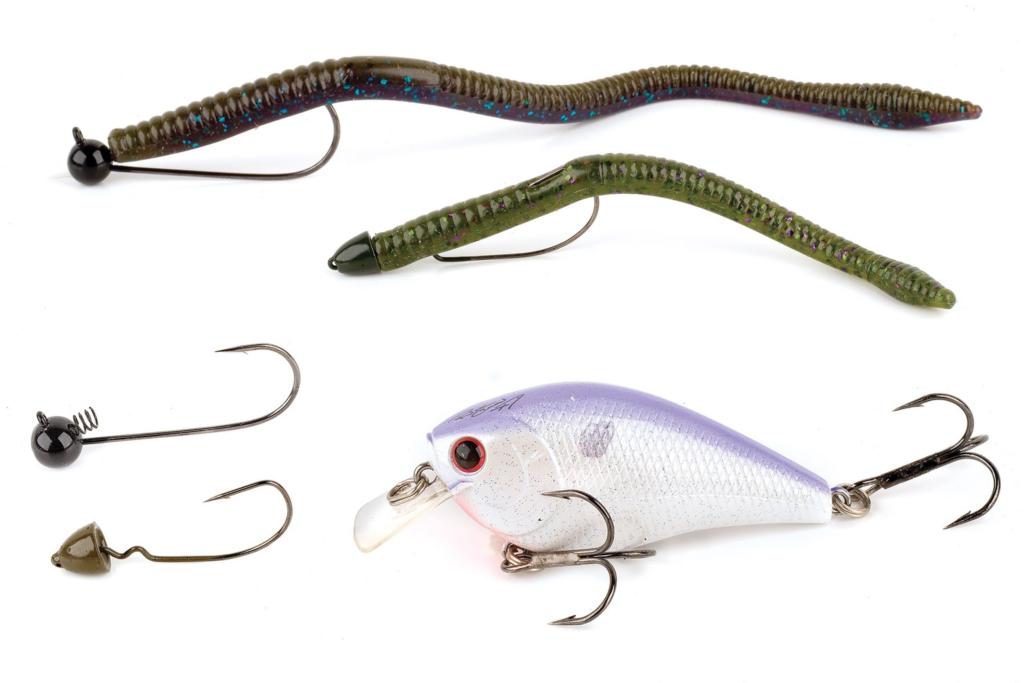
The staples of Ehrler’s final-day, limit-producing arsenal were finesse worms and jigheads. Specifically, he threw three different finesse worms during the event – a NetBait T-Mac Worm in Bama bug, a NetBait finesse worm in summer craw color and a Reaction Innovations Flirt in chartreuse and green pumpkin. He fished the larger T-Mac worm on a 1/8-ounce Reaction Innovations Screwed-Up Jighead, and he threw the smaller finesse worms on a 1/8-ounce Tru-Tungsten Weed Wacker.
“I liked the Reaction Innovations head because it has the best keeper on the market,” Ehrler said, “You can skip the bait better on that head because the worm doesn’t fold up on you on the skip like it does on many other heads. At times, I was skipping that worm 25 feet.
“The Tru-Tungsten head was better with the smaller worms because the overall rig is lighter, and I could feel bottom a lot better with that tungsten head with the smaller worm.”
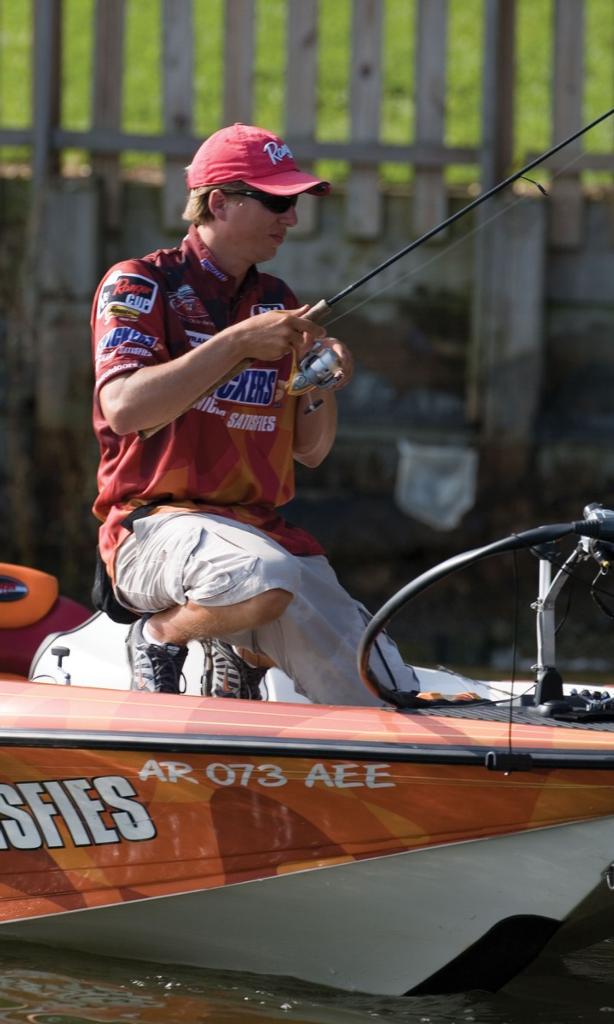
OK, so it’s not terribly surprising Ehrler was using the same basic finesse rigs as other competitors. His equipment was a bit of a break from the norm, though. He used a 7-foot, heavy-action, prototype rod made by Lucky Craft with a slow taper on the tip for casting smaller baits. “The heavy-action fishes more like a medium-heavy rod because of the soft tip, but it has the backbone to set the hook and move the fish your direction immediately, which was paramount for what I was doing in the tournament,” Ehrler said.
 Ehrler fished the jighead worms on 8-pound fluorocarbon and a large-spool spinning reel. “Fluorocarbon is a great line, but it can be hard to use on a spinning rod and reel because it’s stiffer than monofilament and has more memory,” he said. “But, if you put it on a large-spool reel, you aren’t coiling the line as tight or changing its natural coil from the filler spool as much. I used a Daiwa Sol 3000 reel because it has such a big spool, and I never had one problem with line twists or birds’ nests.”
Fluorocarbon may have been an even bigger factor in his catch on the final day. “I had a fish break me off the second day because of my drag,” Ehrler said. “I had it set just like I wanted, but those fish are so powerful that I set the hook and he immediately took control and got me hung up where I couldn’t get him out.” Ehrler adjusted by tightening his drag and letting the increased abrasion resistance of fluorocarbon make up for it.
“I set the hook hard, even with 8-pound line,” he said. “I probably do it a little too hard. But, having good line and a strong rod helps get the fish going your direction. They will still wrap you around things under those docks, but those first few seconds are critical.”
On the last day, Ehrler hooked a fish way under a dock, and the fish wrapped him around three different pilings. When he finally got him out from under the dock, he loosened his drag – as he does with all fish in open water – and it ran under the boat. He spun the boat to chase the fish up the bank, and it got down into a brush pile. He had to seesaw the fish out of the brush pile and finally into the boat. It was a 3 1/2-pounder that culled a small fish. Ehrler had abrasions and scars up his line for 20 feet, so he cut it off, retied and went back to work.
“After fish are in open water, I back the drag off so they can run and tire down a bit,” he said.
He only broke off one fish on the last day, and he blamed himself rather than his equipment. “A big fish bit me right off the bat that morning,” Ehrler said. “It was real close to the boat, and I was overly excited. I swung as hard as I could, and with fluorocarbon, there isn’t as much stretch. So I swung with too little line out, and it broke on the hookset. After that, I calmed down and didn’t break off another fish.”
The game plan
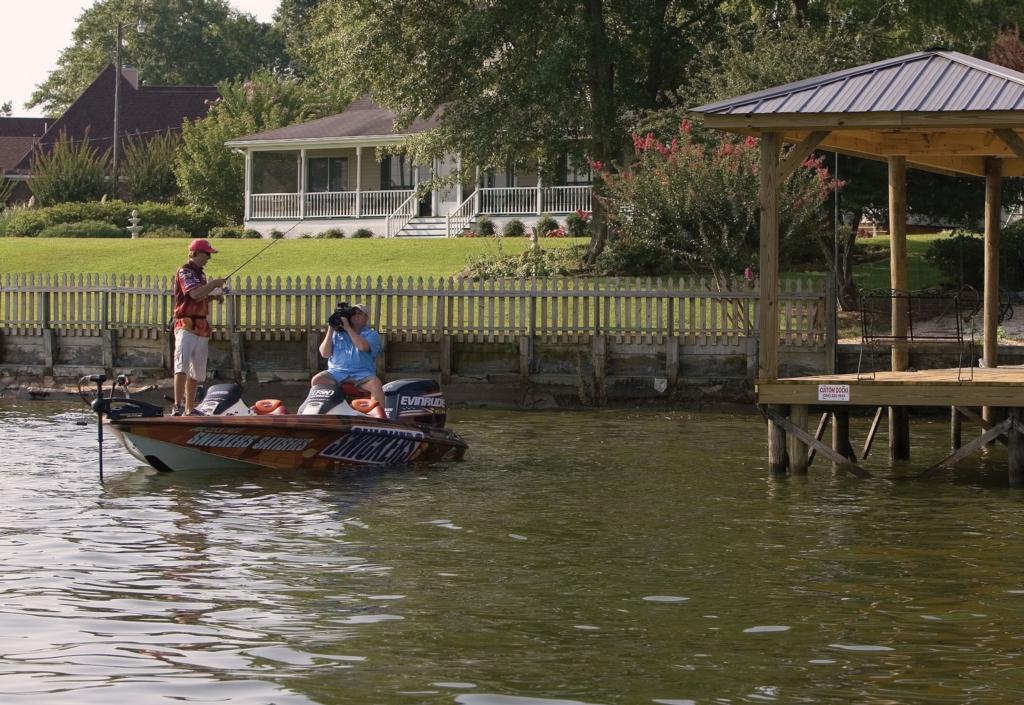 Over the course of the first three days, Ehrler was hitting both offshore spots and one stretch of docks. Each day he caught some average fish on the deep points and brush and then upgraded a fish or two on the docks.
He had four offshore spots scattered throughout the lake that were basically points. He fished a Lucky Craft Flat CB D-20 and shaky-head worms there.
“If you could hit a stump or a piece of brush, you’d say to yourself, `there’s something,’ and a bass would bite,” he said.
The crankbait caught a lot of fish for him in practice but, with the lack of current, not during the tournament. Ehrler could still find brush with the crankbait, cast the worm in and get bit, but the fish weren’t the same quality he had caught in practice.
In fact, the bass he caught in practice came on a topwater lure on seawalls; but the 7 a.m. launch ended any topwater chances for the tournament.
By the time the fourth day rolled around, Ehrler had come to the realization all his heavier bass had come from one stretch of docks. So he gave up his offshore spots. He fished shaky heads under the docks and a Lucky Craft RC 1.5 crankbait on the seawall stretches between the docks. The crankbait accounted for three bass the first three days but none on the last day.
“I just told myself if I was going to have any shot of winning that tournament, it would have to be with all big fish from the docks,” Ehrler said.
The attack
His docks were on a main-lake stretch a few hundred yards long with seawalls and water ranging from 2 to 12 feet deep. There was scattered brush, but Ehrler was quick to point out the brush was not what led him to the fish.
 “Really, I didn’t catch many bass in the brush. I don’t know if they were in those hard-to-reach places or if they were just under there swimming around or what, but the brush really wasn’t key,” he said.
What was the key?
Ehrler approached each dock, looked at the posts and the cross beams under it and decided what casts he could make that would bring the worm by as many posts and pieces of the dock as possible.
“I would skip it under there 20 feet and then shake it on slack line like we fish a drop-shot out West,” Ehrler said. “We just want to touch the weight of the jighead without moving it, so you’re just shaking the slack and barely moving the worm. So I shook it in place on slack line for a while; then pulled up my rod tip, reeled in the slack and shook it there for a while. I did that all the way back to the boat.”
Ehrler would work the bait by one side of each post. Then he would slightly move the boat to change his angle and work the worm by the same posts on the opposite sides. It was a painstaking approach that made him take 30 minutes to fish each dock.
“I would look at the dock for a while and figure out how to skip my worm into the hardest spots under there,” he said.
It didn’t always work out perfectly, either. There were big risks on the skips, and Ehrler lost more than 70 jighead worms under docks during the four-day event.
“If I got hung up, I knew there was going to be a fish under there, so I didn’t want to go in and spook the fish by trying to unhang my jighead. I would just break off and retie another one. Several times I would break off, tie on another jighead worm, make a cast and catch one on the very next cast – usually a good one.”
Ehrler said there was not a good explanation for why the fish were biting. “I don’t know if it was the angle, the spot under the dock or that the fish were just roaming around under there and you would eventually get the lure near one,” Ehrler said. “Sometimes they would bite it on the fall, but most of the time, the big fish actually bit the worm while it was shaking on the bottom.”
Ehrler made only two passes down his now infamous stretch of docks the final day and landed 12 to 15 keepers.
“I actually fished down it really slow on the first pass, being sure to pick through each dock; then I left the area and came back later in the day. I culled out two fish with 3-pounders on the second pass, so that’s why I say there wasn’t much rhyme or reason to the bite.”
In the end, a strong rod, a finesse worm, tough fluorocarbon, persistence and confidence in what he had learned the first three days of the event were enough to overcome another impressive performance by Ray Scheide of Russellville, Ark.
“I really thought the tournament launching so late each morning was going to kill my chances,” Ehrler said. “I was catching a limit by 7:30 each morning on topwaters. I was thinking the 2-pounders I was catching were going to be my big fish, and I would struggle to catch anything after 7:30.”
As it turned out, the 2-pounders weren’t the biggest fish he caught and starting at 7 a.m. wasn’t too painful after all. “Launching so late hurt me,” Ehrler said with a smile, “but not too bad.”