Occasionally, a bass lure comes along that is hard to describe without sounding like a late-night TV ad: A lure so effective it knows no regional or seasonal boundaries … so effective it catches not only largemouth bass, but spotted bass and smallmouths as well … but wait, there’s more …
Currently, in the professional ranks of bass fishing, there is a lure that comes pretty close to such amazing claims.
No, it’s not the Helicopter Lure or the Flying Lure. In fact, the biggest problem with this particular miraculous fish catcher is that it does not have a flashy name.
Instead, it hides under a myriad of monikers, including the jighead worm, shaky head, ball head and even dink-head worm.
Whatever the local colloquialism for the tiny leadhead teamed with a featureless finesse worm, there’s no doubt it has become a universal fish catcher in FLW Outdoors events on lakes and rivers from coast to coast.
On the Wal-Mart FLW Tour, it has been single-handedly responsible for two $500,000 victories in Wal-Mart FLW Tour Championships. In the inaugural year of the Wal-Mart FLW Series, it was the key player in two $100,000 wins.
If there was any way to compute the amount of money won in all FLW Outdoors bass events in the last five years on the jighead worm, it would be mind-boggling. And the irony is the entire lure costs about $1.09 – and that’s for the most expensive models.
The jighead worm is a derivative of the old doodling rig, which is essentially a small finesse worm Texas-rigged on a 2/0 hook, topped with a 1/8-ounce weight and fished on light line with a spinning rod.
But the problem with the doodling rig is that once the worm hits bottom, it has a tendency to lie down horizontally, robbing it of action.
A lead jighead fixes that problem. By Texas-rigging the worm on a jighead, the worm’s tail is forced to kick up with twitches of the rod tip, producing a realistic-looking bottom-dwelling critter that pecks its way across the bottom.
Over the last few years, jighead designers have come up with a variety of effective designs that enhance this tail-up posture of finesse worms, thereby creating one of the most effective fish foolers of the last decade.
Two FLW Tour pros who have demonstrated mastery of the jighead worm are Chevy pro Luke Clausen of Spokane, Wash., and BP pro Shinichi Fukae of Mineola, Texas.
Clausen proved exactly how effective the jighead worm was in 2004 when he won the FLW Tour Championship on Logan Martin by fishing the tiny worm around boat docks.
Fukae used a jighead worm to win the 2006 Wal-Mart Open on Beaver Lake.
Besides these victories, both anglers have pocketed thousands of additional dollars with this simple rig.
“It’s just something I have a lot of confidence in,” Clausen said. “I’ve won way more money with it than anything else in my boat.”
Why the jighead worm?
Perhaps the most burning question bass anglers have about this tiny worm rig is: why do so many fish across so many species and environments find it appealing?
Both Clausen and Fukae laud the small bait’s natural appearance as an answer.
“It probably appeals to a fish’s curiosity more than anything,” Clausen surmised. “Here comes this little thing, pecking along the bottom, kicking up a dust trail. It looks like a minnow or darter or maybe a small crawfish – but whatever it is, the only way the fish can investigate it is with its mouth, so it sucks it up.”
 “The jighead worm looks like so many things bass eat,” Fukae noted. “Whether in Japan, or the United States, West Coast lakes, rivers, Great Lakes or ponds, a little worm on a jighead looks like good bass food everywhere.”
Fukae honed his finesse-fishing prowess in Japan where thousands of anglers harvest bass from tiny ponds, rivers and ditches, making fishing pressure a primary obstacle.
Ironically, Fukae came to the United States to get away from finesse fishing and to employ the power techniques of American bass pros, but more often than not, he has to resort to his finesse-fishing roots during tournaments.
“I like shallow jigs, crankbaits and spinnerbaits,” Fukae said. “But there is so much fishing pressure by the time a tournament begins that it’s like fishing lakes in Japan, and I have to go to finesse fishing during the tournament.”
Clausen also believes the lure’s slinky entrance into a fish’s strike zone contributes to its effectiveness.
“Most other lures, like jigs, spinnerbaits and crankbaits, announce their presence with a loud splash or bulky vibration,” he noted. “But a jighead worm is so quiet and natural; it just shows up in the strike zone. It’s as if the bass discovers it naturally, and I think that goes a long way in convincing the fish to eat it.”
Jighead specifics
The beauty of the jighead worm is its simplicity. Though dozens of jighead manufacturers have improved the minute bass trap with shaped heads, special worm-locking devices and slick paint jobs, the basic bare leadhead in a 1/4- to 1/8-ounce size with a 2/0 or 3/0 hook will still work. In fact, some pros still pour their own plain heads in bulk.
But finesse fanatics Fukae and Clausen have become rather particular about the specs of their jigheads. In fact, both rely on friends to pour heads to their exact specifications.
Examining the preferences of both anglers’ technical designs brings several things to light. For one, both pros have settled on the 3/32-ounce size as being the best all-around size.
“It used to be that 3/16-ounce and 1/8-ounce were the common sizes,” Clausen said. “But the more I learned about the importance of a natural appearance and fall of a jighead worm, the lighter I made my heads. I began drilling out and shaving down 1/8-ounce heads to smaller sizes – not quite a 1/16-ounce – but somewhere between 1/16 and 1/8, which is about a 3/32.”
Clausen uses all three sizes – 1/16, 3/32 and 1/8 – with 3/32 being his favorite.
“The clearer the water, the lighter I go,” Clausen advised.
Fukae also favors a 3/32-ounce head for most of his fishing down to 20 feet and a 1/8-ounce when he needs a faster fall to deeper depths.
In terms of hooks, Clausen prefers a 3/0, and Fukae uses a 2/0, though Fukae did mention the gap on his current hook could stand to be a little wider.
Where the two anglers differ most in their designs, however, is in the line tie, which has been an ongoing dispute among jighead specialists for years.
The difference of opinion exists between the attributes of a traditional 90-degree in-line line-tie and a 60-degree flat-eye line tie.
Clausen has become a big believer in the 60-degree flat eye, which means the line tie is “flat” instead of in-line.
“Most traditional jigheads have a 90-degree in-line line tie, where the line tie is in line with the hook point,” Clausen explained. “The problem is your knot can slide around to various points on the hook eye, constantly changing the tension point on the head.
“If your knot slides all the way around and down to the nose of the ball head, your line is basically in line with the worm, and the head will no longer kick up when you’re shaking the bait. It’s basically like fishing a Texas rig with a bullet weight – your worm just lies on the bottom. A flat-eye tie at 60 degrees guarantees your knot won’t slip around to different angles, keeping the tension point more consistent. Every time you twitch the rod, the tension on that 60-degree flat eye forces the entire hook and worm to stand up, imparting a lot more action to the worm.”
Fukae uses the standard 90-degree in-line tie and said it works great for him.
Another variation found in differing jigheads is the way the jighead secures the worm to the head.
Back in the good ole’ days of traditional stock ball-head jigs, the only option was to Texas-rig the worm onto the shank. The problem, however, was the worm would slide down the shank and ball up on the hook during the hookset, impeding penetration.
In the jighead-worm craze of the last five years, nearly a dozen ingenious designs have been made to help secure the worm head up on the shank and prevent sliding. From screw locks to barbed keepers, many of these innovations are effective, and deciding which one is best is really up to the angler.
 Clausen is partial to the screw-lock design and has taken all the specs of his favorite homemade jighead to Picasso Outdoors to mass-produce a head that will be called the Shakedown (see the related sidebar for other specialty jighead brands).
Fortunately, the plastics portion of the jighead-worm rig is not nearly as tedious to address as the head. Almost any brand of finesse worm will work as long as it is in the 4- to 7-inch size range and green pumpkin or watermelon in color.
Clausen prefers Berkley’s PowerBait Shaky worm while Fukae favors Yamamoto’s 3 3/4-inch Shad Shape Worm or a 5-inch Kut Tail Worm.
In terms of jighead-worm equipment, Fukae uses 6-foot, 6-inch rods in a medium-light action.
Clausen likes to use drop-shot and shaky-head rods, which are both 6 feet, 10 inches in length.
“The drop-shot rod is a little more limber in the tip. It is the one I like for skipping docks because it loads up a skip cast a little better,” Clausen said. “The shaky-head rod is a little stiffer for setting the hook in deeper waters.”
For line, Fukae goes with 6- and 8-pound-test Yo-Zuri fluorocarbon.
Clausen has settled on braided line fused with a fluorocarbon leader. He uses 10-pound-test Spiderwire Stealth braided line tied to an 8-foot leader of 8-pound-test Vanish fluorocarbon.
Where and when
The most interesting aspect of the jighead worm, as revealed by tournament trails across the nation, is the lure seems to have no bounds in terms of season, region or species.
“Impoundments, rivers, lakes, clear water, dirty water, shallow water, deep water, warm water, cold water – it really doesn’t seem to matter where or when,” Clausen said of the best applications for the jighead worm. “It used to be considered a clearwater technique used specifically for spotted bass. Heck, now I use it all year long from Okeechobee to Kentucky Lake to Lake Champlain.”
Fukae likes to target specific pieces of underwater cover with a jighead worm. During a tournament practice period, he will mark anywhere between 100 to 200 GPS spots where he has found a single brush pile, piece of timber, underwater break or isolated rock.
When he returns during the tournament, he says boat position is critical to hit the target with the cast.
“I will only cast three times to the structure,” Fukae said. “If I don’t get any bites, then I go to the next one, make three casts and so on. Even though I am finesse fishing, I’m trying to cover lots of water and lots of structures.”
Clausen is not as particular with his jighead worm.
“I throw it everywhere,” he said. “One of my favorite places to throw it is around shallow cover in stained water – anything that `looks perfect’ for a spinnerbait or jig – because that’s probably all those fish have seen.”
The list of top bass pros tying on jighead worms, especially ones who swore they never would, is growing. Many dedicated power fishermen are learning that if they don’t soon adapt to the ways of the wispy rod and light line, pickings can get slim at the weigh-in and check lines, particularly during a four-day tournament. Jighead worms are being regarded as survival tools as much as anything by many pros, but as Fukae and Clausen have proven numerous times, they can be winning tools as well.
Becoming a leadhead
Jighead worming is more than a technique; it’s a frame of mind. For those partial to heavy-action rods, locked-down drags and rope for line, jighead worming may take some getting used to.
“It’s definitely a different mindset,” Luke Clausen said. “Many jighead first-timers simply work the bait too hard – they’re used to a 1/2-ounce jig or 5/8-ounce worm weight on a flipping stick. Working a 3/32-ounce jighead with that same force makes the worm look unnatural, which defeats the purpose.”
Clausen also noted the term “shaky head” may be a bit of a misnomer since this encourages jigworm novices to shake the rod like a tambourine.
“A jighead worm is easy to overwork, negating its effectiveness,” he emphasized. “Many times I simply drag it along while holding light tension on the line, feeling the bottom. And when I do shake it, I’m just lightly shaking the slack in the line, because that’s all it takes to make the worm kind of `peck’ at the bottom.”
As for hooksets, go easy.
“For hooksets, I sweep the rod and reel into the fish easily,” Shinichi Fukae explained. “A hard hookset is bad.”
Not only is a hard hookset risky on 6- and 8-pound-test lines, but Fukae said a hard, violent set tends to startle a fish, making it panic and go wild. Leaning back and loading the rod while reeling into the fish doesn’t seem to startle the fish as badly.
Finally, both anglers fine-tune their drag systems so the drag gives when the rod is loaded up.
Jighead options
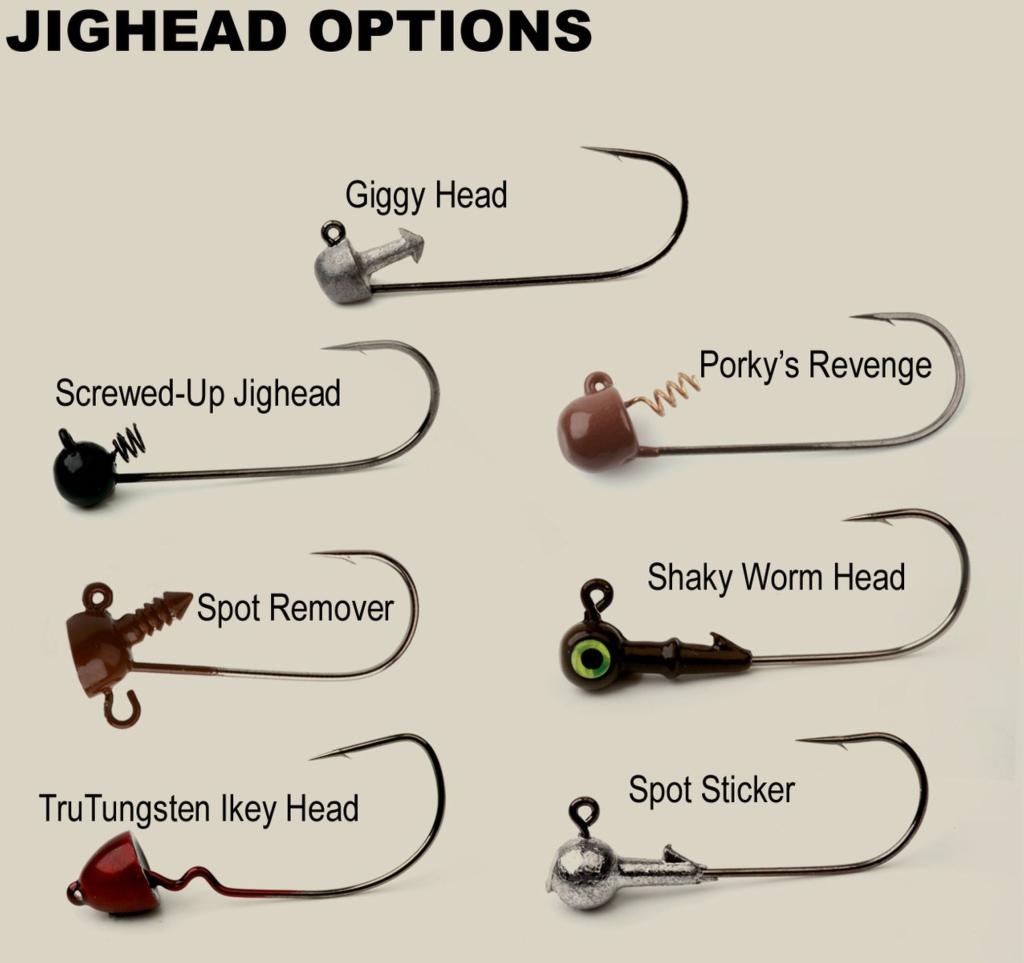
If you’re looking to find the perfect factory jighead, here are a few options:
Giggy Head (gambler-bang.com) – The Giggy Head, with its unique arrowhead-shaped keeper, is a proven, effective jighead design.
Porky’s Revenge (hoerntoadtackle.com) – FLW Tour pro Sean Hoernke’s Porky’s Revenge jighead is available in 4/0 and 5/0, with four weight sizes of each.
Screwed-Up Jighead (reactioninnovations.com) – this design features one of the best screw-lock worm keepers on the market and a flat-eye line tie.
Shaky Worm Head (davisbait.com) – This is the original specialty jighead that started the “shaky-heading” revolution.
Spot Remover (buckeyelures.com) – This uniquely shaped jighead is considered by many to be a co-angler’s best friend on the FLW Tour.
Spot Sticker (spotsticker.com) – The Spot Sticker is a popular choice for catching that fearsome strain of spotted bass found in the Coosa River chain of lakes in Alabama.
Tru-Tungsten Ikey Head (tru-tungsten.com) – These tungsten jigheads are a little pricier than most, but offer more weight in a smaller profile than a leadhead and are available in three different styles for fishing different types of cover.