Captain Larry Miniard stood, a slight bend in his knees, on the casting platform of his Ranger Ghost, eyeing new water trickling into the spartina grass flat. His hand blocked the last of the day’s glare creeping through the corner of his glasses as the St. Augustine sun dipped below the treeline on the Intracoastal Waterway (ICW) behind us. “It’s just about getting right,” Miniard said. “Just a little higher.”
The fall flood tides were creeping their way in, compliments of the first full moon in September. Thousands of fiddler crabs living in the spartina grass, which had been dry all summer, were making an exodus up grass blades to get away from the rising tide. Attempting to hide underwater would soon be a bad idea for them.
The water was no more than 8 inches deep when Miniard said, “There’s a red.” A broad, spotted tail rolled over lazily 40 yards from the boat, then leveled itself before coasting across the grass, its back plainly visible and pushing a large, duck-like wake across the surface. Miniard cinched the laces on his wading boots and stepped into the water.
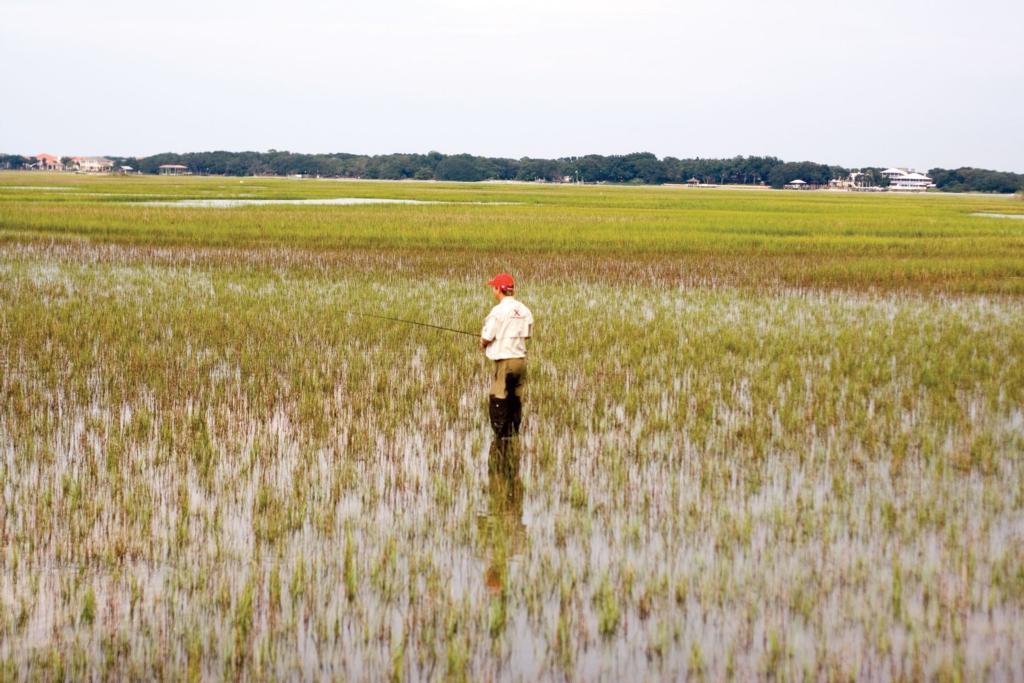 I watched, camera in hand, as he crept across the flat and pitched a pegged shrimp in front of the tailing red. Pulling it across the heavy grass on Berkley FireLine, Miniard killed the lure just in front of the red. A boil and a slash and Miniard’s drag sang, but just for a moment. He reeled in a clump of spartina.
Squatting to look at another, more distant surface disturbance, Miniard began to creep across the flat. Pictures were becoming a secondary consideration at this point.
I looked across the flat Miniard had just left. Three more tails gradually emerged not far from one another, bobbing and flopping busily, and occasionally splashing violently as one seemed to take offense to another’s crabbing. I looked at my camera and smirked, turned it off and placed it in its case. Quietly as I could, I grabbed a rod from the boat.
The water was balmy and only ankle deep. I tried to glide my feet over the top of the grass and set them down with minimal disturbance. There was just a little crunching of spartina stalks with each step. One of the reds flopped over, its bronze flank flashing at me and gill plate undulating up and down within casting range, but not as close as I wanted, as it crushed a fiddler crab. Just down the flat, I heard a tremendous splash on the surface. Miniard was hooked up.
Closing to within 15 yards, one of the reds leveled itself and turned my way. I tossed my own pegged soft shrimp in front of it, pulled it across the grass, and with slightly sweating, salty palms, shook it in front of the red’s nose. The slurping sound the fish made was almost comical as it turned away. I wasn’t even sure it had the shrimp until my line went tight. I set the hook, but the fish had already dropped the lure.
Grumbling to myself at my painfully slow reaction, I reeled in rapidly. Reds were still tailing everywhere all around me. The one I’d so gracefully missed seemed to care very little as he went on, nosing for 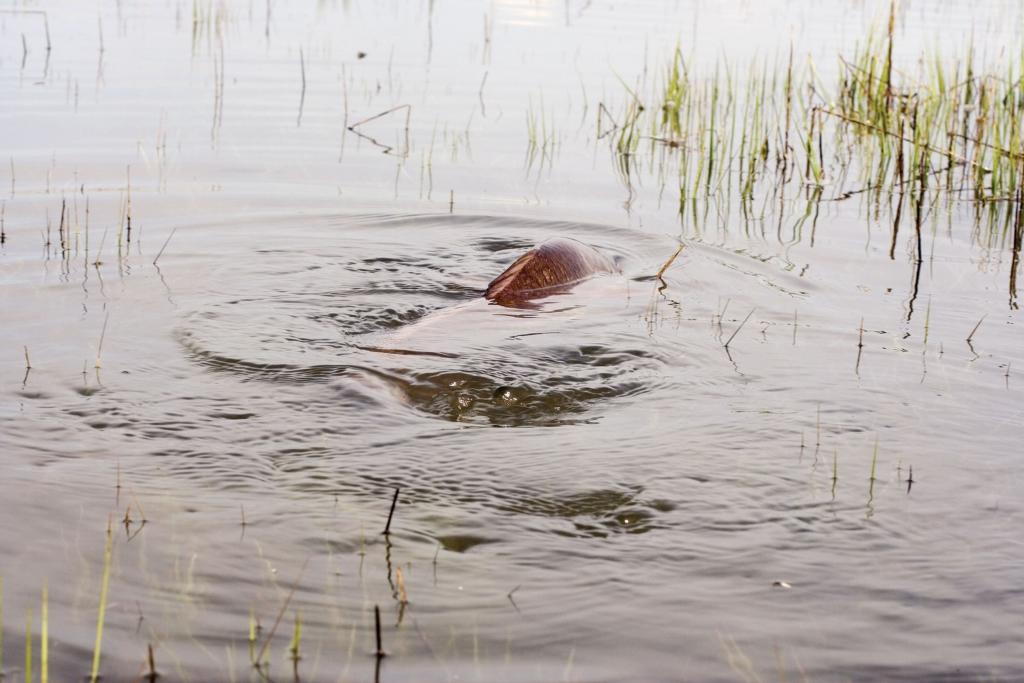 another crab farther down the flat. I knew what needed to be done now. I pitched the shrimp back out as another red leveled itself for a moment 10 yards away. One short pull of the rod produced a near-instant slurp, and there was no question where the hook went when I set on the tight line. FireLine spun off the spinning reel as the red tore across the flat, back exposed the whole way. Wakes of other fleeing fish cleared out as I sloshed along behind the hooked red, gaining line as I went.
My line tangled around a clump of spartina at one point and the fish pulled it the opposite direction. I frantically worked to get it free without consequently freeing the fish, as it was stuck at a near-90-degree angle. The big redfish flopped and struggled and continued to tear at my spool. Finally, the FireLine simply sliced through a few of the stalks, freed itself and straightened up. The redfish began to tire, and I was able to approach it. With a hand under its belly, I hoisted my prize, a near 8-pounder, flashed Miniard a crazy grin and gave him a thumbs up with the other hand. It was a fish I’ll never forget.
Florida flats in the fall
There are places where redfishing is relatively easy. Venice, La., comes immediately to mind. In these waters, if numbers are the measure of success, catching one after another on nearly any reaction bait you care to throw at times isn’t difficult.
But there is a window every fall along the ICW in the St. Augustine area and farther north when a few anglers go searching not for numbers of reds, or even the largest reds, but for a unique redfishing experience in the spartina-grass flats. It’s an experience for those who like it one-on-one with the fish, which makes it especially appealing to any angler with a sight-fishing vice. There are multiple fish to stalk. They aren’t as wary as a bonefish, but caution must be taken just the same. A good stalker can get ridiculously close, within 10 feet, of a preoccupied red, but they are still spooky when they’re cruising. They know the spartina flats are only underwater a short amount of time. Once the tide begins to recede, they must either leave or become beached gull food. So a stalk must be planned, and each individual fish must be watched through the duration of the maneuver. If one fish spooks away, chances are others in the area will go with it.
For Captain Miniard, a full-time guide and tournament pro on the Wal-Mart FLW Redfish Series, it’s a favorite time of the season, and one when he stays booked. “Full moons in the fall bring the heavy flood tides with them,” Miniard said. “But other things, such as hurricanes, can trigger an abnormally high tide. Fiddler and mud crabs that have been on hard ground are suddenly underwater and have no escape. Redfish and sheepshead move in and just gorge on them.
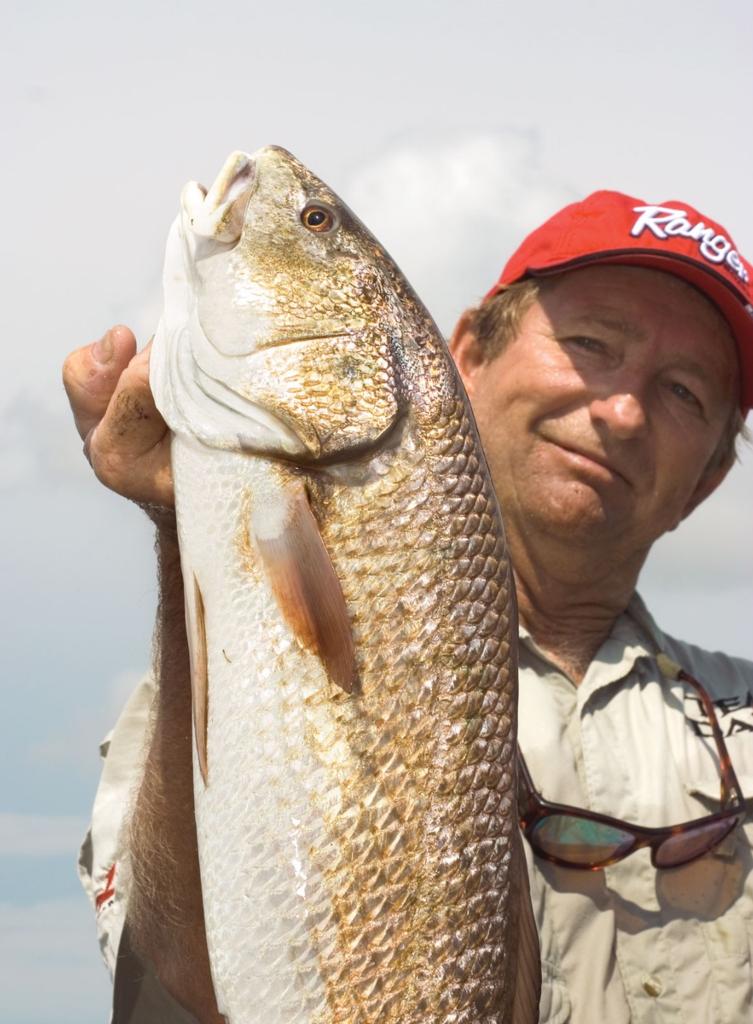 “Many of my flood-tide customers are repeat customers. People just get so addicted to that particular style of fishing.”
Because of the easy casting distances involved, fly anglers in particular relish this time, but it’s a blast with spinning tackle as well.
Spinning tackle also makes things a little easier for catching multiple fish. Miniard rigs up with a 7-foot rod with a medium-heavy action and fast tip for a solid close-range hookset. He spools 14-pound Berkley FireLine as his main line with a short (3 feet or so), 20-pound fluorocarbon leader. The spartina grass, being fairly abrasive and very thick, will shred monofilament under the strain of a big red, so the braid is imperative. With the reds so engrossed, and the grass so thick, I think a reel loaded with FireLine Crystal, tied directly to the lure, would be ideal as well, and save a few tying steps.
Soft shrimp and crab imitations of all types work for this. The fiddler crabs living in the spartina grass are small and dark brown in color, so Miniard tends to err on the side of a smaller plastic. A 3-inch version is his usual choice, usually in darker colors. “Root beer is about my favorite,” the pro said.
Because the grass is so thick, Miniard pegs a small bullet sinker to the shrimp. There’s little to no working the bait. After a stalk is completed on a tailing fish, it’s best to wait until the fish levels itself for a brief rest, as it isn’t going to see your lure while nosing in the grass. When the fish levels itself, make a cast at an angle about 6 inches to a foot in front of it. The cast can be made a bit early in anticipation of the fish leveling itself, but often, the reds simply nose right back down, or spin around on another crab, oblivious to your lure. I learned to carefully pitch at a leveled fish and simply pull the shrimp across the grass, allow a little slack for it to fall right in front of the red, and give it just a little shake. Though the bait instantly seems to disappear in the grass, this is usually all it takes for the red to nose down and grab the lure.
Strikes, at least for me, were tough to feel at times. As often as not, though, the reds made audible slurping noises as they mouthed the shrimp, and by watching carefully, I could usually see my line jump. Waste no time in setting the hook, keeping in mind you’re setting into a generally heavy fish with light tackle at close range, and such things can cause line to snap unexpectedly.
It was a race against time and tide as Miniard and I hit the flats early the next morning. Miniard had studied the tide charts carefully, so we cruised from flat to flat, following the outgoing water and stalking numerous fish. Usually, we’d stop, anchor the boat and each head our own respective directions toward tailing fish. In some places, the grass was so thick and the water so shallow, it seemed as much soggy field as clear flat. But the reds, with their backs out of the water and totally engrossed in their crabbing, were everywhere. I would hear splashes from time to time, and see Miniard working a fish. We waded hundreds of yards away from the boat in opposite directions, and found fish everywhere. Prizes were hoisted up to show one another from across the flat. The nirvana lasted about two hours before the tides receded and the reds left. Those two hours made, however, one of the most enjoyable angling experiences I’ve ever had.
If you want to fish the flood tides with Larry Miniard, you better schedule early because he books fast. For more information, call him at (904) 285-5373 or (904) 708-0060.

The sheepshead factor
Redfish aren’t the only game fish to move onto the flats during the flood times. In fact, Miniard enjoys targeting large sheepshead almost as much as he does reds, especially with a fly rod in hand. “Sheepshead are a big, sought-after fish on the flats,” Miniard said. “The average one caught while wading is usually 4 to 6 pounds. They’re very strong fighters, and use their wide bodies as leverage, sort of like a big panfish. They’re also a delicacy – one of the best-eating fish there is in my opinion.”
While tailing sheepshead are easy to catch with a live fiddler crab hooked on spinning tackle, Miniard has developed a fly-fishing system that is also deadly. He ties his own fiddler-crab imitation, made from the iridescent breast feather of a wild turkey gobbler, into a weedless fly. He’s found it to be one of the few artificial lures sheepshead will take reliably.
According to Miniard, the Florida state-record sheepshead for fly tackle was caught by an angler wading the beaches of Fernandina. Miniard believes he’s had a state-record hooked up himself on more than one occasion, but the largest ones, as is often the case, have found the weak links and escaped thus far.