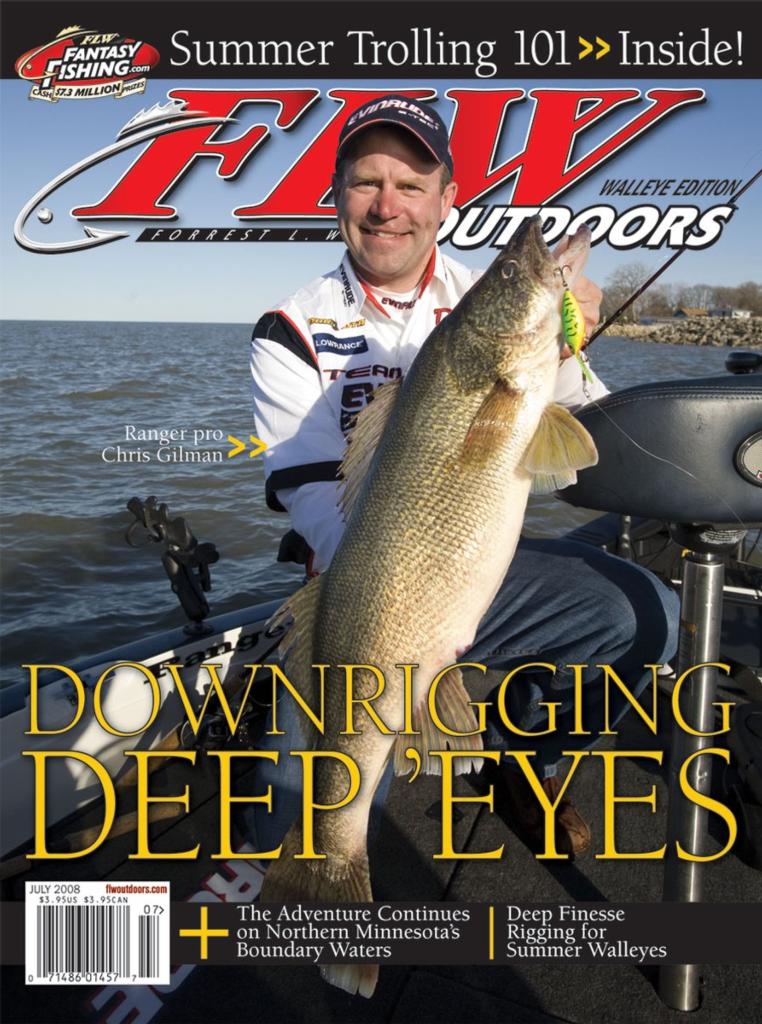
Looking up at his father’s salmon boat sneaking narrowly down a ramp on the banks of Little Bay de Noc, a young angler crammed his hands deep into his pants pockets and waited to climb aboard. I wondered for a minute, as I dropped in on a nearby ramp, if he knew more about the long-armed downrigger gear clamped and bolted in spider formation off the gunwale than me. Likely so, because although he couldn’t have been a breath older than 8 years old, he’d probably spent a few days taking lessons from his father as they dropped heavy downrigger weights into the depths of Lake Michigan in search of fish that prefer life far beneath the waves.
His lessons, while in the name of salmon, are ones I’m not ashamed I haven’t had many of, and most walleye anglers should feel that way. After all, fisheries where downriggers are common fare for walleyes are few, especially with the fish-catching precision of planer-board and lead-core trolling that is so popular.
But despite the precision capable when pulling lines behind the boat, it would be the heavyweight, straight-down tactics of downrigger fishing that offer the most exact depth control and deep-water ability. And that’s a lesson all walleye anglers can afford to experience.
Why downriggers?
Deciding to employ downriggers first requires taking a look at the brand of anglers who use them regularly. Offshore saltwater trollers, like those on the Wal-Mart FLW Kingfish Tour, as well as freshwater salmon and lake trout trollers in the deep basins of Northern lakes, love to drop downrigger balls.
 The reason? Downriggers get lures deep, and they keep lures at precise depths. While trolling 60 to 100 feet (or more) deep, like salmon or salt anglers, may be a rare stretch for walleye anglers, hitting the 45-foot mark is not when on big water.
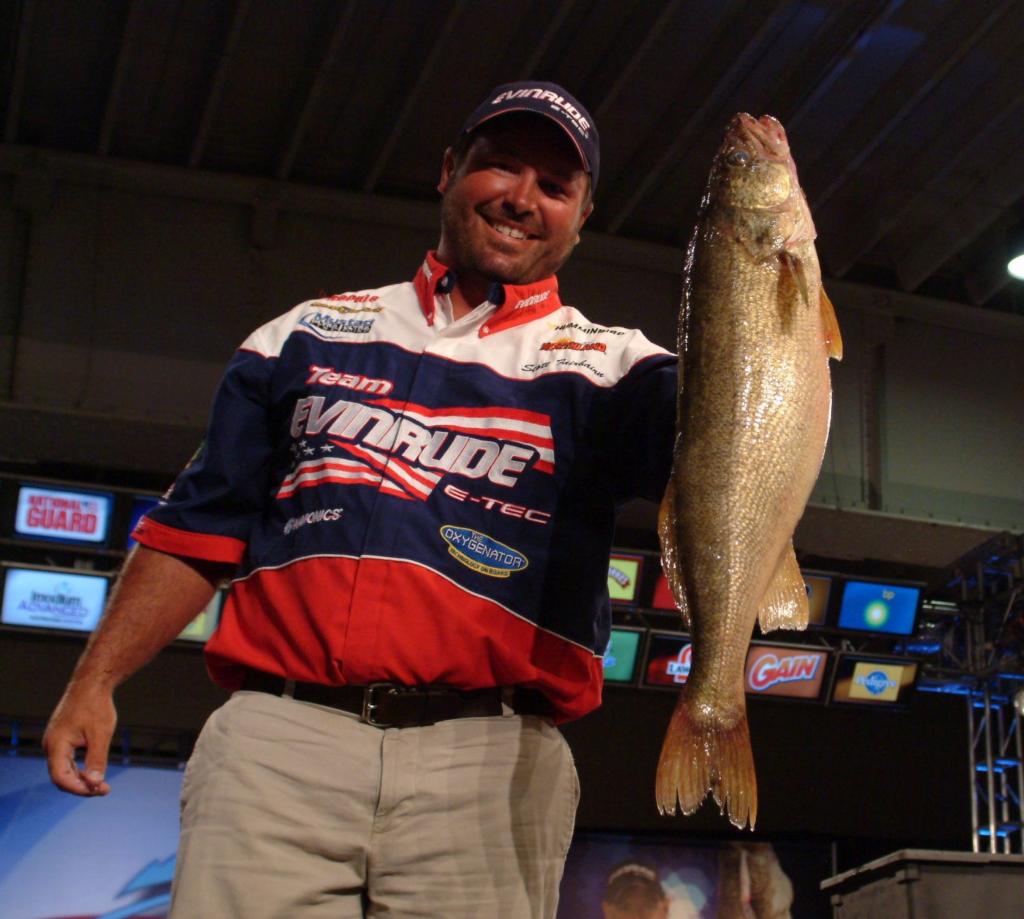
“Once you get down to about the 45- or 50-foot mark, to catch walleyes there’s only a few things you can use to get down there,” said walleye pro Scott Fairbairn of Hager City, Wis. “Downriggers for walleyes is kind of a `French technique.’ A lot of people don’t use them for walleyes. For salmon and lake trout, people use them all the time, but there are conditions when downriggers are the right choice for walleyes.”
In late summer on Lake Erie, for example, Fairbairn drops downriggers in the Central and Eastern basins when fish set up on a hard thermocline between 30 and 40 feet. With the system, he’s confident he can put his baits in a small depth window.
There are other methods to hit the depths Fairbairn mentioned, but the amount of line needed would magnify any subtle changes in speed, weight or lure action. That’s why downriggers have begun to attract walleye anglers.
“I control the exact depth,” said fellow tour pro Pat Neu of Forestville, Wis. “There’s no drift-back at all. The downriggers are straight below the boat.”
Neu is also a salmon troller, often employing downriggers at high speeds in ultradeep water. But since he’s picked up the tactic for walleyes, he’ll drop downriggers for anything deeper than 20 feet. It may seem unnecessary to do so in such shallow depths, but not to Neu.
“One of the problems you have pulling heavy weights to get down deep on a planer board is if you turn 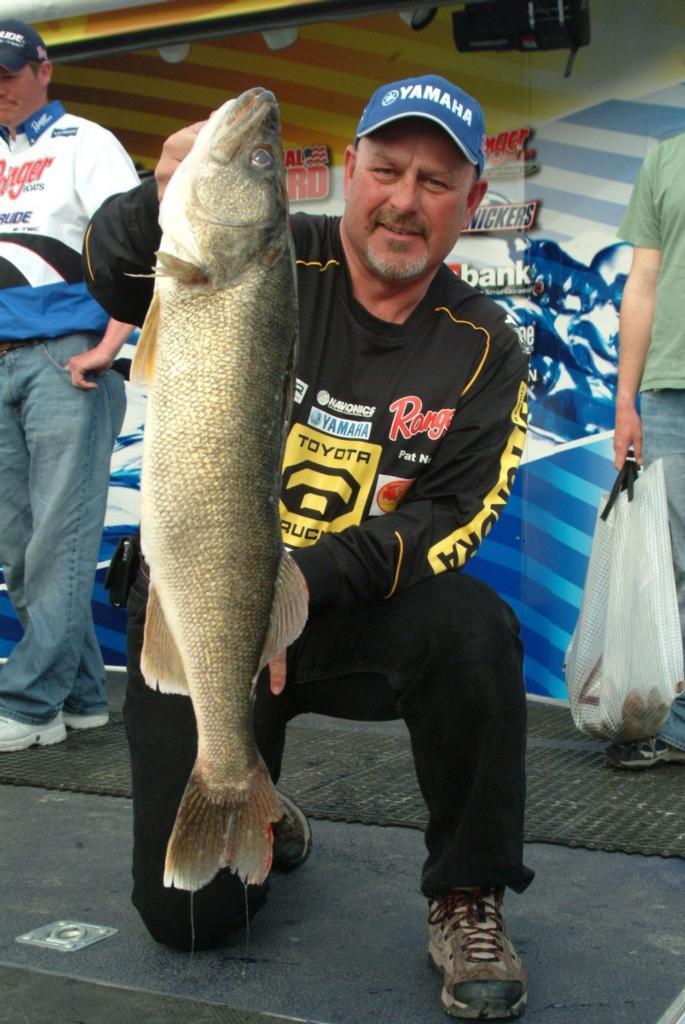 hard toward the planer board, the lure drops,” he said. “If you turn away from that planer board, that outside lure comes up. With the downrigger being so close to the boat, you don’t have that same geometry.”
The result is a constant depth and total control. On Lake of the Woods in northern Minnesota, this control makes downrigger fishing a popular tactic for local guides and anglers.
“The United States side of Lake of the Woods is kind of a bowl-shaped basin, but around the edge of the basin are a lot of rocky humps – they’re rocky reefs,” Fairbairn said. “You can troll out in the basin, but one of the best places to get walleyes is to identify where the reefs are and get an outline for your trolling so you can get in and around them. You could do it with lead-core line, a (Luhr Jensen) Jet Diver or Dipsy Diver, or bigger weights. The problem is if you’re trying to get down close to the structure, those methods require you to have a lot of line.”
In addition to depth and steering control around structure, downriggers can pull lures at any speeds walleyes will eat them, and they excel at the higher end of the walleye-fishing speed range.
“The thing that works against all rigging systems for getting in front of fish when we’re trolling is the faster you go, the less effective a snap weight is or lead-core line is, to the point where they almost become null and void,” Fairbairn said. “You can clip along at 3, 3 1/2 mph with downriggers and still keep baits in the zone.”
Rigging up
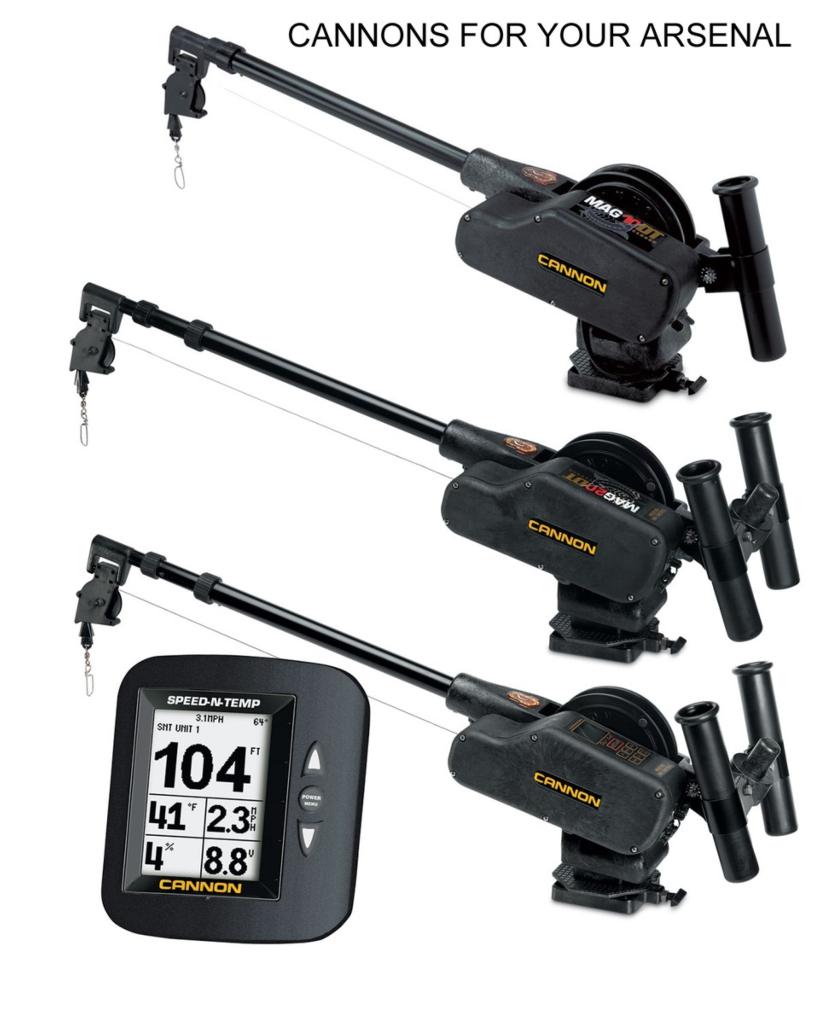
Fairbairn and Neu both prefer the Cannon Mag 20DT/TS downrigger. The Mag 20DT/TS is actually geared for the salt, but it is the Swiss Army knife of downrigger fishing. The pros described them like proud children on show-and-tell day.
“Cannon has a feature that allows the downrigger to automatically adjust to track the bottom,” Fairbairn said about the CannonLink Fishing System Module, which works when paired with some depth-finder units. “If you set the downrigger ball to maintain 5 feet above the bottom and you’re trolling along at 30 feet and the rock pile comes up to 25, the ball automatically comes up. You either have to be really quick at manually adjusting or you want a downrigger that does it for you.”
Neu said he intends to experiment with the Positive Ion Control feature on the unit, which emits a fish-attracting electric field around the boat. Part of using the feature requires leaving the steel downrigger cable on the unit, which Neu does. He runs the cable to a 6-pound ball, occasionally upping to an 8-pounder when nearing max walleye-trolling speeds.
Fairbairn, however, takes advantage of the steel spool on the Mag 20DT/TS, which allows him to change to heavy monofilament or braided line, something not always possible on downriggers with weaker, plastic spools. Fairbairn reasoned in some fisheries, walleyes are sensitive to the hum of a steel cable gliding through the water. But 50-pound (or heavier) braid or mono doesn’t have the same effect.
 He also uses only an 8-pound downrigger ball. By using the same weight for all trolling, Fairbairn can determine if he has hit a line of current, moving into or with the boat, based on changes in the angle of his downrigger cable. That information is valuable if current is affecting the bite. And for beginners, sticking with one size ball is best.
“The best way to learn what you’re doing is to first master, with one size downrigger ball, how the downriggers behave,” Fairbairn said. “You get used to seeing how much blowback you’ve got on your downrigger cable and how hard it’s pulling back by the angle the downrigger is pulling in the water.”
Neu prefers the same 8 1/2-foot G. Loomis steelhead rods he uses for typical walleye trolling operations when using downriggers. The important feature of the rod is one both Neu and Fairbairn agreed is needed in a downrigger rod – the action is soft enough to load the rod with the weight of the downrigger ball. This is accomplished by reeling down on the rod after the line is set until the line release on the ball is nearly ready to pop. A glass rod works great for this because the rod can be loaded with a large arc. On a bite, when the line releases, the rod will snap up and start to set the hook.
For a weekend angler, or one who may only employ downriggers on occasion, there are lower-end models than the Mag 20DT/TS, which retails for $1,049. The Cannon Mag 10HS and Mag 5HS retail for $499 and $359, respectively. Both are high-speed, electric units that have Positive Ion Control, but Cannon stripped a few extras the top-end models have. For the ultimate gear-nut, the Digi-Troll IV HS has a keypad control, LCD menu on the unit itself, and both CannonLink and Positive Ion Control. The price for the top-of-the-line gear: $1,349. Various hand-crank models are also on the market, but they differ little in price from the Mag 5HS. And if downrigger fishing is to be a regular tactic for a troller, Fairbairn cautioned against a model that requires a lot of cranking to raise the weight.
“It doesn’t sound like a big deal,” he laughed, “until you do it all day.”
Deploying
The primary objective in a downrigger operation is to put a lure at an exact depth and keep it there. This is where a bit of prior trolling experience pays off, but a copy of “Precision Trolling Pro Edition” can help, too. That’s because gravity and drag have the same effect on a lure pulled behind a downrigger ball as when pulled behind a planer board. The difference is the leader can be kept significantly shorter.
Although, not a leader in the traditional sense, a leader in downrigger fishing is the length of line let out from the trolling rod before the line is clipped to the downrigger ball.
“The main thing between leader lengths would be a function of whether the fish are spooked by the downrigger ball or the potential of the steel cable to hum,” Fairbairn said. “There’s a couple of schools of thought on that. I’m not one to think the walleyes are spooked by the downrigger ball. I tend to run shorter leaders, because I think if the fish see the downrigger ball and there’s a little bit of attractive tape on it, it gets their attention. And then here comes this lure along behind it.”
Short, for Fairbairn, is 10 feet. Lure drop over 10 feet is minimal, thus allowing an angler to easily drop the lure right above the heads of walleyes. If fish seem reluctant to bite, lengthen the lead. Long for downrigger trolling could reach a couple of hundred feet, but such measures typically aren’t necessary.
To set the downrigger, consider a common 30-foot leader running to a lure. Consult a dive-curve chart for that particular lure pulled behind 30 feet of line, and simply subtract the indicated amount of drop for that lure from the depth wanted to hit. The result is the depth to drop the downrigger ball.
 Unlike in high-speed downrigger trolling, blowback on a 6- or 8-pound ball is negligible at walleye speeds, so no figuring is required to compensate on that account.
As far as choosing lures, downriggers are a good match with any popular trolling lure. Shallow-diving crankbaits require less figuring and worry for diving beneath the downrigger ball than deep-diving crankbaits. And spoons, which are very popular perhaps due to roots in salmon or lake trout trolling, and crawler harnesses require less figuring still. But when using crawler harnesses, Fairbairn recommended sticking with willow-leaf blades – he likes double willow-leafs – at high speeds. “They’ll handle the speeds we’re running with downriggers better,” he said. “Colorados make a terrible mess out of our line.”
For attaching the leader, Fairbairn uses pinch-pad release clips supplied by Cannon. When a fish takes the lure, the line pulls free of the jaws and releases. He changes the pressure required for release by clipping the line deeper or shallower in the jaws – perfect for fine-tuning depending on if hard-biters, soft-biters or perch are present.
There is another way, however, to rig a line release, which has been used for other trolling applications on the tour.
“I’m going to use rubber bands,” Neu said prior to the Wal-Mart FLW Walleye Tour Presented by Berkley season-opener held on Lake Erie’s Western Basin. A rubber band, which is tied around the leader and attached to the clip on the downrigger ball, offers two advantages. First, it will break on a hard bite and release. The second advantage is forewarning.
“The rubber band acts as a bite signal because it will stretch when a fish first takes it,” Neu added.
When the rubber band stretches, the rod will move, and Neu knows there is a fish on. If it’s a light biter, the rubber band won’t break, but he’ll still see the movement and know to set the hook.
Depending on local regulations, downriggers can even be worked into multiple-line spreads. A Ranger 620VS is aptly suited for two downriggers, one on each end of the transom. But lines can be stacked on the downriggers using stacker clips provided from manufacturers like Cannon. Rig a lure as usual, placing the rod in the built-in holder on the downrigger. An additional rod can be added on the gunwale on the bow side of the downrigger, and a line from that rod can be attached to the downrigger cable via a stacker clip at any depth above the ball.
Another simple way to double-up is similar to using slider rigs. On a leader of the desired length, tie a snap swivel on the opposite end of a lure. Lower the downrigger with the first lure attached, and snap the swivel around the line at the halfway point. Finally, lower it down fully. What happens when a downrigger is deployed is the line from rod to lure will develop a bow, which reaches its maximum distance from the downrigger cable at its center. Due to drag acting on the lure, the snap swivel and line will settle at the center point.
Another good tactic Neu uses is to incorporate downriggers into a planer-board spread, running the downriggers deep and adding planer boards outside to cover the upper portion of the water column.
 I don’t know if that young boy and his father caught any salmon on Lake Michigan last summer, but I know for sure they appreciate the advantages of downriggers for trolling deep, trolling close to structure and pulling lines at high speeds. Consider trying downriggers, and that appreciation may spread to you, too.
Color-coded cannon balls and more
Bullet Weights Inc. introduced new downrigger weights last summer, expanding its ever-popular line of weights for trolling applications. The new downrigger weights complement their cannon ball weights. Currently, the cannon ball sinkers range from 1/2 ounce to 3 pounds. The new Downrigger Pancake Weights come in 10-pound and 13-pound sizes, and anglers may choose from black or orange colors. The Downrigger Ball with Fin weights range from 4 pounds to 12 pounds and come in green, black or orange vinyl coatings, as well as uncoated. For more information on Bullet Weights offerings, visit bulletweights.com or call (800) 872-0131.