
Two things help Captain Rob Gorta produce redfish in skinny water for his clients on a daily basis. For Gorta, silence is golden. In fact, he’s much more cautious dealing with reds than he is with snook or tarpon. His approach traces one of stealth, during which he avoids noise of any type. Gorta will even slip an anchor over the side without a ripple rather than try to ram a push-pole tip into the bottom of the flat and create sound waves fish can hear.
While most of us believe redfish lack the eagle eyes and wariness of a bonefish or the rejection of noise like a tarpon, Gorta clings to the opposite opinion. He strains his eyes to spot his quarry at maximum distance and seldom approaches any closer than he must. While others may opt for heavier line, Gorta insists on 10-pound test or even 8-pound-test so his casts can be longer and he can reach out to the fish at an extreme range. One may think he puts too much into silence and distance, but it works time after time.
Vision testing
Contrary to popular belief, redfish boast excellent vision. In fact, they will often spook from the sight of a lure in the air or a rod in an angler’s hand waving overhead unless they have their heads buried in the grass. Once a fish is alerted to an angler’s presence, it may not streak straight for the county line, but it is much harder to fool with natural bait or artificials. And when a redfish does spook, it will move off a considerable distance and not return to the same spot. Remember: Any fish on a shallow flat is really out of its element and feels threatened. It is much more alert to danger than the same fish in deeper water.
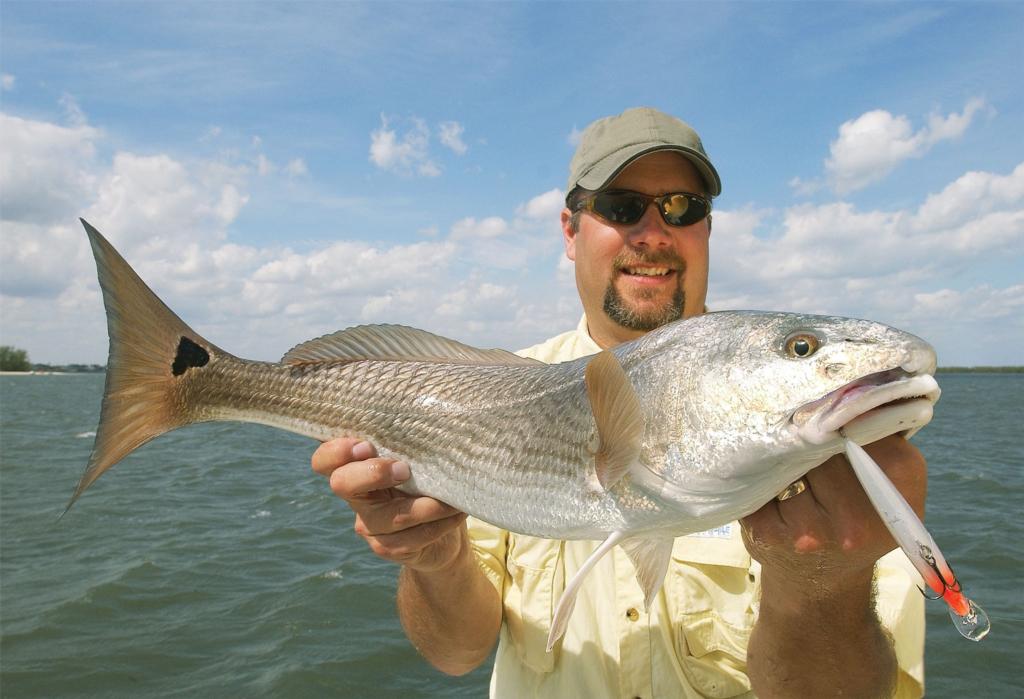 Regardless of the terrain, versatility holds the key to success on the flats. Those who focus on only one thing often miss spotting the signs that pinpoint the presence of redfish. The ideal, of course, occurs on those slick-calm days when redfish seem to be tailing everywhere. They wave those spotted tails like battle flags as they nose down to feed on the bottom. At times, however, it can be difficult to discern the tip of a tail as it punctures the skin of the water.
Spotting redfish in clear water takes several forms. Once the whole fish is just lying there or cruising slowly, the odds shift to the angler’s favor, provided he hasn’t alerted the quarry to his presence. To increase the chance of catching reds, an angler also has to look for parts of a fish. It may be only a head poking out of the bottom grass or just a tail that’s visible. Like with any other form of hunting, recognizing that a full silhouette doesn’t always come into view is important.
Cast carefully
Whether using natural bait, either live or dead, or artificial lures, the proven approach is to cast slightly beyond the tail and off to the side to the head of the fish. Then, ease the bait toward where the fish is tailing and hope the fish spots the bait when it lifts its head. With an artificial, make sure to keep it right in that area until the fish takes it or moves away with it. Redfish rank as aggressive feeders, and they’ll pounce on an offering once they see it.
Cruising redfish stream an unmistakable wake from their dorsal fins as they move through the water. There could be a single fish or multiple reds showing. At times, the water shakes in what seasoned flats fishermen call nervous water. Casting to cruising fish requires timing, precision and accuracy. The mistake many make is to think the wake is emanating from the nose instead of the dorsal fin and cast too close to the fish. The key centers on casting beyond the path the fish is taking and then retrieving quickly until the offering is right in front of the fish. It shouldn’t look as if the prey is attacking the predator. If using an artificial, wait until the fish almost reaches the lure and then start moving it away as if it were escaping. This creates the trigger mechanism that results in strikes.
 As a school of redfish feeds, puffs of mud or marl get kicked up when rooting the bottom. It requires practice to spot this at a distance, but after learning to do it, the catch ratio will increase. At the same time, individual fish can be spotted “flashing” in a school at a considerable distance. They tend to roll periodically, sending out a “flash” of reflection from their sides. These two signs are standard targets for Gorta, who will then make extra-long casts with bait or artificials to reach them. If he does it right, he’ll keep picking off fish without disturbing the school and causing it to move away from him. Even with a single fish or a couple of fish, Gorta insists on long casts and the quiet approach.
Speed and accuracy highlight the rules for casting to specific fish or working a given area. That first cast represents the best opportunity, so it is imperative to make it count. In the event of a miss, don’t try to make a good cast out of a bad one. Instead, retrieve the bait or lure as fast as possible and make another presentation. The same rule applies if the fish doesn’t see the offering and starts to move away from the cast. Hoping the fish will come back is a bad dream. Keep getting a bait or lure in front of the redfish again and again until there’s a bite. Nobody is counting the number of casts you have to make to do so.
Playing fields
Stay alert to other scenarios. Reds can be cruising on the backs of rays, so it’s always worth a cast or two when a ray is spotted. Potholes attract fish. They’ll either lie in the pothole or on the fringes, so cover each one thoroughly. Natural bait produces more fish in certain situations. Recently, while working a flat loaded with redfish, they refused lures and didn’t want to eat a shrimp. But the flat was covered with potholes, so a cast was made into a pothole and the shrimp was allowed to swim around the area. Within moments, a red found the shrimp and the battle ensued. A similar approach works when reds are prowling under overhanging mangrove branches. It often pays to cast a bait in a seemingly productive spot and let it sit there until it is picked up by a cruising red.
Skinny water differs considerably depending on where an angler happens to fish and even the day he’s out there. It’s not just a matter of depth. Sometimes the water seems as clear as the windshield on a car, and there are also plenty of situations where it is off-color or downright murky, making it hard to see through the surface. Redfish need grassy bottoms to thrive, but they’ll cruise shorelines in search of food as the tide begins to flood, and they can often be found under overhanging mangroves. Marshy shallows covered with protruding grass can also be redfish paradise in parts of their range. Each of these situations may beckon a slightly different technique.
Marshy habitat has its own set of guidelines. Fish will work along the grass line or they’ll linger around points or in pockets. Casts that parallel the grassy shoreline can have a more pronounced effect than simply casting perpendicular to the shore and retrieving back to the boat. Picture a setting with creeks, pockets and general openings that can be typical of this habitat. An angler can’t cover everything and can’t work back into every indentation. Using topwaters in these situations to make a bit of noise and entice the redfish to find the lure is often helpful. It gives the feeling of covering more ground.
Redfish respond to rising and falling water, working up on a flat on incoming tide and dropping back toward deeper water when the tide falls. Finding the right depth can be critical. One tip worth remembering is to look for sharks. They are usually found where their prey happens to be found. The presence of sharks is an excellent barometer for finding the right depth.
Stalking redfish on the flats, whether wading or fishing from a boat, has always been an exciting challenge. It’s a one-on-one contest between the angler and the fish. Make every move count and you can come out with bragging rights.
 Sneak, creep, whisper and hush
Tricks to stay quiet in skinny water
By Curtis Niedermier
John Henninger of Jacksonville, Fla., has four top-five finishes, including a win, in Wal-Mart FLW Redfish Series events. His partner, John Eggers of Jacksonville Beach, Fla., has been a part of all but one. The duo is a regular contender no matter where the series travels, and part of their success has come from their tendency not to talk to each other – when chasing spooky reds in skinny water, that is.
Henninger and Eggers cut out as much sound as possible when chasing skinny-water reds. And they take a few preventive measures with their tackle to keep their casts low-key before presenting the bait. Sound kills on the flats. Zip it, and it may be possible to stick a few more big reds in skinny water.
Boat >> Henninger and Eggers run a Ranger 168 Phantom, which has a Zero-Slap hull design. The design cuts down on reverb and keeps waves from transferring back out after hitting the boat. To reduce electronics noise, they always shut off the depth finder, and they even turn off the livewell pump.
Poling >> To pole quietly, anglers must insert the pole without making a splash, and they can follow Henninger’s lead to cut down on bottom noise.
“I always use the fat end of my pole,” Henninger said. “It doesn’t stick in the mud or the bottom. A lot of guys use the pointed end of the pole, and it makes a crunching sound.”
When fish are really spooky, Henninger nearly always uses his push pole to stop and hold the boat, rather than the Power-Pole. But when it’s time to move, he’ll try to use the wind to power his drifts rather than poling.
Tackle >> When fish are spooky or lure-wise, Henninger and Eggers will add a 6- to 7-foot leader of 14-pound Berkley Vanish fluorocarbon. The more weary the fish, the longer the leader. Henninger also suggested rigging bait without lead weight and hooking it weedless. The result is a lesser splash on impact.
Finally, when casting, the duo uses Abu Garcia 704LX spinning tackle. They put slight tension on the line before landing to cause the trajectory to change and the lure to skip on entry, resulting in a quieter touchdown.