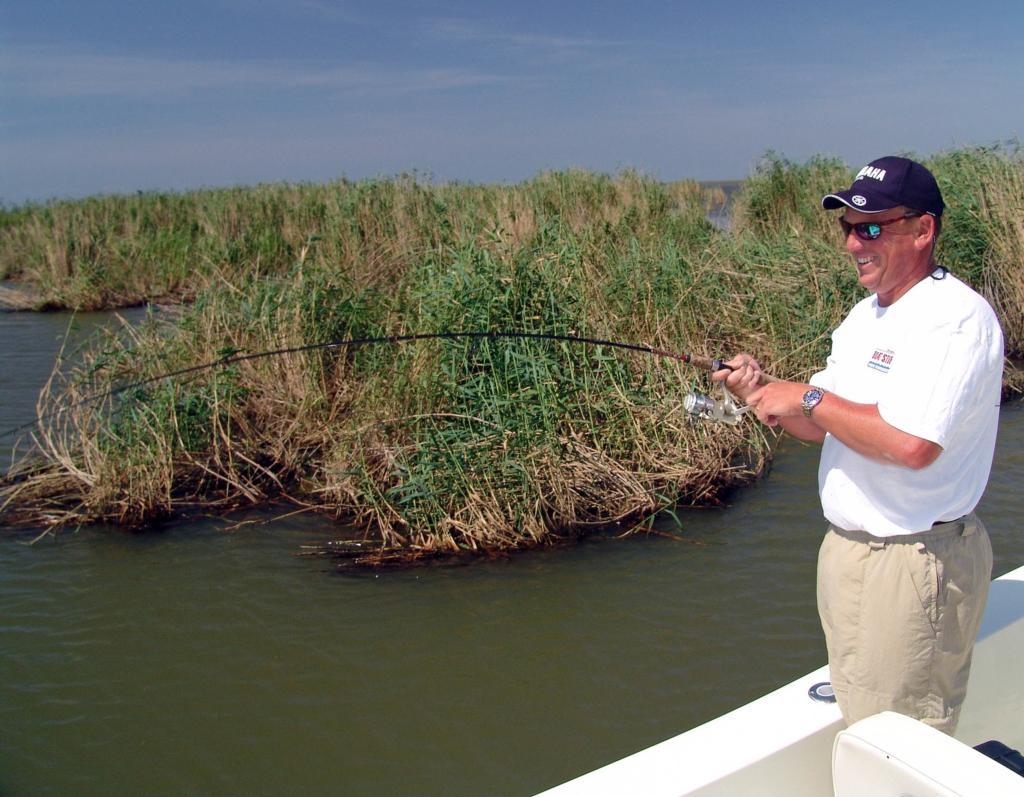
Perhaps more so than any other body of water in the nation, the Louisiana Delta has the ability to both intrigue and perplex anglers of nearly every skill level. For anglers, the delta represents the consummate conundrum – how does one fully enjoy the endearing attraction and richness of southeastern Louisiana’s marshes without being simultaneously intimidated by its tremendous expanse?
Indeed, after surveying the seemingly endless acreage of densely diverse vegetation – ranging from neat rows of tall Roseau cane to broad rafts of hyacinth to placid bays choked with hydrilla and coontail moss – there’s a viable venue for practically any bait, lure or tactic you care to test. And talk about chow – this place is a veritable full-capacity, year-round food production facility that cranks out innumerable quantities of fresh and saltwater forage like crabs, crawfish, minnows and mullet.
Throughout the famed Venice marsh areas near the delta’s southern terminus – as well as areas outside the river levees like Delacroix (east side) and Lafitte (west) – this region abounds with saltwater species such as black drum, speckled trout, sheepshead, flounder and the delta darling – redfish. Remarkably adaptive, reds roam from highly saline coastal fringes to deep marsh reaches where waters turn lightly brackish to purely fresh.
 In this expansive habitat with lots of fish, one might surmise that you can randomly pick a spot, make a cast and reel in a keeper. Incredibly, because the fishery is so impressive, it does occasionally work that way – but not always. However, whether you’re a tournament angler or a vacationing fisherman, it’s clear that maximizing your enjoyment on the water means understanding why some spots are routinely more productive than others.
A comprehensive treatise on “How to Fish the Louisiana Marsh” defies brief summation, so we’ll just look at a handful of factors that help narrow the search. For starters, redfish spend their juvenile years inside the marsh but move to the outer edges and barrier islands when they reach sexual maturity at roughly 27 inches.
Per state regulations, Louisiana allows anglers to keep five reds a day between 16 and 27 inches, with one over 27. And knowing the species’ geographic generalities plays a big role in finding the right size fish for a trophy catch, a tournament livewell or the barbecue.
Best baits
Live shrimp under a popping cork will yield a host of marsh denizens; however, artificials are the way to go for searching broad habitat. Weedless gold spoons and jigs with cocahoe minnow tails or scented soft-plastic bodies are great for making long casts along cane and grass edges. Topwaters are also a good bet for locating fish. However, be sure to follow up any boils or misses with a subsurface bait, and you’ll usually connect.
Hang a ¼-ounce jig with a minnow tail or soft jerkbait under a rattling cork and you have an effective rig for attracting distant fish and stimulating those in the area. A sharp tug makes the cork and its beads rattle and slurp at the surface while the bait hops below. A good choice for working over weedy bottom is the cork rig, which attracts fish with feeding sounds and then rewards them with an easy target.
 Spinnerbaits have long been a marsh favorite, but you need to make sure to choose the right one for the job. A heavier spinnerbait with a willow blade allows for long casts when locating fish, while sight-casting calls for a lighter model with a Colorado blade that produces plenty of “thump” without spooking fish with a big splash. For working over submerged weeds, spinnerbaits with double willow leaves ride higher to avoid snags.
Tip: Appeal to a red’s eyes, ears and nose by using a scented soft plastic on spinnerbait’s hook.
Structure strategy
The need for shelter and food drives every fish’s habitat decision. Tournament weeks put a lot of pressure on normally unpressured Louisiana redfish. So if you’re not seeing reds or at least their wakes, look deep into the weedbeds where pressured fish seek solace. Burning spinnerbaits and buzzbaits across the weedy surface usually entices resting redfish as well.
 Throughout the marsh, semi-enclosed ponds and lakes offer prime redfish habitat with shallow, sheltered waters rich in food. Some offer neat, orderly grass lines while others bristle with mini-islands and disjointed vegetation known as “broken marsh.”
Favoring both decors, redfish will search for crabs and baitfish along the edges, often running so shallow that their backs break the surface. Focus on points, coves and any contour irregularities that may benefit feeding fish.
While these venues offer prime sight-fishing opportunities, don’t overlook the center of a marsh enclosure. Scattered grass sprouting in open water indicates a bar or ridge, and reds will occasionally patrol such spots as well as deep oyster beds. Watch for other telltale indications such as flipping shrimp and the scattering of baitfish – both clear signs of predation.
Water flow
Although tidal influence is strongest at the marsh’s Gulf edges, daily ebb and flow will raise and lower interior waters as well. Incoming water allows redfish and anglers to access shallow ponds and sloughs. But keep an eye on your surroundings, lest you find yourself stranded as the outgoing cycle drains the pond and closes the exit.
“The excitement of chasing redfish in the shallow marsh can leave you high and dry,” warns Louisiana guide Capt. Troy Robichaux. “When the water (starts falling), get to the deep water fast, because the tide runs out of the marsh in a hurry.”
 Just don’t leave the pond entirely – move outside the mouth and work baits along the flats adjacent to the falling water. Here and outside unnavigable marsh creeks, redfish ambush tide-borne crustaceans and baitfish.
Delta guide and FLW Redfish Series competitor Capt. Anthony Randazzo explains: “The redfish will sit just outside the edges of the current where they don’t have to fight the water. They will just hang in the slack water and pick off their meals as they flow through the (opening).”
Despite the notion that all delta waters resemble muddy milkshakes, marsh filtering actually yields pockets of clean water where it’s easier to spot fish. Clarity is best where tidal flow and Mississippi River currents move water through lines of grass, Roseau cane and other vegetation.
“Usually the things that we look for are areas that filter the water, so when the tide runs out of the cane, it comes out cleaner than it went in,” Randazzo said. “That tends to attract more baitfish and game fish. Also, areas with older, denser marsh behind the cane will filter the water even better than just frail sections of cane on the edge of the coast.”
Navigational aids
Charts are a common notion for most fishing pursuits, but the delta marshes are so vast – and their channels, sloughs, passes and bays so numerous – that it all tends to blur together unless you can maintain an overhead perspective. “Standard Mapping” aerial photography produces satellite imagery charts that provide a picture of how the whole complex ecosystem looks from above.
With these detailed reference tools, you can literally put your finger on the chart, follow your course and determine precisely where – if anywhere – a waterway goes. Sometimes alternate entrances and exits exist and sometimes they don’t. Avoid the time gamble – and a potential tidal trap – with a clear indication of waterway linkage.
In addition to natural features, satellite charts will show the manmade ditches as well. Example: On the delta’s east side, a long north-south canal known as “Twin Pipeline” serves as a freeway through much of the Delacroix marsh.
 Study Louisiana’s delta region and you’ll quickly discover that there’s more habitat than you could ever fish in a lifetime. So don’t even try. In fact, you’ll routinely fare much better by picking specific targets, monitoring water movement and casting until you locate one of the area’s many goldmines. In short, do your homework, fish a manageable area, and sit back and take in one of the greatest and most unique fisheries in the nation.
To be sure, the delta won’t disappoint.