
————————————–
Editor’s note: Learn more about FLW Outdoors Magazine and how to subscribe by clicking here.
————————————–
There are several key differences among obvious fishing spots, subtle holding areas and dead water. Obvious fishing spots attract both fish and fishermen; dead water draws neither; and subtle holding areas draw fish but few anglers. The latter go overlooked because such areas are often indistinct or lie within the no man’s land between obvious fishing spots.
In a world where walleye anglers are programmed to look for fish on classic structure and along sharp drop-offs, subtle holding areas blend into the woodwork. And walleyes holding there hide in plain sight. It’s like they’re camouflaged amid indistinct surroundings. Nothing stands out, and angler attention is turned elsewhere.
Rivers offer classic examples of this phenomenon. Typically found quite shallow compared to their lake and reservoir counterparts, it doesn’t take much of a change for river walleyes to notice a difference in their surroundings. A dip or rise in the bottom of a few inches that deflects or minimizes current, a change in bottom content from softer to harder substrate, or flooded brush or timber are all fair game for attracting river walleyes.

Articles on river fishing often focus on fishing obvious spots. This feature does not. It’s about the in-between, subtle spots most fishermen miss, but fish use throughout the course of the fishing season.
Indistinct eddies
When the water is high and fast, eddies tend to be tight, swirling and obvious. Contrast this situation with large, indistinct eddies that form during low-water or slow-flow conditions typical of fall and early winter. They are present, but much harder to detect.
Large eddies are most likely to occur at river bends in conjunction with holes. Water deflecting around the inside point sweeps gently along the outside of the bend, leaving the inner portion of the shallow flat with little to no flow. Or a large eddy can span a shallow flat, plus the adjacent drop-off into a hole, providing fish a variety of depth options within the gentle swirl.
Fish could be just about anywhere, rather than in a tight little holding area bordered by distinct edges, which can leave them spread across a wide swath of river.
To home in on the fish requires multiple anchor positions or a more aggressive trolling approach. Drifting probably isn’t an option, due to the nearly slack water. Instead, pop the electric trolling motor down and  progressively cover different portions of the eddy, vertically jigging on and off bottom. Or slow-troll a three-way rig and minnow or floating jighead tipped with a minnow.
Smaller mild eddies are easy to fish by casting. Drop anchor and pitch a jig and minnow all around the boat. Scrape the jig back with a succession of gentle lift-drops, followed by a spin or two of the reel handle to retrieve slack line. Slowly fan-cast in all directions to determine what portion of the eddy holds the fish and at what depth.
Intermediate flats
As you proceed downriver between holes, the river typically shallows in straighter, wider sections. Most anglers consider this to be intermediate water with no fish and no bites. Not necessarily.
It depends on depth, bottom content, flow and the nature of the basin. A long stretch of 3-foot sand bottom probably won’t hold many walleyes, but a couple of hundred yards of 7- or 8-foot-deep basin will. Chances are a few boulders, dips, rises or other irregularities will be present to hold fish within a general section, rather than spread throughout the entire stretch.
Use a deep-diving crankbait to troll expanses of moderate depth with little variety. Troll slowly upstream, moving just fast enough to make progress against the current and ensure the bait vibrates.

Adjust the line length to allow it to occasionally scratch bottom, but it needn’t pound. Then cover ground, testing the waters to see what’s there.
If you feel rocks, find a deeper stretch, or better yet, get a bite, spin the boat around and troll back downstream through the area. Be sure to throttle up sufficiently to overtake the flow and keep the crankbait wiggling instead of hanging limp and lifeless. Likewise, cut back on the throttle to head back upstream for the next pass.
Lures that dive somewhere between 6 and 12 feet deep are good for quickly evaluating intermediate stretches between major fish-holding holes. In the cold water of fall through early spring, I like long, thin, subtle lures, like the Rapala Down Deep Husky Jerk or Rapala Minnow Rap. During warmer summer conditions, I prefer wider, more aggressive wobblers, like the Rapala DT6 or Storm Wiggle Wart MadFlash.
In shallower river stretches, like the upper Mississippi near my home in central Minnesota, I’ve caught a lot of big river walleyes by trolling lipless rattling lures during the summer. Lures like the Rattlin’ Rapala and Rapala Clackin’ Rap work down to maybe 7 feet. I like to troll them so they barely tick the bottom occasionally. They also seem to work extremely good for trolling downstream, probably because they’re heavy.

A few trolling passes to scout out the area are plenty sufficient on most shallow rivers because lures don’t need to get very deep. If I’m more serious about my coverage, I bring along a casting outfit spooled with Berkley FireLine, which gets my lures deep and enhances my feel for lure vibration and bottom interpretation.
Dips and rises
Dips and rises frequently occur on otherwise flat, featureless bottoms within the no man’s land between major holes. They may not look like much, but to a 4- to 8-inch-tall walleye, a 1-foot-high rise creates an obstruction of skyscraper proportions. Better yet, it deflects current above and around it, forming a place to rest or ambush prey.
A dip in the bottom is similar, but fish slip down into the depression. The same rule applies in either case: The more aggressive and intent fish are on feeding, the more they position at the upstream edge to grab an approaching morsel. The less active they are, the more they lounge down within or to the rear of a current-deflecting dip or rise.
If dips or rises are sufficiently large and deep, troll crankbaits through them. More likely, they’ll be relatively small. If a depression is about 2 feet deep within a 6-foot-deep sand flat, for a total of 8 feet in depth, vertically jig it. For a 1-foot dip atop a 3-foot flat, cast a jig or crankbait.

The same goes for a rise atop a flat, which is generally associated with the presence of harder bottom. Crankbaits are ideal for casting across rises. Retrieve them just fast enough to get a good wobble while scratching bottom and deflecting off the peak of the rise.
Dips and rises can hold fish at any time. Fish moving up- or downstream often dodge from spot to spot to hold and rest between major holes. And if prime holes at river bends are crowded with anglers, which is common during spring walleye runs, fish may adjust to the pressure by shifting into these less obvious spots.
Sandbars and dunes
Sandbars and rolling sand dunes are present in nearly all rivers. Their shapes and depths continually adjust and readjust to changes in water level and current flow.
Rolling dunes are an intriguing phenomenon, which few anglers even know exist. Basically, a long stretch of sandy bottom is subjected to variations in current, such as where a feeder creek or washout enters the river. The turbulent mixing effect of the flows creates somewhat of a wavy bottom that often stretches some distance downstream, just like miniature versions of dunes in the desert.
They can be 6 or 8 inches high across a 12-foot basin or much more prominent, like 2 or 3 feet high on 8-foot bottom. To find them, simply watch the electronics. In areas where the bottom inexplicably begins to roll up and down, chances are there will be dunes.

In all cases, the crests deflect current above the dunes, and walleyes can lie out of the flow between them. Where dunes only stretch partially across the river, their outer tips may collect active walleyes along the edge of the current, depending on the flow. Sometimes fish rest inside and between the dunes. At others, they’re up near the tops or out near the edges, ready to pounce on a passing meal.
I like to anchor at the tips of these sand formations and cast a jig around the boat. I let the jig settle to bottom and then lift the rod tip, raising the jig and rolling it a short distance downstream before it settles. With a succession of casts, I can roll a jig up and down several major dunes before having to relocate and re-anchor. If I catch a few fish, I often wait for the next active batch to move through, biding my time between bites.
Dunes in deeper water are more likely to be slight ripples in the bottom. They don’t provide much current deflection, but in low-flow conditions, they may be all it takes to hold walleyes.
Vertical jigging, three-way rigging and crankbait trolling are all options because such areas are virtually  snag-free and easy to fish. Plus, the fish are usually loosely spread within a general area, rather than on a tight spot. It’s not necessary to be precise. Just cover water and you’ll catch fish.
Changes in bottom content
A similar theory as that of fishing sand dunes applies to areas of bottom content change, such as a sudden scattering of rock on a sandy bottom. Again, the rocks may not offer much distinctive cover, but they offer something different to attract walleyes. And the area is an easy place to jig, three-way rig or troll.
Clam beds provide some of the best walleye-holding areas in the river, despite often being associated with little or no depth change. The fish aren’t looking for a drop-off – just current deflection in or adjacent to a feeding area.
Clam beds are most often located by feeling them with lures or occasionally snagging and bringing one back to the surface. And there’s something special about clam beds – their typical depth, usual degree of current or current-deflecting ability – that consistently attracts both baitfish and walleyes.
Flooded shoreline vegetation and wood
When I fish rivers, I do a lot of casting, which is something most walleye anglers don’t or won’t do. They’re accustomed to deeper trolling and drifting techniques. But the minute you tell them to pitch a lure shallower, toward shore, they’re petrified. The mere thought of fishing around tangled wood snags and lure-devouring boulder crevasses sends shivers up and down their spines.
 But I catch a disproportionate amount of my bigger river walleyes in less than 6 feet of water, often right up on the bank. Throughout the summer, many of those are caught casting crankbaits to rock points, riprap, midriver shoals and wing dams. Not live bait, not jigs, just crankbaits.
Also, if there’s one thing river anglers can do to improve their fishing during the high-water conditions typical of late spring, it’s to move out of the main-channel current and probe shoreline cover. If swift current forces walleyes toward shoreline havens that deflect the flow, follow. You can’t catch ’em where they once were, but you can catch ’em where they now are if you use appropriate tactics.
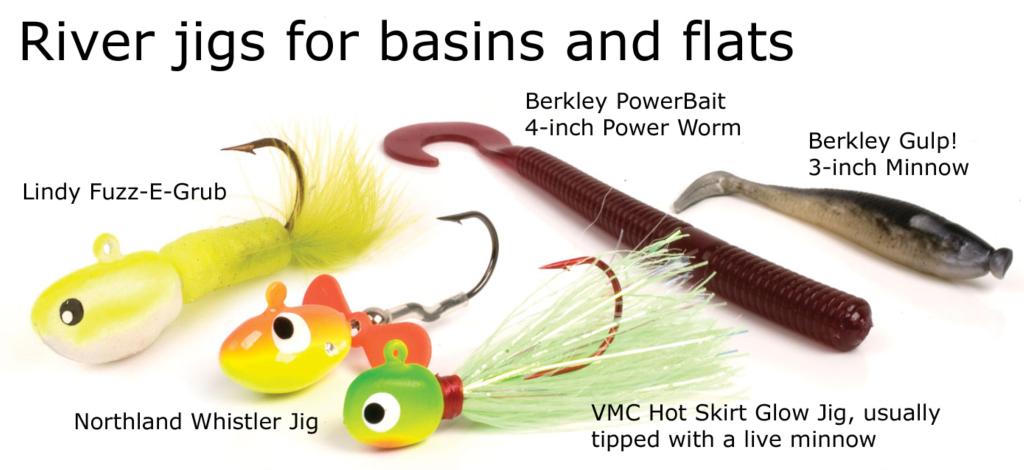
In familiar snags, pitch 1/16- to 1/8-ounce open-hook jigs with 4-inch worms between the branches. They’ll come back clean, most of the time. But when faced with probing miles of shoreline to locate fish by flipping and pitching jigs into and around all forms of brush, wood and weeds, I prefer rigging my jigs weedless.
I use a 1/8-ounce VMC Dominator Metal Head Jig tipped with a 3-inch Berkley Gulp! Minnow – a durable lure around cover. By rigging it Texas style, I eliminate most hangups without unduly sacrificing hooking percentage, and the oversized hook really digs in on the hookset and jerks big fish out of cover. If you don’t like the larger hook in this bass-style jighead, switch to a smaller jighead with a fiber or wire weedguard.
Channels and backwaters
During spring high water, side channels and backwaters often become the best fish-holding spots on the river, largely because the main channel becomes a mighty tough place for fish to fight the increased flow. Yet, at the same time, backwaters that were formerly stagnant, and perhaps just a few feet deep, will have sufficient depth and current to attract walleyes, plus plenty of newly flooded cover to break the flow. In effect, backwaters become the “new river” – exactly the places to fish.
During rising water, the basins of backwaters and side channels offer the same kinds of dips, rises and changes in bottom content as the main river, and many of the same basin tactics apply.
The main challenge comes when shoreline cover begins to flood. A rim of suitable cover for walleyes to enter is created first, which can easily be fished. Thereafter, potentially untold acres of flooded fields and forests could arise should the swelling river jump up and out of its banks. When that happens, fish often penetrate and spread out amid the foliage, and it’s suddenly like looking for needles in fields full of haystacks.
The best advice is to focus on places that can be fished effectively and forget the rest. During rising to moderately high water, flipping jigs into shoreline wood cover or tossing a slip bobber and minnow next to a prominent logjam are obvious options.
As the river begins to flood, still flip jigs into adjacent cover, preferably focusing on the general area of the original shoreline, which forms a distinctive lip beneath the surface. Or make short casts into cover with a shallow-running, minnow-shaped crankbait, continuing to focus main efforts along the flooded lip – still a focal point of feeding activity.
Once the entire area floods in earnest, well into the trees, the best bet is to accept the limitations and forget about fishing the extreme shallows. Instead, try to intercept walleyes coming and going through concentration points and predict where moving fish are likely to pass.
This is prime time to fish around entrances and exits for backwaters and in and around channels between islands. Current and fish funnel through tight slots, and somewhere nearby, current breaks may at least temporarily hold moving fish. Walleyes may relate to visible current seams along shore or be up in flooded cover. They may be in logjams lodged within the flow. Yet something, somewhere, should gather and at least temporarily hold small groups of moving fish.
It’s not easy. It’s extraction. A few fish here, a few there, with not much in between. That’s the hallmark of postspawn, high-water fishing where subtle fish attractors that most people miss still produce walleyes during tough conditions. If you’re willing to forgo the obvious and seek out the subtle, chances are you’ll catch fish where few anglers have gone before.
So, how shallow is shallow?
Certainly, 6 feet is plenty deep to hold any walleye that swims, be it in the center of an eddy or along the front face of a wing dam. When it comes to flooded shoreline wood cover, however, anything goes.
Three feet? Two feet? Even less under ideal conditions? You bet. If their dorsal fins aren’t poking above the water’s surface, it’s probably plenty deep enough to hold walleyes in good wood – especially under low-light conditions, or at night.