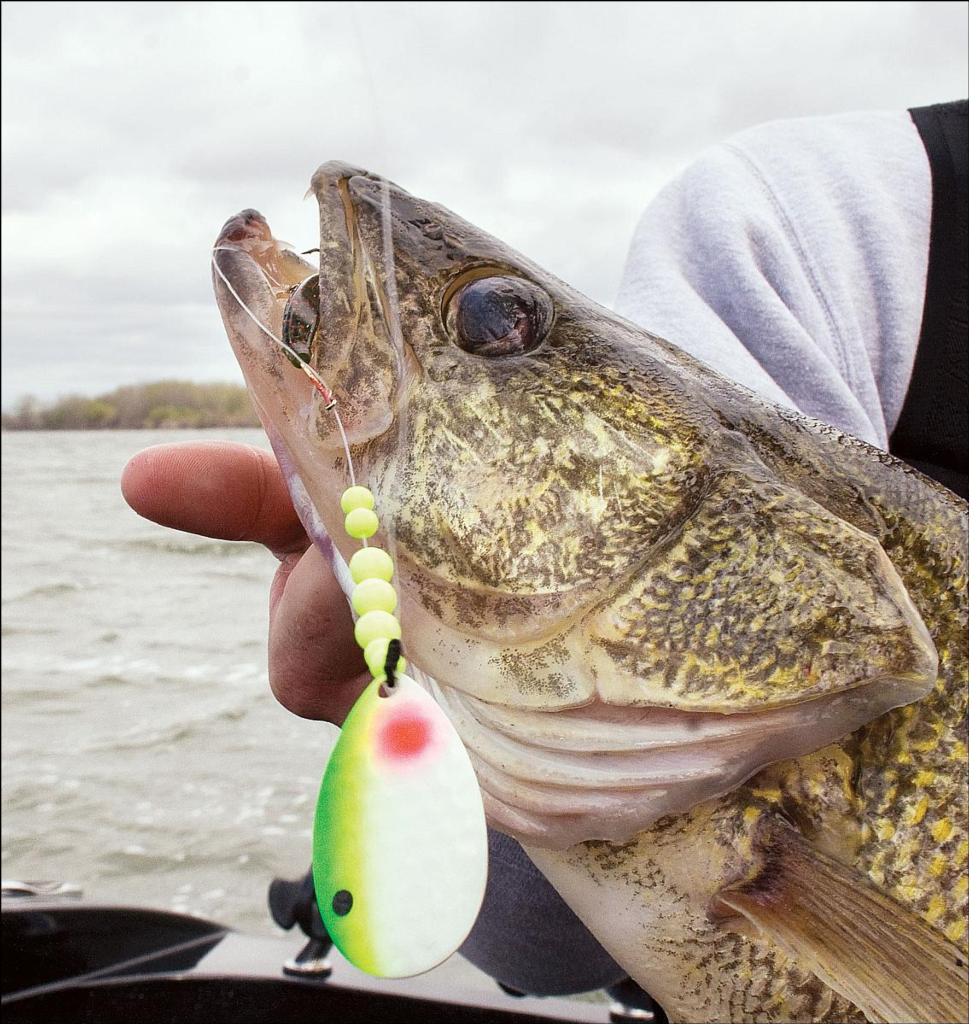
————————————–
Editor’s note: This is just one article from a recent issue of FLW Outdoors Magazine, which publishes both a Bass Edition and a Walleye Edition. To learn more about the magazine and how to subscribe, click here.
————————————–
In the United States, “bigger is better” isn’t just a saying; it’s a way of life. Trucks, houses, value meals, fish – we want things big. And that thinking is starting to expand into spinner fishing.
Up until now, most anglers have favored No. 3 and No. 4 blades. Sure, there were some oddballs who used larger blades, but they were part of a secretive bunch and didn’t spread the word. Now their secret is leaking out – fast. Big blades are suddenly in, and anglers who make the switch are putting larger walleyes in their boats.
Super sized
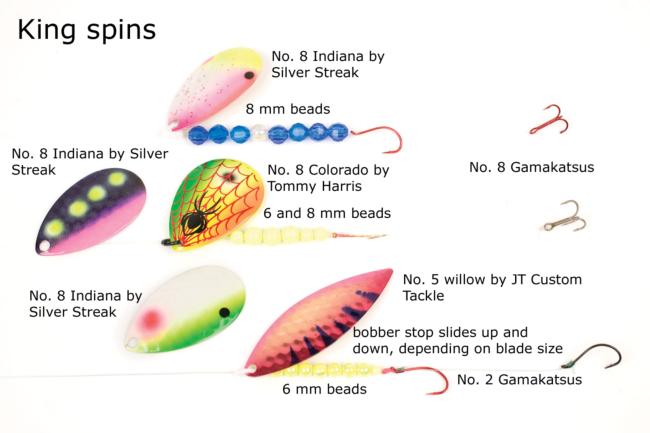
So the question remains, what is a big blade? For purposes of discussion, “big” is anything larger than a No. 6 in both Colorado and Indiana styles, and larger than a No. 4 1/2 for willow leafs. Basically, such sizes are similar to what anglers might expect to see on the muskie bucktails and spinnerbaits.
While there are numbers of big-blade makers out there – many muskie-lure builders actually stamp their own blades up to size 13 – the main players on the walleye side right now are Wolverine Tackle Co., with its Silver Streak line; JT Custom Tackle and Tommy Harris, a custom blade painter and designer. Silver Streak currently produces a No. 8 Indiana, while Harris offers a No. 8 Colorado, and JT Custom Tackle offers several custom willow blades larger than the traditional No. 4.
Unfortunately, there are only a few blade makers now who apply paint jobs as elaborate as can be found on most smaller blades. To my knowledge, Harris is the only major manufacturer that has custom holographic No. 8 Colorado blades. However, as the fishing world slowly catches on to the effectiveness of big blades, anglers will probably begin to see custom and premium blades in larger sizes in the near future. In fact, the demand is already high for some.
“After a tournament, especially a Great Lakes event, my phone rings off the hook,” Harris says.
It is not only pros who call. Co-anglers and pre-fishing partners who have witnessed the effectiveness of big-blade spinners often constitute the first wave of new customers who want the same sort of spinners that they saw in action during a tournament.
 Big is better
Why do big blades work so well for big walleyes? Many anglers feel that a revolving blade creates a baitfish silhouette, especially when it’s riding in front of a fluttering night crawler. Maybe, maybe not; but what can’t be denied is that a blade adds vibration and flash to the offering. Depending on their style, blades produce different vibrations that fish detect through their lateral lines, just as they do the gyrations of a struggling minnow. As for flash, metallic blades or blades with prism finishes reflect light suggestive of fleeing baitfish. In clear water, that flash can be used to attract fish from a distance. Even colored blades produce flash, though their main goal is to attract fish through colors and contrasts. Big blades, then, amplify the effects of vibration and flash.
“Simply put, bigger blades are an advantage because they draw fish from a longer distance,” says Jeff Seyka, tournament pro and co-owner of JT Custom Tackle.
The ability to draw fish from farther away has distinct advantages, especially when an angler is having to cover a lot of water. For example, say a fisherman is trolling a regular spinner rig 30 feet down in 50 feet of clear water. Assuming no walleye will travel down in the water column to eat, that only leaves fish in the bottom 20 feet of water as potential targets. With bigger blades, the window is expanded. The extra flash and vibration can call up fish from much farther than 30 feet. So instead of having to troll the spinner 30 feet deep, an angler can troll it 15 feet deep and still have the ability to call up fish from anywhere below. Now, instead of only targeting fish in a 20-foot zone, you’ll be targeting fish in a 35-foot zone. That nearly doubles the potential for bites.
Seyka and I have witnessed the “calling” effects of big blades countless times on lakes Michigan, Huron and Erie with spinners, and it is even more pronounced on the deeper waters of Lake Ontario. On my graph, I have watched the arches of giant walleyes rise more than 50 feet in the water to smack a giant-bladed spinner pulled behind a Luhr Jensen Dipsy Diver. In fact, on deep bodies of water, making a walleye come from a long distance away to eat a lure is often more productive than relying on a reaction bite when the lure goes right by the fish.
However, as potent as the big blades are in clear water and under sunny skies, Wolverine Tackle Co. owner Chip Cartwright believes they work even better in overcast situations and in dirty water. Both set of circumstances narrow down walleyes’ vision, and inevitably the strike zone. That’s where the extra thump from a bigger blade will add a few extra feet to the strike zone. That can be a huge advantage.
Compare it to being blindfolded and trying to find someone who is blowing air on you. If he was right next to you and he simply blew air from his mouth, you would probably feel it. But if the person was 10 feet away, you probably wouldn’t. However, if the person was holding a hair dryer, you would definitely feel the gust of air, even from 10 feet. That’s what big blades accomplish. They allow an 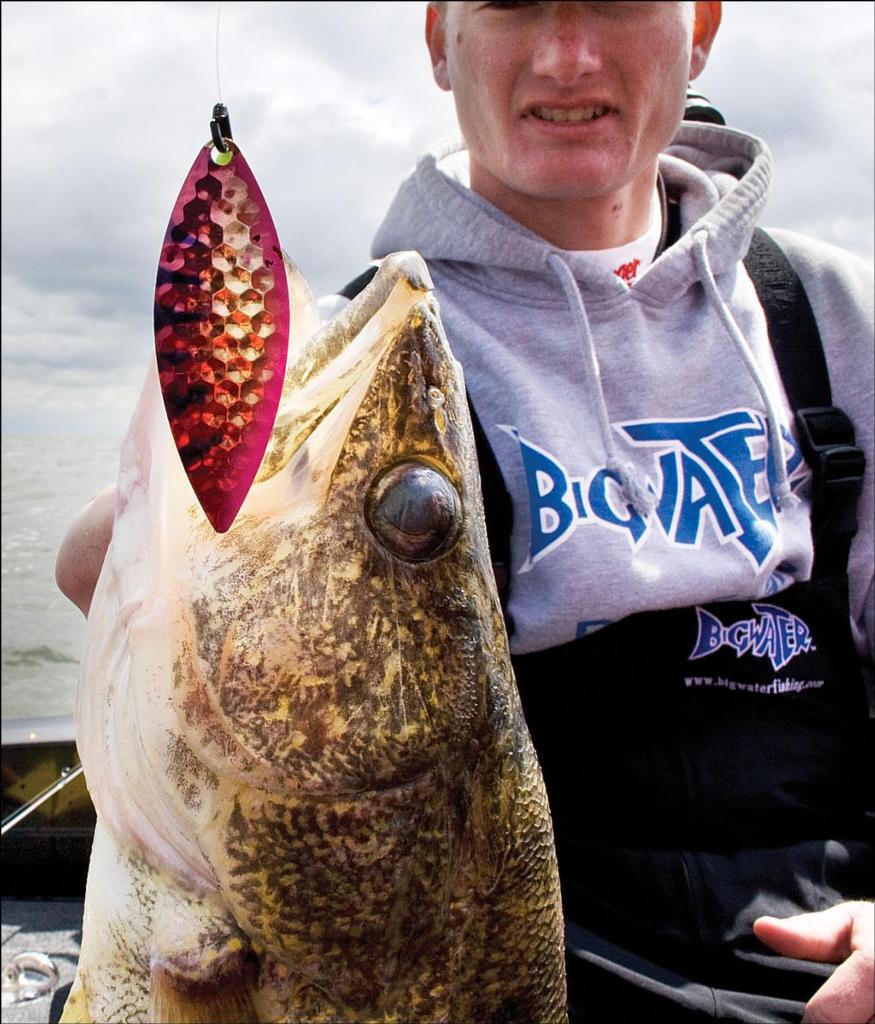 angler to cover the water column more efficiently.
With so much drawing power emitted by big blades, anglers have more wiggle room as far as positioning their baits. Even if they’re off by a few yards, they might get bit. Still, the more accurate the placement of big-blade rigs in the water column relative to the fish’s position, the more productive the presentation will be.
Shape choices
At this point, you might be thinking, “Yeah, those big blades work on big-water fisheries with giant walleyes, but they will never work on my lake.”
While it’s true that big blades tend to draw strikes from large walleyes, anglers might be surprised at how many small ‘eyes also clamp down on big-bladed spinners. They will work on any fishery, and they will work year-round.
The idea that smaller is better in spring is a long-standing theory. However, big-bladed spinners are quickly becoming the go-to lures in early season tournaments. In the past few springs, spinners with Silver Streak No. 8 Indiana blades have won thousands of dollars on Erie alone. The reason is that much of the forage that survived the winter will be considerably larger than it was the previous year. Many smelt and shad will have reached maximum size, and even minnows of the previous year will be larger.
The combination of bigger natural targets and cold water temperatures makes giant Colorado and Indiana blades come into their own during the cold-water periods of spring and fall. Their near-vertical profiles as they revolve create large silhouettes, similar to a smelt, alewife, chub, perch or shad. Plus, big spinners can be trolled at slower speeds and still do their job.
Once water temperatures rise and new forage in the form of young-of-the-year baitfish appear, oversized willow-leaf blades are the better choice. Employing a willow blade in summer is far from constituting a new trend. Catching summer walleyes is often about finding the fish, which usually means covering water. With their tight revolution path, willow blades excel at going fast without pulsing too much. Plus, considering that walleyes’ metabolisms will be running on high, the fish are more likely to chase down a fast-moving spinner that emulates fleeing forage.
Perhaps without stopping to think about it, anglers have been going to larger profiles for years by running twin No. 4 willow blades on their spinners. However, both charter boat captains and tournament anglers have started to figure out that a single large willow leaf – a No. 4 1/2, 5 or larger – is even more productive.
Since switching to single big willows, Seyka has seen his big-fish catches skyrocket. Plus, he gets to do more fishing because a single big willow tangles less and has a better hookup percentage than a spinner rigged with smaller twin blades.
 Rig modifications
While there really are no set-in-stone rules to using monster blades, there are a few modification recommendations.
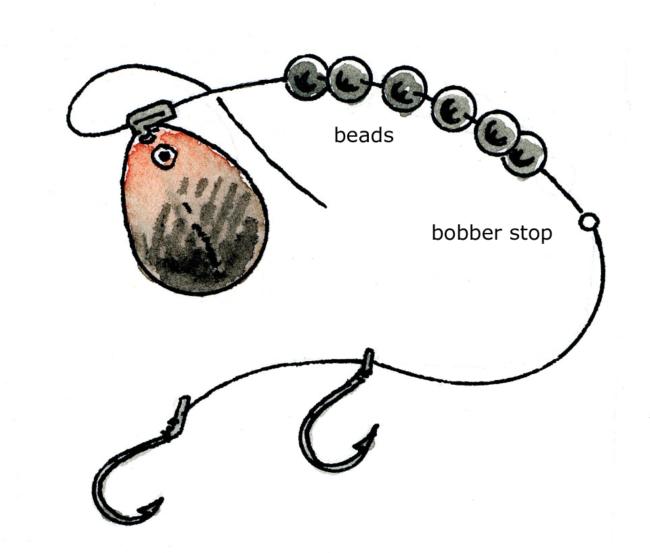
The increased blade size requires more beads be used in order to clear the front hook of the harness. This will ensure better hookups, as walleyes usually attack the blade and not necessarily the crawler. Plus, keep in mind that swapping a No. 4 with a No. 5 could result in the blade covering the hook if the spinner is not tied correctly. This can affect hooking percentage. A simple trick is to tie a few rigs with a bobber stop just in front of the front hook, or make it the first thing threaded on the snell. This allows you to adjust the distance between the clevis and the first hook without retying or changing a harness altogether just by sliding the bobber stop forward from the beads.
Speaking of beads, while anglers are super-sizing their blades they should also think about doing the same with the beads. Seyka prefers 8 to 10 mm beads, which is big stuff for spinner fishermen. They bulk up the presentation and display the bead colors even more, which allows walleyes to find the lure easier. Although it looks gaudy and too large for walleyes, it’s not.
Another modification is to use a quick-change clevis with a slight barb on the end of it. The added barb will prevent walleyes from flinging off the blades during a fight. When all else fails, it might be better to use a folded-metal clevis, particularly on hard-to-find blades.
In the end, the biggest thing anglers need in regards to big blades is the confidence to try them. As is the case with that double cheeseburger and large fries, bigger can be better for walleye spinner blades too.

Blinding flash
Big blades have enough intrinsic flash and fish attraction. However, that hasn’t stopped many anglers from trying the newest innovation: ultraviolet paint.
UV light can’t be seen by humans. However, it can be seen by fish, and it penetrates farther into the water column than normal light. UV paint reflects this light, making the colors on the blade much more visible to walleyes. While there are times when the combination of UV paint and big blades might cause walleyes to shy away, more often than not the duo excels.
Recently, the combination of a No. 8 UV Indiana blade has been a consistent producer for me. If an angler is fishing a stained fishery, or simply wants the boldest lure possible, UV paint and big blades provide the answer.