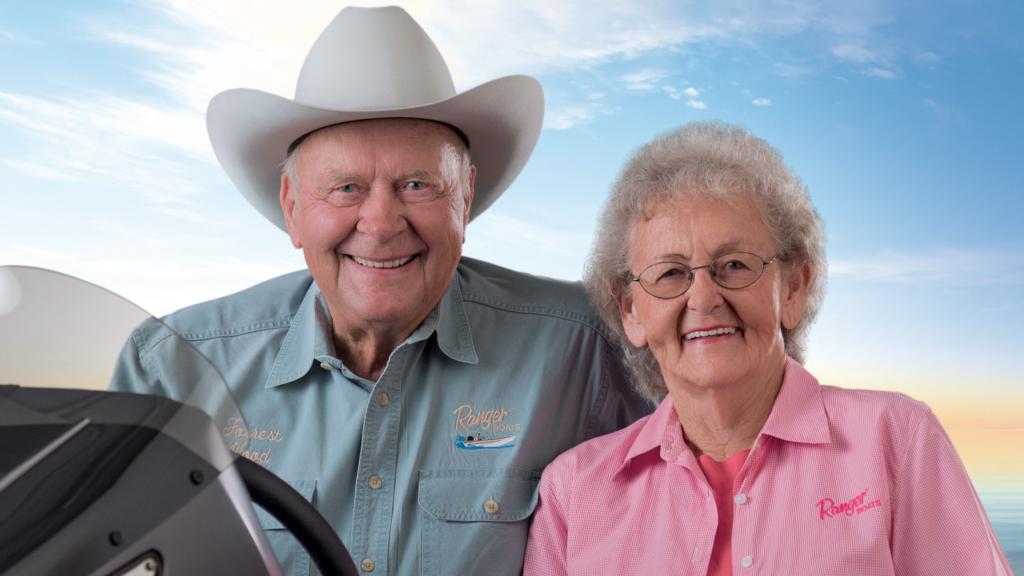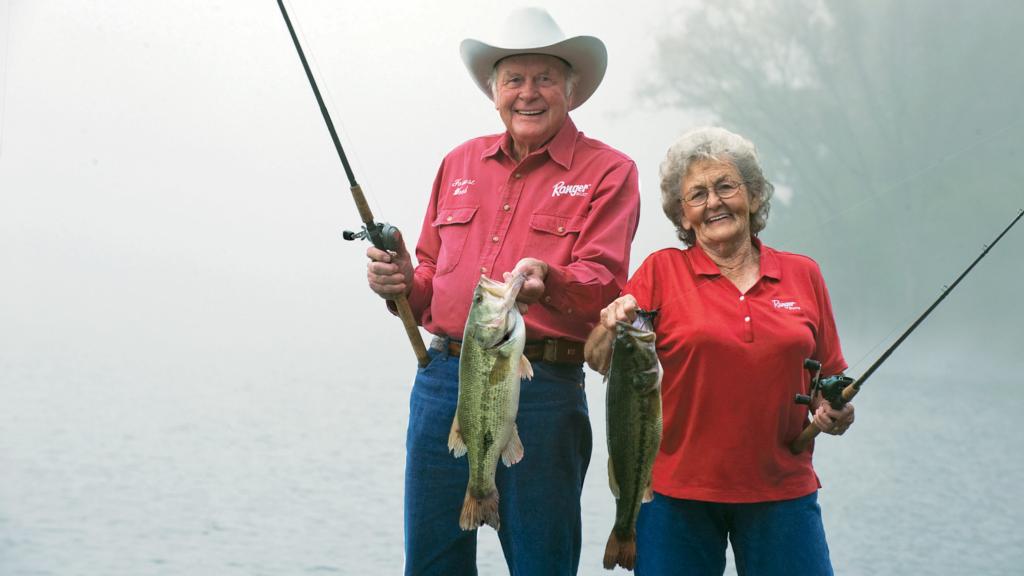
When the letter that notified Nina Wood that she was being inducted into the Legends of the Outdoors Hall of Fame came awhile back, she was a bit surprised. The rest of us were not. In a sense, it was a restatement of the obvious, another in a long line of awards and recognition earned by the co-founder of Ranger Boats.
Like her husband, Forrest, Nina has become a fixture in the world of bass tournaments – a walking monument to the sport, if you will. Forrest and Nina were there when the concept of elevating tournament fishing to something more than just local get-togethers for good ol’ boys was only a twinkle of an idea. The Woods’ role in the process and the growth was essential, and their toil-and-sweat drive to succeed in all their endeavors also assured that bass tournaments would catch hold on a grand scale.
Nina’s story is a story of the singularly American notion that anybody who works hard to make any reasonable dream come true very likely might. How else to explain how a young woman, one of five daughters and two sons, went from being a farm girl from northeast Arkansas to becoming a national personage?
Humble Beginnings
Nina was born in the Newton Flat community, within a stone’s throw of where the Bull Shoals Dam now looms over eastern Arkansas’ stretch of the White River Valley. Nina still remembers the days when the whole family helped plow the river bottoms with mules, tend chickens and take care of other chores. But there was always some time left over for fishing, and she can also recall the evenings when she and her siblings would sling cane poles over their shoulders and accompany their father down to the riverbank to fish – more for sustenance than for fun.
When Nina was 11, her family was coaxed from its farm through the force of eminent domain so the dam could be built. Of course, good things can come even out of bad things. Had it not been for the Bull Shoals Dam displacing her family, Nina never would have had to switch schools and might never have known Forrest. She and Forrest met when both were ninth-graders at Flippin High School, where Nina became captain of the girls’ basketball team and an All-State player in 1949-1950.
She and Forrest started “meeting,” or courting, in high school and were married on April 21, 1951. Brenda, the first of four daughters, was born in 1952. Linda came a year and six days after Brenda, followed six years later by Rhonda. Fourteen months after the latter came Donna, the youngest.
Forrest worked on the Bull Shoals Dam for a couple of years. Eventually the Wood family got on better financial footing so that Forrest could resume his goal of becoming a successful farmer. The family’s leanest years came in an era when most people could look only to themselves for help, but such labors tempered them into something stronger.
Fishing Becomes a Business
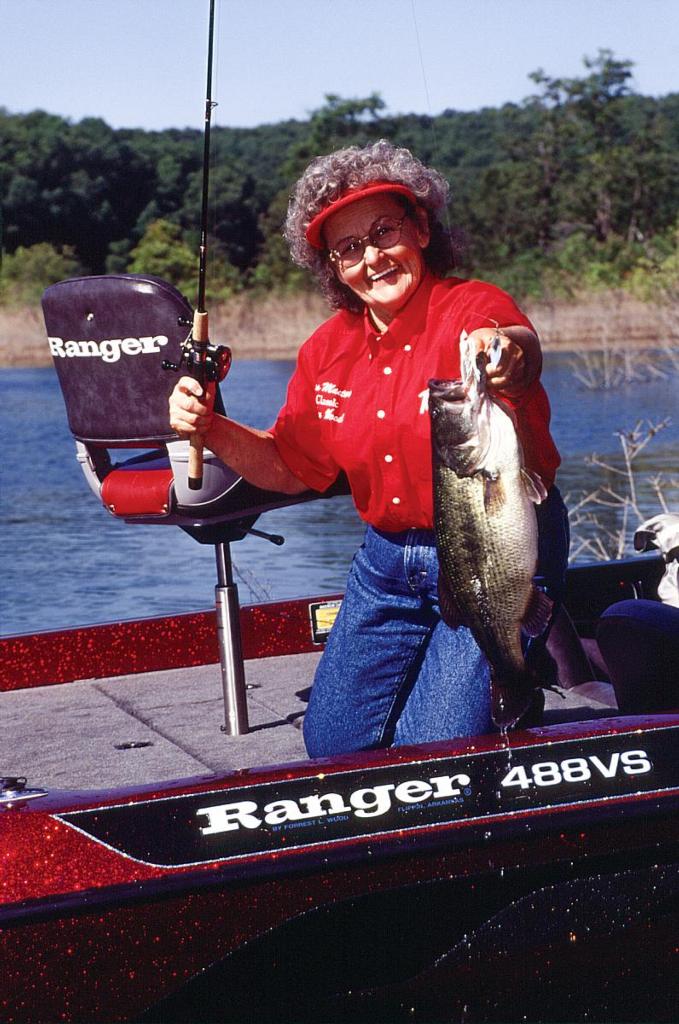
Bull Shoals Dam had caused some problems for Nina’s family, but she and Forrest saw that it also created some opportunities. The government started putting bass in Bull Shoals and trout in the White River below it. Fishing was good and getting better. Forrest and Nina had always been around fishing and fishermen, and soon they were making plans to open a guide service for tourists and anybody else who could afford to pay them. Nina made lunches for Forrest and his customers, and kept up with bookings and paperwork.
Later, throughout the late ’50s and early ’60s, their business grew to the point that they could afford more wooden boats and hire other guides to run them. The rocky shoals of the White River were tough on boat bottoms, however, and eventually caused them to develop leaks. Forrest acquired a machine that would apply a protective fiberglass coating to them. It helped.
Time passed, and the guiding business flourished. Forrest got an idea: Why not make an entire boat out of fiberglass? Why not, indeed. In the summer of 1968, he made his first boat in the back of an empty filling station on Main Street in Flippin. He called it a “Ranger,” because he admired the toughness of the Texas Rangers and the Army Rangers, and decided to name his fishing boat after them. Five more Rangers followed that year, and all were sold quickly. After 14 years in the guide business, the Woods decided it was time to do something else. And as they moved forward, other adventuresome pioneers in other locales were moving in the same direction toward a confluence of history that would become the sport of tournament bass fishing.
Branching Out
While Forrest played his role in that genesis, Nina played hers. Serving as the business manager of the new company while tending a houseful of girls, she learned by doing. In May 1971, a fire swept through the Ranger plant. They rebuilt and kept making boats. In December of that year, a tornado swept through and destroyed the barn and other structures on the farm where they lived. They rebuilt that too. Throughout it all, some things came easy for them, and some didn’t. But whatever came, Forrest and Nina dealt with it.
Eventually, Nina was able to go to tournaments with Forrest and practice with him.
“I didn’t get to catch too many fish, because whenever I caught one, we would have to leave right then because Forrest wanted to save the fish for the tournament,” recalls Nina.
Ranger Boats grew quickly, and within a few years Forrest was too busy running the business to fish tournaments. Instead, company employees such as Jim Nolan and Mel Sargeant were among the first tournament anglers to be identified as “Ranger pros.” Others – both established anglers such as Roland Martin and promising newcomers such as Hank Parker, Guido Hibdon, Denny Brauer and George Cochran – quickly followed. Nina managed the pro-staff, and the combination of her homespun friendliness and business savvy resulted in some of the brightest stars in fishing joining the Ranger team.
Over time, Ranger’s role in tournament fishing developed to the point that Forrest and Nina became bellwether figures and ambassadors of the sport; their mere presence at an event stamped it as something especially important. It’s that legacy that will be celebrated in August when “Miss Nina,” as she is more commonly known, will travel to Nashville and be recognized by the Legends of the Outdoors Hall of Fame at a banquet aboard the General Jackson Showboat on the Cumberland River.
More Than a Friend
Such honors and recognition are important, but more important is how we are esteemed by the people who surround us, the people we work with and interact with on a daily basis. In that regard, Nina was put on a pedestal long ago, principally because she and Forrest lived their lives in such a way that always reflected a genuine affection for the sport of fishing and for those who have played their various roles in helping to make it grow and prosper.
After the Ranger brand was well-established, Nina and Forrest would attend tournaments from coast to coast, as often as they could – not so much because they had to be there, but because they enjoyed the company of others who held the same aspirations and who saw the world as they saw it. They still go to tournaments; the Woods attend all major FLW events and participate in various activities while there. They make it a point to visit The Bass Federation (TBF) Pizza Party that precedes the Junior World Championship at the Forrest Wood Cup each year (Nina is well-known for being an excellent bowler, and at last year’s Cup she was presented with a new bowling ball by TBF as a token of its esteem). And if you’re looking for the Ranger booth in the FLW Expo, just follow the long line of autograph hounds waiting to collect the signatures of Forrest and Nina.
Such adulation is nothing new, and demonstrates the mutual affection that Nina and fishermen of all ages feel for each other. In tournaments of long ago, Nina usually had a 35mm film camera with her, and she would photograph various anglers who weighed in big fish or winning stringers. Afterward – whether they ran a Ranger or not – these fishermen would receive a souvenir scrapbook in the mail that held the photos that Nina took.
“She took thousands of photos at tournaments, and every time I won a tournament I would get a photo album from her,” says Brauer. “I still have them, and they bring back wonderful memories. Nina was the photographer, head of the Ranger pro-staff, head cheerleader – you name it, she was it.
“I’ve always looked at Forrest and Nina as family – an extra set of parents – because they’re so caring,” continues Brauer. “They always treated me like one of their own, and there are a number of pros who feel the same way. I don’t think we could have the sport we do now without them. They helped it get over the hump and growing. And Forrest would be the first to tell you that he got a lot of credit for what Nina did.”