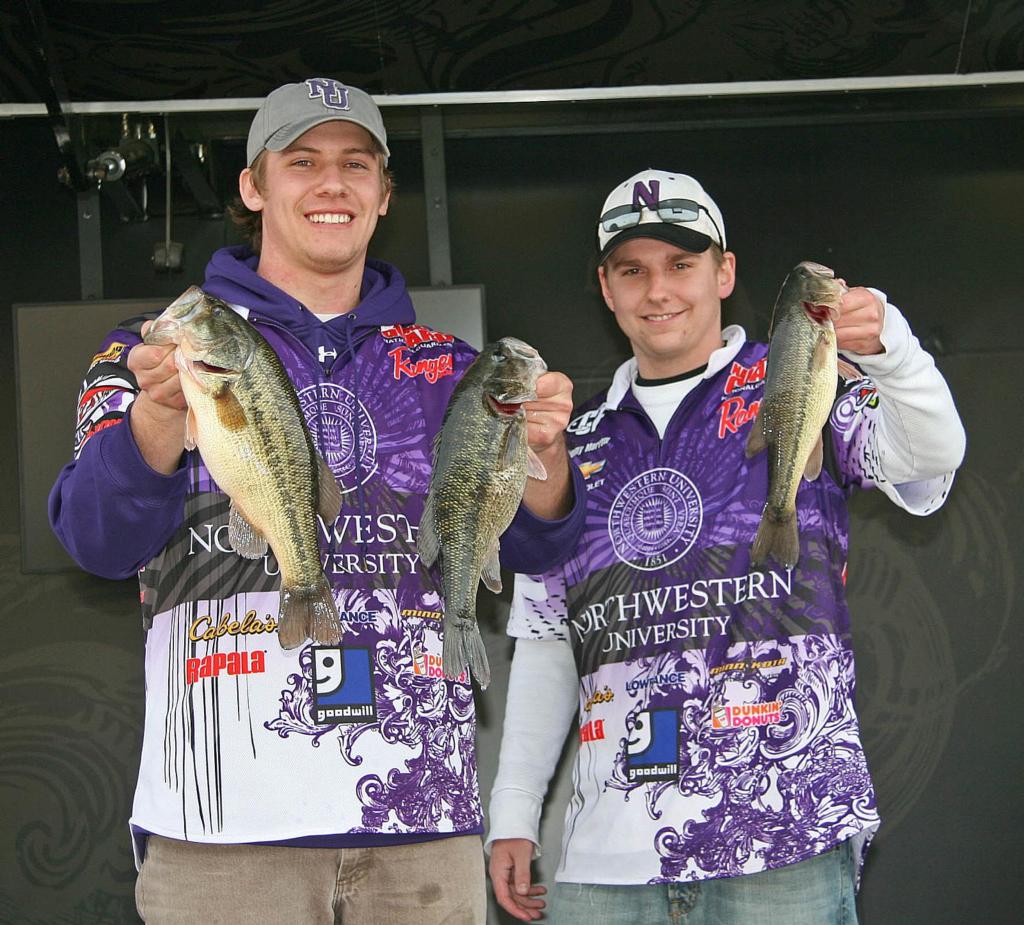
(Editor’s note: Leading up to the 2012 National Guard FLW College Fishing National Championship – slated for April 13-15 on Lake Murray in Columbia, S.C. – CollegeFishing.com will publish weekly, in-depth features stories of each of the 25 national championship team qualifiers. At stake in the tournament is a first-place prize package worth $100,000 as well as a chance for the winning team to compete in the 2012 Forrest Wood Cup.)
Class: Junior
Major: History, Legal Studies
Hometown: Georgetown, Ill.
Other interests: Baseball, reading, studying, watching “Swamp People” and other History Channel shows, squirrel hunting and long walks on the beach.
Class: Junior
Major: Sociology, Business and Integrated Marketing Communications
Hometown: Arlington Heights, Ill.
Other interests: Golfing, hiking and traveling.
Q&A
CollegeFishing.com: How were you introduced to fishing?
Kestufskie: I grew up in the country outside a small rural town in east-central Illinois where my family is full of fishermen and women. My mother and father often took me bluegill fishing in one of the numerous ponds in a county forest preserve near my home. My first fish catch came well before my first memory, so I cannot recall when it occurred or what I caught.
When I grew older, I fell in love with wade fishing for smallmouth bass in the small local rivers and streams. I have spent countless summer hours chasing them with my father and brother. These hard-fighting bronzebacks strengthened my love for fishing. I’ve never owned a boat, but occasionally my uncles or a friend’s father would take me bass fishing on their rigs. I began competitively fishing around five years ago in a small buddy tournament. I truly enjoyed the competitive aspect associated with tournament fishing and it compelled me to create the team at Northwestern.
Morrow: I was actually introduced to fishing in Florida. My grandparents had a house in Tampa, and I used to go there every year. One of my oldest memories is fishing off of their dock for snapper, sea trout and snook, and ever since then I have been obsessed with fishing for all different species in both fresh and saltwater. It is sort of an unlikely story that I got into fishing since no one in my family is an avid angler, but my love of nature and the water attracted me to the sport.
CollegeFishing.com: What style/method of fishing are you most comfortable with?
Kestufskie: I grew up primarily fishing residential reservoirs, so I enjoy flipping and pitching at visible cover and docks with Texas-rigged soft plastics. For a while, my go-to bait was a coffee-scented tube. As I became more experienced, I experimented with more reaction-style baits. I love cranking heavy cover with square-bills. However, my favorite method currently is topwater frog fishing. My father first introduced me to frog fishing and there is no shortage of slop to fish in central Illinois. Due to the amount of agriculture and its associated nitrates, many lakes and farms ponds experience eutrophication. My frog-fishing experience paid off immensely at the Kinkaid regional, where we caught all but one of our keepers on frog baits.
Though both Jimmy and I definitely have preferred fishing methods, I would say one of our biggest strengths as a team is our ability to adapt to unfamiliar fishing methods. For example, we placed fourth at the Lake of the Ozarks qualifier event last season exclusively fishing jerkbaits. Neither of us had ever fished this style, but we studied online materials about jerkbait fishing and made the necessary adjustments on the water.
Morrow: I grew up bass fishing in small ponds around the Chicago suburbs, so I am most comfortable with finesse fishing soft plastics such as a Senko or a traditional Texas-rigged worm. That said, my favorite style to fish is with topwater baits. Whether it be a spook or a frog, I absolutely love the excitement of topwater fishing and like to fish that style every chance I get.
CollegeFishing.com: What did it feel like to qualify for the 2011 FLW College Fishing National Championship? How do you plan to prepare for the big event?
Kestufskie: Honestly, when we started this team as freshmen two years ago, I never believed we would make it to a FLW College Fishing Regional Championship, let alone win one. I was content just to fish tournaments across the Midwest and have fun. Now we are headed to the National Championship and could not be more pumped! We have come a long way since our club’s first qualifier tournament at Bull Shoals in 2010 where we blanked. Prior to that tournament, we had done a very minimal amount of research. We did not know what it took to compete at this level. The disappointment and embarrassment I felt after this disastrous tournament got my competitive juices flowing. We managed to squeak into the Regional Championship in the first year of our club’s existence, and Jimmy and I could not have been happier.
At our first Regional Championship, we were complacent and did not prepare nearly enough for the tournament at Monroe, where we failed to weigh in a keeper. We were extremely ill-prepared and did not even have a map of the lake until the day before the tournament! This showing at the 2010 Regional Championship motivated us to work harder and fish better this year. We had an extremely successful qualifier season, finishing in the top five at two of the four tournaments (fourth at Lake of the Ozarks, second at the Detroit River) and had a great deal of momentum heading into the Regional Championship. We had a number of opportunities to pre-fish Kinkaid thanks to my relatives, Larry and Judy Hughes, who graciously allowed us to stay at their home and pre-fish from their boat. Winning at Kinkaid was extremely gratifying after all the hard work we put into our preparation. It was an exceptionally tough tournament filled with a rollercoaster of emotions, but it felt great to come out on top.
The National Championship is our Super Bowl. Currently, our club only competes in the National Guard FLW College Fishing Series. We only have two members in our club and very limited time, so we chose to exclusively fish in the best college circuit with the most competitive anglers. Jimmy and I have thoroughly combed through online tournament results and fishing reports for Lake Murray. In addition, we will spend the entirety of our spring break in South Carolina on our new Northwestern-wrapped Ranger (thanks to the FLW) getting acquainted with the body of water. We will weed through all the information we have gathered from the internet and try to find some patterns we are comfortable with. We are 100 percent committed to one goal: catching enough Lake Murray bass to win the National Championship.
Morrow: Qualifying for the FLW College Fishing National Championship feels absolutely amazing. After qualifying for the central regional in the first year the club was in existence, Matt and I could only hope that one day we could make it to the national championship. This year that dream came true with a victory in the central regional championship. Matt and I have been in preparation for this tournament for awhile now, and it is simply amazing the amount of information you can find on the internet if you know what to look for and how to search for it. I truly believe that a winning formula for a tournament directly correlates with the amount of off-water prep you do before a tournament. Also, Matt and I are going to Murray during our spring break at the end of March to get a hands-on feel for the lake.
CollegeFishing.com: Tell us something interesting about yourself that most people wouldn’t know.
Kestufskie: Throughout my lifetime, I have introduced various people from different backgrounds to the sport of fishing. After my freshman year at my local high school, I transferred to a private boarding school on the East Coast. The vast majority of my schoolmates grew up in metropolitan areas and had very different childhoods from my own. My campus featured a couple ponds which luckily boasted a healthy population of largemouth bass. I brought my rods and invited my dorm mates to come fishing with me. They quickly became hooked and we spent a lot of our time fishing. I learned that fishing as a pastime is unique and can create shared bonds between seemingly different people.
The same has happened at Northwestern. Our university lagged behind our Big Ten cohorts and never had a fishing club or team. Before us, no students had ever expressed an interest. When I learned how easy it was to enter into the FLW College Fishing series, I knew we could make it happen. Luckily Jimmy and I had met the first week of school and lived across the hall from each other. Our success has brought us a great deal of attention at our school. We were even brought out onto the football field for a home game and recognized in front of the fans!
Morrow: Without a doubt, my favorite type of fishing is shark fishing from the beaches of Florida. I use an inflatable kayak to kayak and throw out baits that weigh up to 10 pounds 300 yards offshore. The gear is heavy-duty with 100-pound test monofilament main line (the reels hold around 1,200 yards of it), 15 feet of 450-pound cable and a 3-foot section of #19 wire attached to a 12/0-16/0 straight shank hook depending on the size of the bait. When a shark hits the bait, the adrenaline rush is like nothing else I have ever experienced. Battling sharks up to 10 feet from shore on stand-up gear is truly something special. After sometimes a two-hour fight, I tail rope the hammerhead, bull, tiger or lemon shark and pull them up on the beach. I then put in a tag behind their dorsal fin and release it from the beach. It is intense fishing to say the least.