Q: What is the most difficult part of being a professional walleye angler?
-Peter, Washington
A: I think No. 1 is learning to adapt to what’s happening on the water at any given time. The problem we all run into is fishing memories or having a preconceived idea of what is going to work. You have to be able to look at the changes in the fish’s habits from day to day, or even hour to hour. Weather conditions play the biggest part of how we decide to approach the way we fish at any given time and place.
After you find the fish, they will tell you how to catch them. By this, I mean the location and type of structure they are relating to will normally tell you the best method you should use to catch them. For instance, when you find structure holding fish, try different methods to find the best presentation to catch them.
Q: What boat and motor would you recommend for a beginning walleye angler? I have a modest income and I’m looking to spend between $10,000-$15,000 on a new or used rig. I prefer to have the standard amenities such as a live well, electronics, trolling motor, etc. Any suggestions?
-Jim Greisler, Escanaba, Mich.
A: First and foremost, buy the right boat for the waters you are going to fish. There is nothing more frustrating than going to the ramp and not being able to get out. I’ve caught hundreds of fish from a 16-foot tiller boat over the years mostly on smaller inland-type waters but would never chance taking it out on a big, open-water bite. I would suggest you ask yourself this, “What kind of water am I going to want to spend the majority of my time fishing?” Is it a river system, big water, or smaller lakes?
Within your budget look for a used rig that will fill your needs. By buying used, you not only save money, but you are more likely to find a boat with more equipment on it than you might be able to afford if you bought it new. There are a lot of good “experienced” boats on the market for a guy to get started in. After some time, and as you get more into the sport, you can always upgrade.
Q: Do you think the new underwater cameras are worth the money? I’ve had thoughts about investing in one but I would like a pro’s opinion. What are their advantages and disadvantages compared to sonar and flashers?
-Jeff, Big Lake, Minn.
A: YES……I feel my camera is one of my most important tools in helping to understand what’s going on down below the water’s surface. I’ll move along using my Lowrance unit until I find fish, or some type of structure that needs a closer look. I then use the camera to tell me what kind of structure is actually there. It helps me to find the transition areas that are sometimes hard to find on my electronics. It also tells me what kinds of fish are relating to the structure. The only drawback is that you need to move slowly as not to miss anything.
Q: Are there certain tactics in walleye fishing that help trigger big bites? Or is it strictly a “spot thing.” Several times I’ve fished an area and caught dozens of walleyes but none were over 17 inches. Is there a presentation that will trigger bigger fish or do you think it’s simply a matter of changing locations?
-Pat, Appleton, Wis.
A: This is one of those questions that could be debated for hours. I have in the past found certain waters, like once on the Missouri River, where I was catching 20 to 30 fish between 14 and 18 inches. Then, all of a sudden, I’d catch a 5-pound fish. But, this is not often the case. I believe the larger fish tend to school more with other fish their own size. It has been my experience that year classes tend to school together.
The smaller fish tend to be more aggressive in their feeding habits, and tend to hit your baits before the larger ones get a chance. The larger fish like the solitude and tend to feed more at their leisure and mood. If I’m only catching smaller fish I’ll change locations, or try a little deeper water close by to see if the larger fish are there. Again, once you find the fish, the type of structure they are relating to will dictate the method you should use.
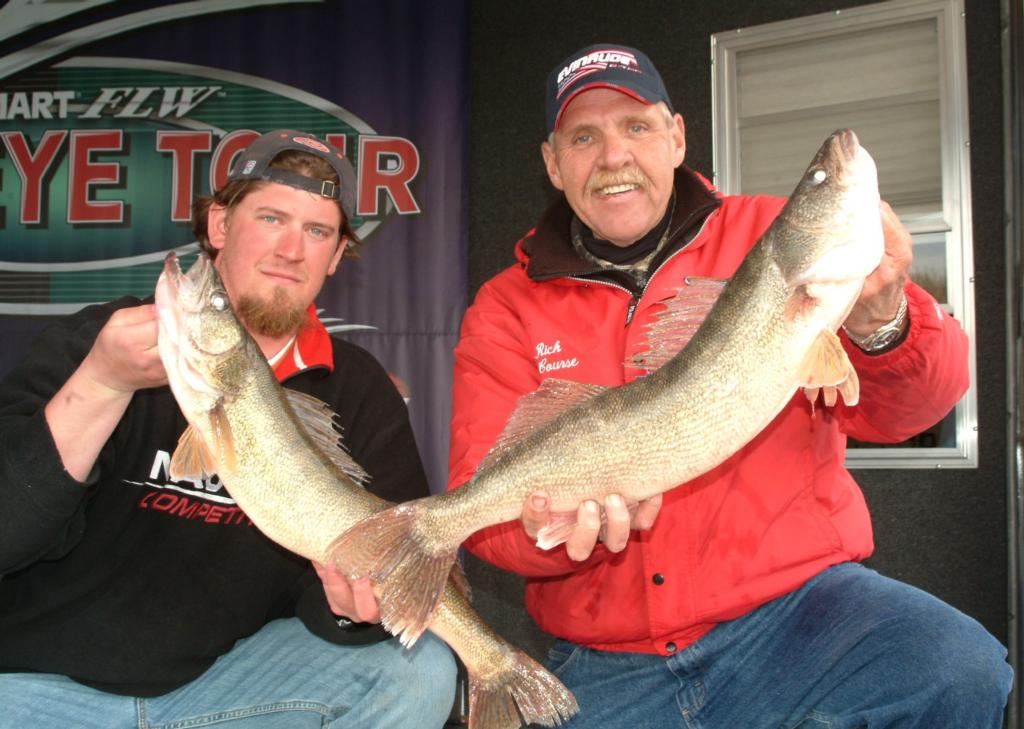
Rick Lacourse is a veteran walleye angler who has fished the Wal-Mart FLW Walleye Tour, Professional Walleye Trail and Master’s Walleye Circuit. The Port Clinton, Ohio, resident won the 1997 PWT Championship and finished in fourth place at the 2004 RCL Championship. Lacourse’s favorite walleye technique is trolling crankbaits. Lacourse’s wife, Julia Davis, also fishes as a pro on the FLW Walleye Tour. Lacourse’s sponsors include Ranger Boats, Evinrude, Minn Kota, Gemini Sport Marketing, Off Shore Tackle, Panther Marine Products, Dixie Marine and Clamps, Inc.