Q: If you could create an ideal schedule for the FLW Walleye Tour, what would it look like? Would you also give an explanation of why you picked each lake or river?
-Steve Krunning, Fargo, N.D.
A: Hi Steve, thanks for the question. I hope you weren’t looking for my thoughts on the most picturesque or exciting family fishing venues, because if I were to choose my “ideal” FLW Walleye Tour, each tournament would be on a body of water where I would have the most experience, and the best chance of winning.
That said, most of my best finishes over the past 14 years have been on the Great Lakes, so I would have to put together a schedule around my big-water favorites. I would start the season on Lake Erie in April, where big fish are concentrated in the western basin and there is a great combination of open-water and reef trolling. In addition, there are still good numbers of prespawn females that can tip the scales over 10 pounds, giving you an edge if you can connect with them.
From Erie I would go west to Green Bay in late May, where big fish can be found in shallow water from the mouth of the Fox River all the way north to Michigan. These fish can be tentative, but in most cases a slow-trolled crawler harness will produce.
The next stop would be Bay De Noc in upper Michigan in early June. Once again, there are good numbers of big Great Lakes walleyes that would be moving out of the bays, following shorelines and beginning to set up on reefs inside and outside of the main bays. These fish love a crawler harness; the key is to locate and stay with the fish.
The last stop would be one of my favorites from years past: Saginaw Bay. Arriving in early July, fish can be caught on crankbaits or harnesses, from the base of the bay all the way north past the Charity Islands.
For the FLW Walleye Tour Championship, it would be back to Green Bay in late September. Big fish can once again be caught on crankbaits or harnesses from the Fox River all the way north into Michigan waters.
Q: I understand people use planer boards to get their baits away from the boat, but I don’t fully understand the application. I already have a trip booked for Green Bay next May, and I’d like to practice this technique a little. Could you describe what a planer board is and exactly how I use one? Is there actually a spool of line inside the board? When and how do I take the board off when I get a fish? How do I set the hook? Thanks for your advice.
-Roger, Waunakee, Wis.
A: Great question, Roger. I’ll try to answer as best as I can without writing a book.
First, the planer boards you will want to purchase are made by Offshore products and are available at most sporting goods stores. I have tried and still own several different brands, but the only boards in my boat are the Offshore brand. When you purchase your boards, make sure you buy both left-hand and right-hand boards so you can work off both sides of the boat, and spend a little extra money for the “tattle flag” option. These spring-loaded flags allow you to see a light bite on a crawler harness or determine if you have picked up weeds on your crankbaits. Spring tension is adjustable for crankbait and harness applications.
Now that you have the correct equipment, let’s outline the operation. Planer boards are designed to spread your baits away from the boat, not only reducing the chances of spooking the fish, but greatly increasing the water you can cover and reducing tangles. The boards do not contain spools of line; instead they fasten to your line using a pair of quick-release clips. Setting lines is as easy as free spooling line until your crankbait or harness is at the correct depth, then attaching the board to your line as shown in the instructions. Spring tension on the tattle flag should be set so that the flag remains vertical while trolling, but any extra drag causes the flag to drop. In this way, a bite is obvious, as is any weed or debris collecting on your lure.
Setting the hook is relatively easy. When trolling crankbaits, most of the time the fish will set the hook itself due to the tension created by the forward speed. Trolling crawler harnesses will take some practice, but in general, just remember not to jerk or rip at the rod. The best way to set the hook, once the flag has dropped, is to reel line at a slow to moderate speed to increase tension, then pick the rod out of the rod holder and begin a steady retrieve. Once you have reeled in enough line so that the board is approaching the boat, move toward the front of the boat, and allow the board to swing in close enough for your partner to remove it from the line. When removing the board, try to keep as straight a line as possible between the rod tip and the fish, this will reduce the chances of the line going slack when the board is removed.
That’s about as brief as I can make it; best of luck on Green Bay!
Q: What do you think of the direction that PWT is moving? It seems like $3,000 is an awful lot of money to enter, but the field sizes are smaller. I’d argue that the best walleye anglers will rise to the top, especially in a combined-weight format, no matter the size of the field. What is your honest opinion?
-Mark H., Belle Plaine, Minn.
A: Hi Mark. I have tried to locate documentation on the new $3,000 Super pro tournaments, but as of the writing of this letter, only the unofficial dates for the events were listed on the PWT Web site. It would not be appropriate for me to make comments based on limited and/or undocumented information.
What I can tell you is that I have been very pleased with the progress of the FLW Walleye Tour as well as the FLW League events. The payout percentages are improving annually, and co-anglers are rewarded with cash, making angler participation more enticing.
The FLW Walleye Tour/League format opens the door for new tournament anglers to move up through the ranks, yet provides a quality championship for top anglers who fish all four qualifiers and amass adequate points. The idea of tournament fishing is to increase awareness and participation in the sport of walleye fishing. I believe that the two-tier structure of the FLW Walleye Tour and league events, combined with increased cash payouts, provides the opportunity and incentive for more anglers to get involved and excited about our sport.
Q: What’s the proper technique for setting the hook when casting crankbaits?
-Rob Melke, Fergus Falls, Minn.
A: Hi Rob. Good news on this question. For the most part, walleyes seem to do a real good job of hooking themselves if you can get them to hit the crank. So I’ll tell you what I do, and if you hook up with the same percentages I have over the years, you’ll be in good shape.
I use two different setups for casting cranks, but the hooksets are virtually identical. When I am casting heavier baits, such as a Rat-L-Trap or Fat Rap, I’ll use a bait-casting setup, medium heavy, with 12-pound-test mono. I will set the hook moderately hard, but quickly is the key, at the slightest hint of a hit. I have my drag set to a level that is forgiving if I hit into a large fish, and it allows me to begin cranking through the hookset, the way you would if you were reeling down on a slip-bobber. Constant pressure is the key.
When casting lighter baits like a Rapala or Thunderstick, I will switch to a spinning rod and spool my reel with 10-pound-test Berkley Fire Line. This combination gives me better casting distance, and the limited stretch of the line works well to counter the relative softness of the rod. Once again, I set the hook moderately hard and reel through the hookset, keeping constant pressure. I hope this is helpful; good luck casting!
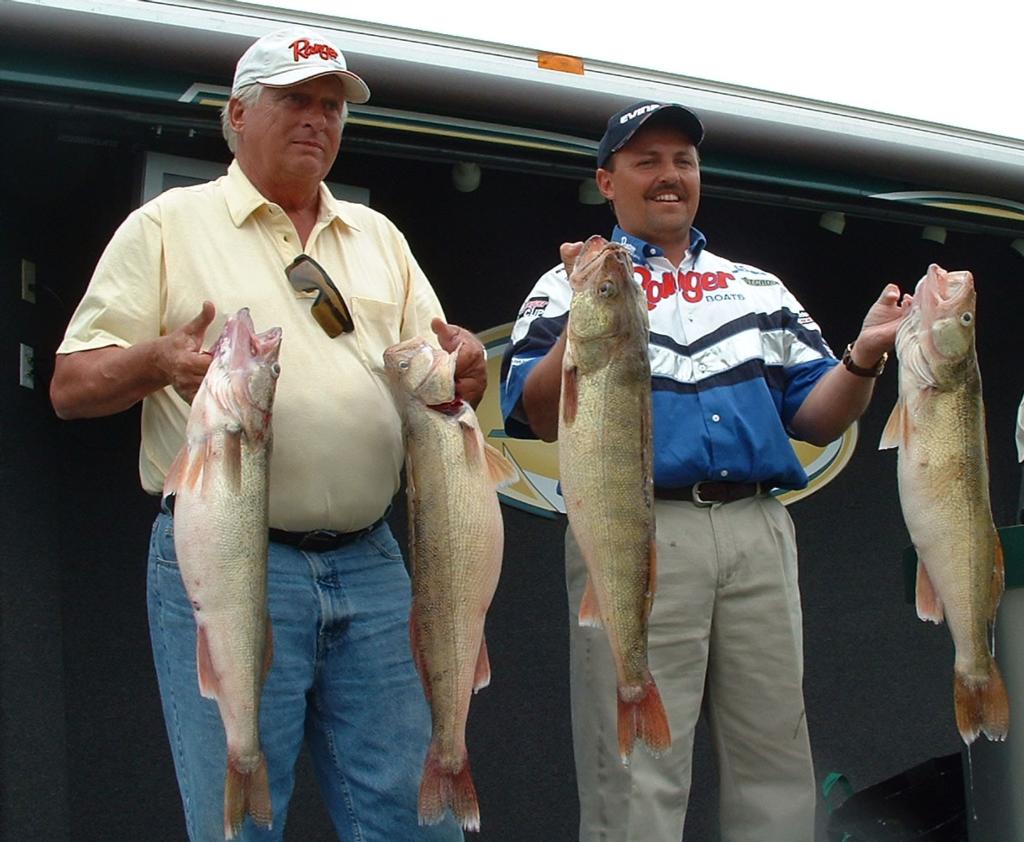
Pat Byle is a veteran of the Wal-Mart FLW Walleye Tour, having fished competitively in each year of its existence. Byle has also fished professionally on the Professional Walleye Trail and Master’s Walleye Circuit. The Hartford, Wis., native has earned over $75,000 on the FLW Walleye Tour and has qualified for the season-ending championship in four consecutive seasons. Byle’s sponsors include Ranger Boats, Evinrude and Minn Kota.