Q: When you’re fishing springtime walleyes, how do you hook your minnows? Do you hook them through the mouth or through the top of the back?
-Matt, Fargo
A: Good question Matt. The answer is I will use both methods, depending upon my presentation. If I am fishing vertically in current or casting and retrieving a jig, I will always hook the minnow through the lips. This is also the method I use if I am three-way rigging in current, or slow trolling with a Lindy Rig. Using a lip-hooked minnow allows the minnow to pull naturally, while keeping the bait alive so that it will often struggle to free itself, creating the vibration that will often trigger strikes.
One drawback to lip hooking is that the minnow can free itself from the hook do to the fact that it is not deeply hooked. To prevent this from occurring, use a small piece of a plastic twister tail and add it to the hook after the minnow has been attached. Pushing the plastic down past the barb of the hook will keep the minnow from coming free but will not negatively affect your hook set.
If I am fishing a minnow below a slip bobber, I will use the “through the back” method, hooking the minnow just behind the dorsal fin, and not too deep to hit the backbone. The key to success, especially with bobber presentations, is to make certain your bait is alive and fighting, creating the flash and vibration to attract and trigger strikes.
Q: Could you recommend a line for vertically jigging walleyes in clear water?
-Bill, northern Minnesota
A: Thanks for the question. I have vertically jigged in a lot of water over the past 20 years, and have tried countless colors, brands, weights, of monofilament and super lines. For my money, and for consistent quality and knot strength, I would look no further than Stren original in low-visibility clear. I will go as low as 6-pound test for smaller presentations, but usually spool with 8-pound test. If I am jigging deep water I will often spool with 8-pound Berkley Fireline and attach the jig with an 18-inch Stren 8-pound mono leader.
This allows me to pre-tie an assortment of jigs and spool them on a tackle buddy, then I can quickly exchange or replace if I break off. The Fireline provides added sensitivity when jigging deep water with monofilament. Over many years of tournament fishing, I have found that action of the jig and bait presentation have far more to do with success rate than the color or invisibility of the line.
Remember to check your knot and line regularly to ensure the knot is still tight at the top or the jig eye, and that there are no nicks or abrasion in the last couple inches of your line. Good luck.
Q: Can you buy a three-way rig preassembled like a Lindy Rig or do you create the presentation itself? I’ve never used one but I’ve heard they can be effective in moving water.
-Ryan, Chanhassen, Minn.
A: Three-way rigging can indeed be very effective in moving water. It is something you may want to look into, if you spend any amount of time fishing walleyes on rivers, and particularly if those waters are turbid reducing visibility.
I have seen some pre-tied rigs, but typically these are intended for still fishing, such as the Wolf River Rig found on the shelves of bait stores and tackle shops in the Fox Valley area of Wisconsin. All of the three-way rigs that I use I tie myself, and will pre-spool the drop weights and leaders on tackle buddies so that I can quickly exchange weights and lures. I will typically use Fireline on my reels but will tie the lines for the weights and leaders with monofilament. If I snag up and break off, it is a simple matter of snapping on a new mono leader. Another advantage of tying your own rigs is the assurance of quality line and other components. I prefer to use Stren DuraTuf because I like the added abrasion resistance it provides, due to the constant bottom contact associated with rigging.
You will need to experiment with different weights and leader lengths, depending on whether you are using live bait, with or without a float for buoyancy, or artificial baits such as floating Rapalas.
One or my favorite baits for three-way rigging is a No. 5 or No. 7 floating Rapala. I’ll use an 8 to 10-inch drop to a 1-ounce sinker, and then add a 24 to 30-inch leader back to the lure. I like a bell sinker for a sandy, snag-free bottom, sometimes dragging the sinker for extra bait action, and will often switch to a Lindy No-Snagg sinker or a pencil weight if I get into an area with a lot of snags.
I also prefer using a baitcasting reel versus a spinning reel; I especially like the Diawa PT33SH because it has a flipping switch that allows me to release just the right amount of line at the touch of a button.
Hope this gives you a starting point; be sure to check out the results of the FLW Walleye Tour event in Red Wing, Minn. I’m sure there will be some success stories there using three-way techniques.
Q: What kind of set up (rod, reel, line, etc.) do I need to slow-troll crankbaits with bottom bouncers?
-Jon Redwine, Eau Claire, Wis.
A: I do a lot more trolling with crawler harnesses on bottom bouncers than I do crankbaits on bottom bouncers; however, the equipment is going to be pretty much the same. I am assuming that you are going to be pulling cranks in current, or possibly along a distinct breakline, using your bow-mount trolling motor. If this is the case, you will probably be using a weight in the range of 3/4-ounce to 1 1/2-ounce. This is pretty typical of the weights I will use when pulling three-ways with floating Rapalas or similar baits.
I use a St Croix Avid Series 7-foot baitcasting rod, medium action, with a Diawa PT33SH baitcasting reel. The Avid Series rods are lightweight, helping to reduce fatigue when pulling for hours at a time. The Diawa PT33SH has a fast retrieve and more importantly, has a flipping switch allowing me to release just the right amount of line with the touch of a button. I prefer to use 14-pound Berkley Fireline on my reels, and I will use 8 to 10-pound test Stren DuraTuf for my leaders. Once again, this would be for slow-trolling stick-type crankbaits; your weights and rods get heavier as bait speed and depth increase.
I see that you are from Eau Claire, Wis. If you spend a lot of time fishing the Mississippi, you may want to consider investing in handline equipment. I have had the opportunity to learn this technique and it is simply the most effective way to present crankbaits in a current flow, especially in deep water with rapidly changing bottom contours.
I hope this is helpful, best of luck on the Mississippi.
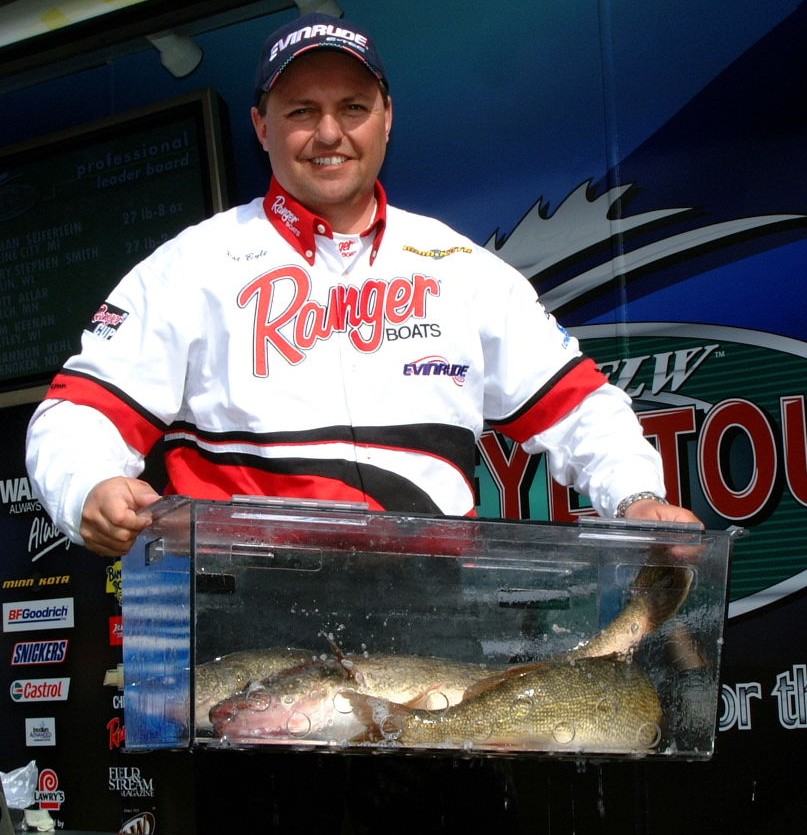
Pat Byle is a veteran of the Wal-Mart FLW Walleye Tour, having fished competitively in each year of its existence. Byle has also fished professionally on the Professional Walleye Trail and Master’s Walleye Circuit. The Hartford, Wis., has earned over $86,000 on the FLW Walleye Tour and his sponsors include Ranger Boats, Evinrude and Minn Kota.