Q: I read that many of the pros were using slip-bobbers on Devils Lake. This seems like such a simple presentation. What subtleties do you use to make it more effective? Also, what kind of structure do you look for when using this set up? Why does it seem like the bobber-bite dies when it gets really windy?
-Tyler, Anoka, Minn.
A: Tyler, slip-bobbers really are a simple presentation. Most folks use slip-bobbers in Devils Lake to fish the numerous flooded trees and brush walleyes use for cover. Some of the best areas I have found usually have a lot of horizontal cover such as fallen trees in 4 to 10 feet of water or areas with a lot of flooded brush. Casting any lure into this extremely heavy cover is usually not very efficient due to the amount of snags encountered. One trick to extracting walleyes from this mess is simply to anchor or tie the boat to a tree and suspend a light jig and leech combo under a slip-bobber slightly above the cover or in small open areas.
When a bobber goes down quickly set the hook and get the fish up near the surface to avoid getting wrapped in the trees. I like to use a short leader (15 inches) of Trilene XT 8-pound test with a main line of 10-pound Fireline. The monofilament will break if I get snagged and allow me to get most of my rig back.
The bobber bite seems to be best in the trees when it is fairly calm. I believe the fish seek the shade and cover on calmer days. When the wind blows and the waves pound into the trees it is hard to present a slip-bobber rig correctly. The waves tend to drift the bobber too fast making the presentation more likely to snag up or not allow the fish enough time to react to the presentation. Also the walleyes may abandon the trees temporarily because the waves cause the submerged trees to move violently up and down creating too much disturbance for the fish to feel comfortable.
Q: With one event left, who do you think is going to win Angler of Year of the year? Is it possible to still defend your crown?
-Ben Henning, Shakopee, Minn.
A: Ben, the AOY competition is still tight. Dennis Lantzky has a nine-point lead on Jason Przekurat and a 12-point lead on Tom Keenan going into the Green Bay event, which is the last qualifying tournament of the season. This should make for a real barn burner in the points race. Both Jason and Tom live near Green Bay and are well known for their outstanding ability to catch big-water walleyes. However, Dennis is no stranger to big-water fishing and is having a tremendously consistent year. I’m sure he will work extra hard for a strong finish at this event. For me to retain my AOY title I will most likely have to place in the top-five and hope for a miracle. The points are too close for me to pick a winner but I would bet one of the top three will pull it off.
Q: How will the fishing be on Green Bay in July? Will most of the guys still troll with crawler harnesses in shallow water?
-Packerwalleye, Oconto Falls, Wis.
A: Packerwalleye, I think the fishing on the Bay in July will be excellent. We may not see the huge weights we did in May last year but there will be numbers of big fish caught. I’m sure many fish will be caught fairly shallow pulling crawler harnesses but a deep, suspended bite with spinners or crankbaits could produce some huge weights too.
Q: What is the difference between a crankbait and a stickbait?
-Michael, Bowling Green, Ohio
A: Michael, an artificial minnow or crawfish imitating bait with a large, diving lip that causes the bait to dive deep on the retrieve or when trolled is commonly referred to as a crankbait. An example of this would be a Berkley Frenzy Diving Minnow. When you hear someone talking about a stickbait they are usually referring to a slim, minnow imitating bait that has a relatively small diving lip and runs four feet or less on the retrieve such as a Berkley Frenzy Firestick Minnow. Technically all artificial balsa or plastic baits with a diving lip could be considered crankbaits, but anglers often refer to the slim shallow runners as stickbaits and the baits with a large diving lip as crankbaits.
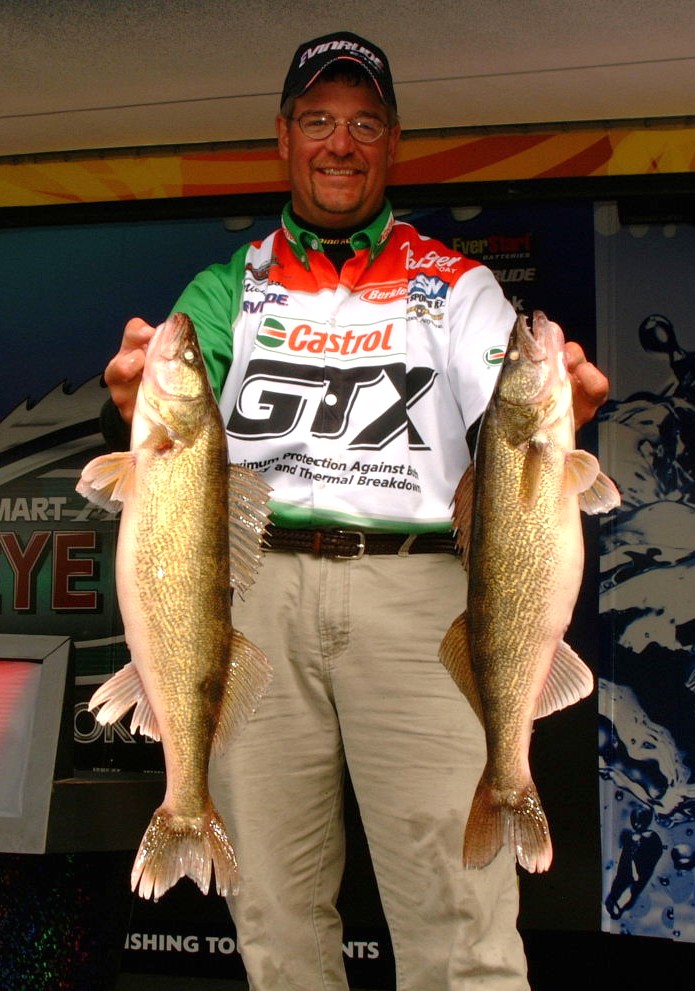
Nick Johnson earned walleye fame by becoming the first angler to win back-to-back FLW Walleye Tour events. In 2004, he claimed the FLW Walleye Tour Championship on the Mississippi River. Johnson followed that performance with a season-opening victory in 2005 on Bull Shoals reservoir. For his career, the Elmwood, Wis., pro has finished in the top-10 six times and his career earnings exceed $445,000. Johnson, the reigning 2005 FLW Walleye Tour Angler of the Year, is sponsored by Castrol, Ranger Boats, Evinrude and Minn Kota.