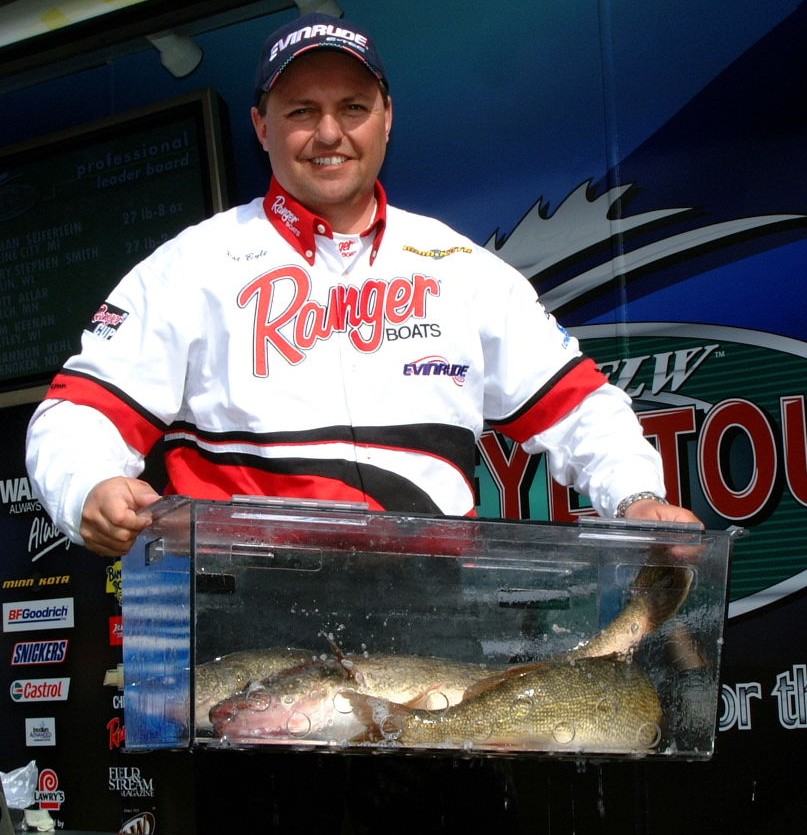
Q: How do you get crankbaits down to 30 and 40 feet of water? I read that the pro winner at the championship was running his cranks on the bottom in 40 feet of water. I’ve trolled cranks before, but this I don’t understand. The big walleyes are on the feed in my neck of the woods, and I want to get out there one more time before it is too cold.
-Kyle B., Minnetonka, Minn.
A: Hi Kyle, there are several approaches to driving crankbaits down to greater depths than can be achieved using typical monofilament lines, leadcore, snap weights and Berkley Fireline.
My favorite, and the method of choice at the recent FLW Walleye Tour Championship on Lake Oahe, is to troll with leadcore line. Leadcore is simply a two-component trolling line, a leadcore surrounded by a braided Dacron sheath. The weight of the leadcore pulls the crankbait down faster than the bait will pull itself. I prefer using 18-pound-test leadcore with a 20-foot, 10-pound-test Berkley Fireline leader. Using a leader allows the bait to maintain maximum side-to-side action, while using Fireline allows the crankbaits’ vibration to be transmitted directly to the tip of the rod, allowing the angler to recognize immediately if the lure becomes fouled with weeds or other debris. This is critical if you are going to be in close contact with the lake or river bottom.
I will spool the leadcore line, typically 180 to 200 feet, onto a Diawa SG47LC reel. This reel is larger than the SG27LC that I use for trolling with monofilament, which provides the added capacity for the larger diameter leadcore line. Although I prefer a line-counter reel so that I can duplicate the let-back distance from one rod to another, it is not an absolute necessity due to the fact that leadcore line is color-coded and dyed a different color for every 30 feet.
 There are several options for fastening the leadcore to the Fireline leader. I prefer the following. First, gently spread the Dacron cover to loosen it from the leadcore. Slide the Dacron back, exposing about 6 inches of the leadcore, then break off and discard the exposed lead. Push the Dacron sheath back down the leadcore so that 6 inches of Dacron sheath hang loose at the end of the leadcore. Next, push one end of the Fireline leader into the empty sheath until it hits the leadcore. Tie a single overhand knot and pull it tight on the section of sheath containing the Fireline. Tie a second overhand knot and tighten it about an inch or so from the first. These two knots will provide a very secure link between the leadcore and the leader.
To simplify, you can use a small barrel swivel to connect the leader to the leadcore; just be certain to use one that is small enough to fit through the rod tip and guides. I take the extra time to tie the knots. I don’t like the metal swivel in contact with the guides, and if the fish makes a last-second run, the swivel can momentarily hang up on the tip, causing excessive stress on the line and hooks.
Leadcore trolling depths will vary depending on the crankbait and the trolling speed, but generally speaking you can expect to achieve 5 to 7 feet of depth for every “color” of leadcore. Add to this the diving depth of the crankbait on 20 feet of 10-pound-test Fireline, and trolling depths of 30 to 40 feet can be reached.
One last important point: Select a rod that has a slow taper to provide extra cushion, as leadcore and Fireline have very little stretch. I hope this is enough info to get you started. I think you’ll find it a very effective method for digging up walleyes.
Q: Why is back-trolling so popular? Do pros backtroll or is it just a weekend-angler phenomenon?
-Bobby, Traverse City, Mich.
A: Great question, Bobby. I think back-trolling is popular mainly because it works well for the weekend angler who typically does not have as many options for boat control as a pro angler. It allows an angler with a single-engine tiller to slowly and precisely navigate in and around productive structure with relative ease and reasonably good control.
Most pros have the relative luxury of transom, cavitation plate and bow-mounted electric trolling motors as well as four-stoke kicker motors. Minn Kota makes an excellent assortment of electric trolling motors with thrusts over 100 pounds, very capable of handling the trolling requirements of weekend and professional anglers alike. We have numerous options for slow-speed presentations and do not need to turn to back-trolling, a method that our larger boats with contoured transoms would be less than ideally equipped for.
 Q: How often do pros anchor in one position? I find that during some of my most successful outings, I’m anchored and fishing vertically. Yet, in tournament fishing, it seems people rarely use an anchor.
-Navyanchor, Janesville, Wis.
A: I think that the reason you don’t read or hear of pros anchoring on a regular basis is mainly due to the bodies of water we fish. Most are huge expanses of water, and sometimes relatively featureless. The Great Lakes, for example, have schools of meandering walleyes that chase schools of baitfish. Some of the large reservoirs we fish have countless points, inside turns and numerous flats, sometimes miles in length.
Most pros recognize that anchoring can be an extremely effective tactic, but will choose to use it where it gives them a competitive advantage. I’ll give you a few recent examples. At Devils Lake in North Dakota, virtually everyone ties up or anchors near productive brush. As more and more of the exposed timber is broken away by ice, anchoring is more widely used. Another example would be anchoring above wing dams. Many of the top finishers at the Red Wing, Minn., qualifier and recent FLW Walleye Tour championships at the Quad Cities anchored above productive wing dams. At the qualifier on the Illinois River a couple years ago, a few of the 10 finalists anchored in a large eddy just below the dam. The conditions were perfect, and fish were concentrated in a relatively small area of slower-moving, shallow water. Anchoring allowed the anglers to repeatedly cast their jig presentations into the high-percentage zone.
So, where quality fish are concentrated in small areas, anchoring is a great option. For the majority of the water that we fish on the FLW Walleye Tour, we continue to run and gun, seeking out schools of active fish. It’s simply a matter of choosing the best method to get the job done.
Q: What’s your favorite excuse for not catching fish? Come on, everyone has one. Nobody catches fish all the time; sometimes the walleyes just win. Too sunny? The water is too muddy? Cold front?
-Mayflyman, River Falls, Wis.
A: Hey, Mayflyman, your namesake is one of my favorites. “There’s a bug hatch going on.” Believe me, I’ve used that one a time or two. My favorite though is “cold front got `em shut down.” How many times have you heard that one? We all make excuses at one time or another, and no one is going to catch them every time. That’s why they call it fishing and not catching.
Pat Byle is a veteran of the Wal-Mart FLW Walleye Tour, having fished competitively in each year of its existence. Byle has also fished competitively on the Professional Walleye Trail and Master’s Walleye Circuit. The Colgate, Wis., pro has four top-10 finishes to his name and has earned roughly $95,000 in his career. Byle’s sponsors include Ranger Boats, Evinrude and Minn Kota.