Q: Can you please tell me what a willow cat is? How do you hook a willow cat? I fish for walleyes on Lake Erie when I’m not bass fishing. I catch my share, but you’re never too old to learn something new about different bait. Thank you.
-Bill Madden, Canton, Ohio
A: The willow cat, also known as Tadpole Mad tom (Noturus gyrinus) in our area, is a small bullhead-looking fish that is related to the catfish family. They usually are about 2 or 3 inches long. There are actually quite a few different species of willow cats. A few species can actually grow up to 10 inches. Willow cats are primarily found in the Midwest, but have been found as far east as Tennessee, North Carolina and Virginia. I am not sure if they are found in Ohio or not. The best bet is to ask the Department of Natural Resources in your area to see what sub-species you have.
An inexperienced angler may have a hard time telling the difference between the bullhead and the willow cat. The best way to tell the difference between the two is by looking at the tail. A willow cat will have a much larger tail fin, kind of similar to an eel. A bullhead will have a short, squared-tail fin. A bullhead will also have more of a white bottom. If you see a bullhead and a willow cat in the same bucket the difference will be obvious. The color of a willow cat really depends on what kind of river bottom they come from. Willow cats can be brown, blonde, and black. Bullheads are almost always black, especially when they are real young.
There are a lot of beliefs as to why willow cats are loved by walleyes. Some simply feel that willow cats have a slime to them that gives off a scent that walleyes just crave. Others think that willow cats are predators to the walleyes during the spawn so they act on aggression.
If you are allergic to bees, I would try to stay a way from willow cats. Their sting can cause a lot of symptoms for people that are allergic to bee stings. Those stingers on the willow cat can really pack a punch. A willow cat stung one of the guys on our team during the 2005 Wal-Mart FLW Walleye Tour Championship. I won’t mention his name but he literally experienced cold sweats, had his arm go numb, and was whining all night while I was trying to get my beauty sleep.
The best way to hook the willow cat is right up through the lips with a No. 2 or 1/0 hook. Some people just hook them through the tail thinking they get more action that way.
Q: Where and how do you catch walleyes on the bay of Green Bay in early June?
-Robert Kemick, Bradford, Pa.
A: The bay of Green Bay is one of my favorite fisheries in the entire Midwest. I have had some of my best days ever on that body of water and I have only fished it a few times. Every year in the spring the walleyes start migrating their way up the Fox River and other tributaries. Once the spawn is done they start their migration out of their spawning grounds and back out to the main bay. Water temperatures play a major role for Green Bay walleyes. As water temps warm, the walleyes will start heading north. Some of my best fishing has been right in front of the mouth of the Fox around the Kidney Island area. This area is also a great place to get out of the wind. Watch out for the “garbage can lids”, or in other words, the sheepshead. Those fish can trick some of the best fishermen. If you are not catching walleyes, the sheepshead will definitely keep you entertained and in shape. Some of the other areas that can be good are the Little Sumacio River and Oconto River area. Most people troll crankbaits or pull spinners in shallow water using Berkley XT in 12 or 14-pound test. I pull spinners with crawler harnesses attached to Off Shore planer boards. The water in this area is pretty dirty so using No. 4 or No. 5 chartreuse blades would be a great option.
Q: What is the ice fishing on Lake Pepin like? How thick does the ice get? Would you recommend trying it? If so, what techniques should I use? Also, what’s the bite like on the river at ice-out? As you can tell, I’m getting spring (river) fever.
-Bob McNaul, New Trier, Minn.
A: Lake Pepin ice fishing used to be incredible for both walleye and sauger. When they introduced the nuclear power plant above lock and dam No. 3 the lake really changed. Prior to the plant, a lot of people traveling to Minnesota from Wisconsin used to cross the lake from Pepin to Lake City instead of going all the way around. Plows would come out and clear a perfect path across. Ice would be almost 3-feet thick most years. This doesn’t happen anymore. It is my belief that when the plant raised the temperature of the lake it totally changed the fishery. Don’t get me wrong they still catch fish through the ice, but from my experience there is a small window of opportunity each morning and afternoon. Best areas to work are all the points up and down the Minnesota side of the river using a small jigging Rapala and fathead minnow. The Maiden Rock flat produces a few walleyes and saugers here and there on the break. With all ice, please make sure the ice is safe before fishing. Remember that Lake Pepin is still part of the Mississippi River so the water is still moving underneath the ice.
 In all honesty, I really don’t ice fish that much anymore. I tend to stay in the boat year round fishing near Red Wing, Minn. Your best bet, if you have a boat and you like catching fish, is to go up near the Red Wing Dam during the winter. The power plant keeps the river wide open all year long down to the head of Lake Pepin. The warmer water pulls a lot of the baitfish from the lake and the walleyes and saugers follow. Evert’s Resort near Hager City, Wis., keeps a landing open all winter long and will let you use the access for a small fee. Jigging or dragging jigs during the winter seems to be the best presentation. Some of my favorite baits that time of year are B-Fish-N Tackle Ringworms, Berkley’s Power minnows and Berkley’s Gulp Twister Tails.
Q: Would you explain to me your favorite live-bait rigs for wing-dam fishing? Things such as type of hook, leader length, weight size and type, bait preferences etc. I’ve fished the river a handful of times and I can see the wing dams with the naked eye, but I never catch much.
-Frank R., Ellsworth, Wis.
A: I use a lot of different presentations during different times of the year. The biggest thing is to know what to look for. This might get a little long but this information should help.
The best way to visually study the actual physical characteristics of a wing dam is to do so in the winter or early spring when water levels are at their lowest and water clarity is at its best for the season. Water clarity at this time of year will allow an angler to look at the shallowest portion of the wing dam and see the individual rocks along the top and a portion of the front face of the dam. If it is cold out, ice forming on the rocks that stick out above the water will give an angler an easy visual of the high spots. Knowing that will tell you there is a low spot on each side. When the water levels are back up these low spots should be a great area to anchor above or troll through. The best way to remember those “spots on the spot” is by taking pictures so that in the following months once the waters have risen and hidden these areas from view, one can look back to the pictures of those particular pieces of structure.
Another critical piece of the puzzle is to learn to judge the amount of current going over the top of a wing dam and if the appearance indicates tolerable current conditions. Sure, an angler can fish all the wing dams in a couple-mile stretch of the river in a day but wouldn’t it be much easier to build a feel for what is or is not a likely fish-holding wing dam by assessing at a glance the amount of current present on a dam? This skill, this snap judgment of the state of the conditions on a particular wing dam, based on the appearance of the current flowing over the dam comes through time spent on the water. To begin building this skill, pay particular attention to the velocity and appearance of the water in the areas on dams that you are catching fish. What you will find is that fish inhabit a very small portion of any given dam and since current velocity tends to increase as you move out from shore towards the tip of the wing dam, one can reasonably expect that most wing dams will have at least one small area that has favorable current conditions. Being able to spot these areas at a glance saves time and focuses an angler’s effort on high percentage areas.
Which wing dams to start on? That really depends on a lot of factors – mainly river conditions and time of year.
Spring
Usually in February and early March walleyes start to make their annual run up to the tail-water areas for spawning. At this time walleyes are still in their wintering holes or on their way out of them. These wintering areas could be anywhere from deep, backwater holes to the main channel abysses. Other key areas at this time of year would be side cuts leading to and from the backwaters. An angler will find that the wing dams directly above and below these areas are going to be your best producers of quality walleyes if water levels remain stable.
Some of my favorite presentations this time of the year are three-way rigs and jigs. Pulling live bait or cranks on three-ways around the face, tip and backside of the wing dam can be very productive. However, the speed of your presentation is very critical as low water temps dictate slow fishing speeds. My favorite technique is pitching jigs. Jigs are exceptional producers when fished slowly with 8-pound Berkley Sensation line.
Late spring
Now the calendar says late-March and April. Water temps and flows are rising, and baitfish start piling up out of high-flow areas. Walleyes still have to find food so finding wing dams with less current on them will be your best spots. I like fishing wing dams that are in a series along a shoreline, spread out over a short distance. Each upstream wing dam will slow the current for the next one downstream. The last wing dam in the series should be a sure bet to yield some quality walleyes in high water conditions; during periods of lower water levels wing dams upstream in this series will hold the most fish. The faster the current the closer you will want to be to the shore.
Wing dams located on the inside of bends in the river will have less current on them than wing dams located on outside turns at the same water levels. This makes wing dams on the inside turns particularly attractive during periods of high water.
At this time of year, with the water levels running high, walleyes will tend to spawn in low current areas like backwaters, small side lakes, streams and bays. Once spawning is complete those wing dams in the immediate vicinity of spawning areas that are able to provide shelter from high current as well as provide feeding opportunities will be the ones you want to target.
May-September
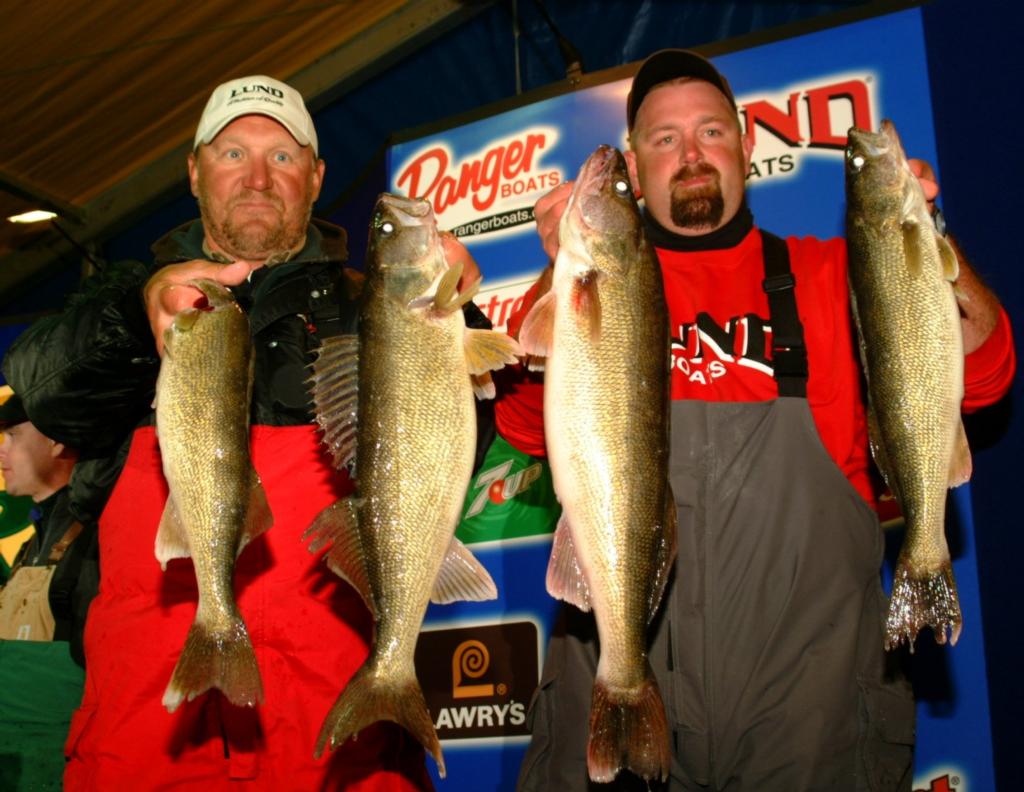 The bite is still in great shape except now we have to change a few things to stay consistent. Walleyes are starting to spread out over the entire river system so covering a lot of ground and targeting active fish will put more fish in the boat. Cranking for walleyes should be in full swing. Finding funneling areas is a must. I can think of a couple areas that consist of lakes or bays that only have a few outlets from these off-channel areas to the main river. These should be great starting spots. The wing dams next to them are even better. Trolling crankbaits can be a very fast and efficient way to locate walleyes around wing dams. Throwing deep-diving crankbaits from an anchored position to the “spot on the spot” on a dam is often the ticket once fish have been located or if the trolling bite dies.
When casting a deep-diving crankbait to a wing dam, I like to throw it on top of the wing dam and slowly reel it back to me, frequently ticking the rock of the dam. When the line goes slack or the crankbait stops running as hard as it was earlier in the retrieve, this is an indication that you have worked your crankbait down into an area in front of the dam where the current is slack or moving much more slowly than the current nearby. This is the spot to target. Walleyes will use this spot to rest out of the current while they wait for a potential meal. Make sure when casting cranks you use something like Berkley Fireline. There are a lot of snags on the wing dams so the stronger the line the less you will have to re-tie.
Live-bait rigging is another good presentation this time of year. There are a couple ways I like to live-bait rig a wing dam. One way is Dubuque rigging and the other is the old fashion egg sinker rig, either fished from an anchored position or from a boat hovering above the sweet spot on a wing dam while the position is being maintained with an electric trolling motor or small gas kicker.
On days that walleyes seem finicky the Dubuque rig and control rigging the face on the wing dam may make all the difference. This way one can cover all depths of the wing dam and be able to use different presentations. A Dubuque rig is rigged up on a three-way rig and differs from a normal three-way rig in that a jig is used for the needed weight to maintain bottom contact instead of a bell sinker. Doing so provides an angler with an additional bait in the water. This rig is only legal on border waters. Check your local and state regulations. I use a ringworm from B-Fish-N Tackle or Berkley Gulp Twisters for most applications now. On the other leader that averages 2- to 4-feet in length, I typically fish live bait like night crawlers or leeches. Remember that boat control makes all the difference with this technique. Keeping that rig in the strike zone longer will yield more walleyes. The tips and the holes at the end of the wing dams are to be fished completely and methodically using this method.
Fall
Once fall comes around everyone is usually in the woods hunting. It gets really lonely on the river. Why? I haven’t quite figured that out yet. The walleye bite on the wing dams is at its peak in the fall, even surpassing the spring bite for both numbers and shear size of fish caught. Big crankbaits are working. Live bait is working. But best of all, the ringworm and K-Grub bite comes alive again. I don’t mean just any ringworm or grub. I mean big ones. These 4- to 8-inch size plastics bring strikes that will really knock your socks off. The best presentation is working that wing dam from the middle out to the tip.
Depending on how deep the tip is will determine your size of jig. You will want that jig to drift with the current, presenting your bait in a natural fashion few fish can resist. If your jig comes back to you on a straight line or if you constantly have to lift your rod tip and retrieve line to keep your bait up off the bottom, your jig is simply too heavy.
These are just a few things to help you become a better wing-dam fisherman. Building one’s confidence on these structures will really pay off in the long run. Remember there are no wing dams that are identical and conditions are never truly the same from one season to the next. Time on the water with a close attention to details will provide you with the ability to quickly eliminate unproductive wing dams and zero in regardless of season or water level.
Jarrad Fluekiger is a well-known guide and walleye pro from Alma, Wis. Fluekiger has racked up 4 top-10 finishes on the Wal-Mart FLW Walleye Tour and has won over $55,000 in his career. In 2005, Fluekiger finished 4th at the Wal-Mart FLW Walleye Tour Championship in Moline, Ill., and finished seventh in the Land O’Lakes Angler of the Year Race. His favorite technique is fishing wing dams on his home water of the Mississippi River. When not fishing, Fluekiger is a trophy whitetail deer outfitter in Buffalo County, Wis. His sponsors include Ranger Boats, Evinrude, Minn Kota, B-Fish-N Tackle and Berkley.