The baits were swimming along behind the boat when chaos broke loose. Just a minute or so earlier, the pair of baits closest to the transom had come to the top and moved excitedly. They had since calmed, however, and the fishermen attributed it to a false alarm and relaxed a bit.
As they started to speak about what might have gotten the baits excited, a large king mackerel exploded straight into the air about 30 feet behind the transom. The king went straight up, with water trailing in rivulets off every fin and its tail. A bait was wedged sideways in its mouth. The wire leader hung out one side and a treble hook dangled from the other. At the apex of its leap, the king gracefully pivoted and headed back for the water, disappearing as quickly and quietly as it had appeared.
When the king re-entered the water, the clicker on the reel with the second line back began squealing that note fishermen love. It’s somewhere between agony and ecstasy, but it is music to a fisherman’s ears.
“Got him on!” was the happy and excited cry from the cockpit. Then, before the call to start clearing lines could be given, the rod attached to the deep downrigger popped up and bowed over heavily and its reel joined in harmony with the first.
The pandemonium was still not yet complete. Just a few seconds later and certainly as suddenly, the reel on the longer T-top rod found the third part to this whining rhapsody and the deal was on. The fishermen scrambled to clear the remaining lines and then focused their attention on the triple hookup.
The attraction of these fish and the ability to clear the other lines without tangles can be attributed to the spread, or pattern, in which the lines had been deployed. There are several basic spreads, which vary from slow-trolling for kings to fishing for offshore species, but most fishermen tweak them a little to suit their personal preferences. This article will present some preferred spreads of several successful fishermen and offer some insight into the how, why, when and where of what they do.
Kingfish spreads
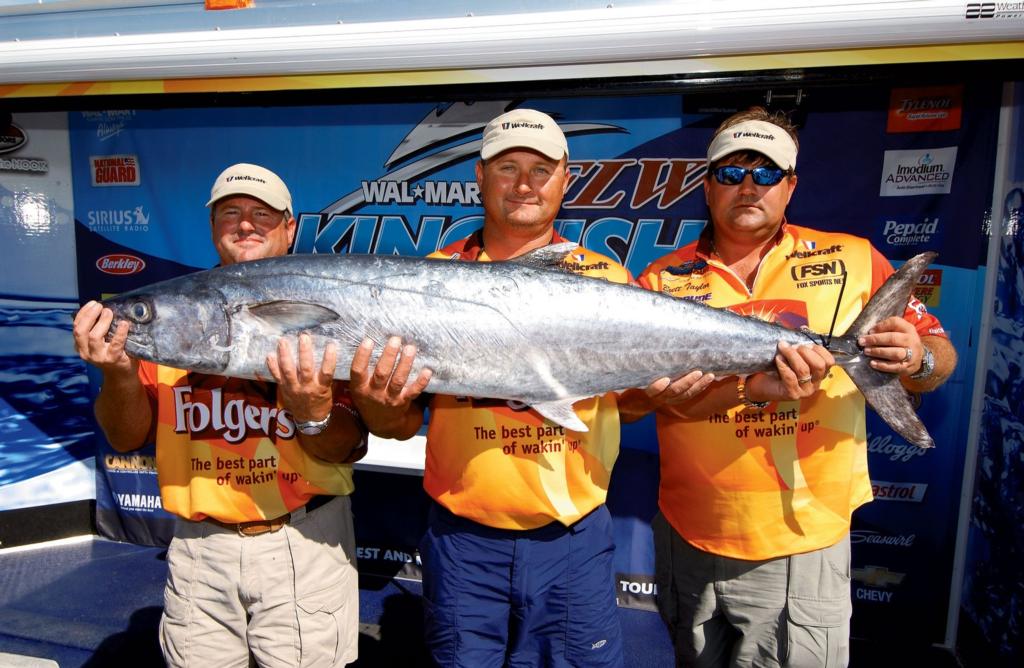
David Kingery and Team Folgers-Offshore Authority of Melbourne, Fla., has been one of the top contenders on the Wal-Mart FLW Kingfish Tour since its inception in 2005. That year, their highest tournament finish was fourth place; they completed the year in 32nd place overall with a 27th-place finish at the championship. In 2006, they scored a win at the Fort Pierce tournament with the largest kingfish landed in an FLW Kingfish Tour event (57 pounds, 13 ounces) and finished the season ranked 15th. The bottom line is they are good fishermen and most can benefit from their knowledge and experience.
“We have a basic spread we begin with in every tournament,” Kingery said. “As I talk about it, don’t get too hung up on the exact distances, but pay attention to the relationships and placements of the different lines and baits. If we are fishing by ourselves or with only a few boats, the spread can stretch out and cover a little more water while it might have to be tightened up in a crowd. If the sea is rough, we may also drop back to only four or five lines to avoid tangling and problems clearing lines after a strike.”
Kingery began with their longest line, which is run in a shotgun position from one of the vertical rod holders on the T-top. He said this line would be well back from the boat, possibly as much as 45 yards in an uncrowded situation. Team Folgers’ members said they like to use a big bait on this line, usually a big blue runner or bluefish.
The next two lines are the lines run from the side rod holders on the T-top. One is set at 35 to 40 yards and the other at 15 to 25 yards. Kingery runs these lines with different baits. If there is a blue runner on one, then there is a goggle eye or pogy on the other.
Team Folgers’ other surface line is run from a transom rod holder and is positioned at the outer edge of the prop wash. This line is five to 10 yards behind the motors and usually begins the day as a double-pogy rig. It will be immediately switched out to a live Spanish mackerel if one is landed during the day.
Kingery likes to get some flash down in the water, so they run two downriggers, both baited with ribbonfish. “We divide the water column into thirds and set a downrigger bait at one-third and two-thirds of the way to the bottom. If we are in 90 feet of water, the shallow downrigger will be at 30 feet and the deeper one will be at 60 feet. Both baits are set at 25 to 30 feet behind the downrigger ball.
“In clear water, the closer baits can see the ribbonfish underneath and often react nervously and in a manner to avoid them,” Kingery said. “The extra movement by these baitfish often gets them noticed and eaten. In the Fort Pierce, Fla., tournament this year (which Team Folgers won with an 88-pound, 10-ounce total), both of our kings hit the shallow ribbonfish – one as we were putting it out.”
Kingery reiterated this was just a starting spread and would be adjusted and changed during the day. He said if the fish weren’t biting, he and his crew were always adjusting the spread, changing baits, moving baits, adding skirts and anything else they could think of to get a big king’s attention and convince it to feed.
“We are always working,” Kingery continued. “If the fish aren’t biting, we are changing something about every 10 minutes. We stay really busy during a tournament.”
Team Kellogg’s-Reel Krazy of Little River, S.C., has a slightly different setup to accomplish the same goals. With a solid 2005 season, they finished in ninth place on the Wal-Mart FLW Kingfish Tour. They had an even stronger 2006 season, with a 12th-place finish in Sarasota, Fla., a seventh in Beaufort,  S.C., and a third at Southport, N.C. They finished 2006 ranked eighth overall. Sandwiched in all this, they managed to win the 2005 Greater Wilmington King Mackerel Tournament and finish well in several other regional tournaments.
“Our fishing setup is about like everyone else’s,” said team captain Bryan Edwards. “The difference is we only use five lines unless it is perfectly calm, and then we add the sixth one. We also fish most of our baits naked and don’t do much with skirts and stuff. However, we have become fans of Turbo Rattlers and will run one on the medium line in the spread.”
Team Kellogg’s fishes three surface lines and two downrigger lines. They start their spread with their longest line. This is set up off a side rod holder on the T-top and goes back about 80 to 100 feet.
“We have become fans of running a ribbonfish on the surface, and this is the line we put it on,” Edwards said. “When we don’t have a ribbonfish on it, it has a double-pogy rig.”
The next-longest line is run off the other side of the T-top and goes back about 60 to 75 feet. If the long line has a ribbonfish, this has a double-pogy rig; if the long line has a double-pogy rig, this line has a single pogy. This is the line that incorporates the Turbo Rattler.
Edwards said their other surface line is the prop-wash line and is run off the transom and set about 15 feet behind the motors. “We fish a single, naked pogy on this line and it has been good to us,” Edwards said. “We’ve caught several high-placing kings on this line, including the 47 to win last year’s Greater Wilmington Tournament.”
Team Kellogg’s also fishes two downriggers. Edwards said they often fished closer to the beaches and inlets and usually found themselves fishing the deeper downrigger about 15 feet off the bottom and the shallow downrigger about 15 feet below the surface.
“We have twin Raymarine E-120 units, and I can dedicate one to just the fish finder and turn up the gain on it to find a thermocline,” Edwards added. “Most of the time, we are fishing places around 50 feet deep. After I allow a few feet to be sure, I set one bait just below and the other just above the thermocline. I am setting them around 15 to 20 feet from the top and bottom, so we have begun setting them there and looking to fine-tune their depths after we have all the lines out.”
I captain Team Seaswirl out of Oak Island, N.C. We fished the 2005 FLW Kingfish Tour as Team Alan Vester Automotive. We had a good season, finishing 10th place overall and 11th in the championship. We have a slightly different version of these setups we refer to as our “prospecting spread.” This spread is designed to get baits into known locations and then be easy to adjust to react to any pattern kings show on any given day.
The lines are set in pairs and the spread begins with the longest lines, which are run from the side rod holders of the T-top. The starboard line is set approximately 100 feet back and is baited with a single live bait, usually a pogy, but a big mullet is used here if available. The port line is set a little shorter at about 80 feet and has a live bait, usually a pogy. This line has whatever attractor we are using that day – it may be a colorful skirt in clear water or a Turbo Rattler in dirtier water.
The next pair of lines are the downrigger lines. We begin with the starboard side dropped two-thirds of the way to the bottom and use a ribbonfish on it. This line also has a dripper bottle of pogy oil attached to the downrigger ball to get some scent down in the water column. The port downrigger line is set at one-third of the depth and has a single or double pogy on it.
The final pair of lines are the transom lines. The first is placed behind the running motor about 30 to 40 feet back. This line usually has a single pogy. The final line is behind the motor that isn’t running and is set at the rear edge of the prop wash, which is typically about 15 feet back. This line has a Spanish mackerel (live or dead) if one is available. If we don’t have a Spanish, we use a double-pogy rig, a ribbonfish or a big, single bait, like a bluefish.
“Our spread is set up to find fish and then allow us to get another bait close to any location the fish show a preference for on any day,” said crewmember Charlie Fisher. “If we get a couple of strikes on the same line, we will have a second line there pretty quickly.
“Last year we had a lot of fish coming right up to the transom baits, but this year our motors must sound a little different or something, and the fish haven’t yet shown a preference. We have caught fish on every line, but they have been spread pretty evenly.”
Offshore spreads
Most kingfish teams also enjoy heading farther offshore for a busman’s holiday catching tuna, dolphin, wahoo and an occasional billfish. Some really gear up with heavier tackle, and some just modify their kingfish gear and head farther off. Below are some ideas on productive offshore spreads from several of these teams.
“We like to fish live baits even when fishing offshore, so our spread will be very similar to our king spread,” said David Kingery of Team Folgers-Offshore Authority. “We make the rigs with a little less wire, especially when there are mainly dolphins around. Also, when fishing for offshore fish, we don’t use ribbonfish; we put live baits on the downrigger lines.”
Kingery said his offshore trolling speed was around 2 knots with live bait, much like when fishing for kings, but moved up to 5 knots or more when trolling dead baits and lures. The most important factor with live baits is to troll fast enough they can’t catch the boat, but slow enough they could easily keep up. When live bait is not available, Team Folgers trolls ballyhoo rigged into an assortment of skirts and small lures.
 Team Kellogg’s also makes several offshore trips each season. “Even though it’s a long run for us out to the Gulf Stream from North Myrtle Beach, S.C., we like to make several trips each year,” Edwards said. “We have a pretty good yellowfin fishery in the spring, a great dolphin fishery through the summer and a good wahoo fishery in the fall. There is just something about the way a wahoo makes the reel sing. There is also a reasonable chance at hooking up with a marlin or sailfish.”
Because there is a pretty good chance of hooking into a really big fish, Team Kellogg’s gears up to 50-pound-class offshore reels and matching standup-style rods. However, they drop back to four lines in the spread.
Much like when they are fishing for kings, they run the two longer lines from the side rod holders on the T-top. The longest of these lines is set about 100 feet behind the boat and is baited with a skirted ballyhoo. The shorter T-top line is set about 80 feet behind the boat and also carries a skirted ballyhoo.
Edwards said they mix the skirt colors through the spread, but they find green and chartreuse to be best for dolphin while a blue and white combination is best for wahoo. Tuna don’t appear to be very picky and will strike either if they are in a feeding mood.
Team Kellogg’s fishes two lines flat off the transom. One is set about 60 feet back while the other is shorter and uses a “bird” as an attractor. The “bird” isn’t really a bird, but a version of a flying fish that skips along the water. The bird is set about 20 to 25 feet behind the motors and the bait is trailed about the same distance behind it. The bait behind the bird is usually a skirted ballyhoo. One of the team’s favorites is a medium ballyhoo rigged into a Green Machine lure.
My team also has a defined beginning set for offshore fishing. As the other folks have spoken mainly about offshore fishing with baits, we thought we would talk about high-speed trolling with lures. This is a technique I learned from many successful captains, and I have found it to be productive, especially early or late in the year when there aren’t many flying fish off the Carolina coast. While this technique and spread produces when a lot of baitfish are around, its strength is covering a lot of water and finding fish when there isn’t much bait to keep them concentrated.
Before heading offshore, the outriggers that aren’t used for king mackerel fishing are slipped back into their holders, as they play a big part in presenting baits just right for offshore fishing.
This type of fishing was really set up for larger boats that create a defined wake pattern at a speed of 10 to 15 knots before breaking over on plane. To help build the wake pattern on many smaller boats, it is helpful to trim the motors out and then slowly increase the engine speed to get the desired fishing speed. This causes the boat to “squat” and make the most wake.
This method uses more fuel, but even in the times of super-expensive gasoline, most fishermen find the extra expense worthwhile. The fishing speed will usually be somewhere between 10 and 15 knots but is determined more by making the optimum wake than the exact speed.
The first line is set from a rod in one of the rod holders on the back of the T-top. This is the longest line and has a chugger lure in calm conditions or a cedar plug in rough conditions.
Next are the outrigger lines. The longest of this pair has a lure on the fifth wake on the starboard side while the other is slightly shorter and sets up the lure on the fourth wake on the port side. These lures should be positioned on the front slope of the wake. Area Rule TuNobs and Fishskin Flyers work well on these lines in most conditions.
The last pair of lines are the flat lines off the transom. On the starboard corner, a line is set to run under the surface. This can be a diving plug or a lure behind a trolling sinker or planer. The other flat line is a lure on the third wake from the port side. This lure should be positioned on the front slope of the wake. These lures work better with conical and weighted heads such as the Penn Tantalizer and C&H Jet Head.
This spread loosely resembles an inverted-V shape, with the longest line being the bottom point and the transom lines being the upper ends.
Fishing is a matter of catching hungry fish and tempting fish that might not be very hungry yet. These spreads are several successful anglers’ ways of placing attractive baits or lures in positions to entice those hungry and not-quite-hungry fish. They are a great starting point to help anyone’s fishing and should at least add more meat to the fish box.