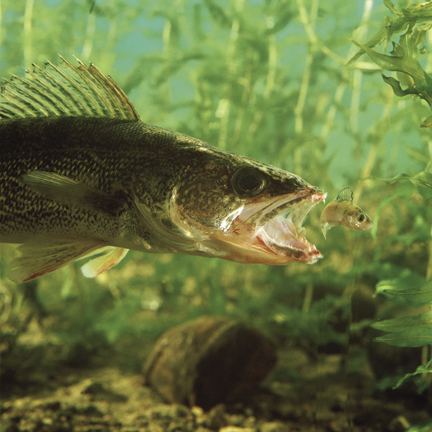
As fall gives way to winter, Northern lakes begin developing a rim of ice, and even hardcore anglers start putting their boats in end-of-season storage. For some, thoughts turn to ice fishing; for others, to a longing for the rebirth of spring, many months away.
For devout river walleye anglers, however, the fishing season never ends. Despite impending cold and harsh conditions, the best of the best is yet to come. Late fall through early spring means peak fishing despite the off-peak perception of winter.
Falling water temperatures, slowing current and dwindling hours of daylight signal walleyes to begin moving upstream. Call it an instinctive, very early prespawn migration if you wish. At the very least, it’s fall and winter staging in advance of the spring spawning cycle.
As the water chills, both predators and prey begin deserting shallow river sections where they might be trapped by the formation of ice cover. In many cases, the fish simply swim upriver to sufficiently deep holes that provide comfort, safety and the promise of a meal as winter deepens. They may move a handful of miles or migrate vast distances, depending on local habitat.
Larger rivers containing walleyes typically have dams occurring every 30 to 50 miles created for assorted purposes, such as power generation, flood control, irrigation and recreation. Dams halt walleye movement, forcing arriving fish to drop back into the deep hole formed just downstream from the dam. Eventually, they filter back into the surrounding downriver habitat. Nearby holes, the midriver basin, points, man-made structures and other obstructions that break current become focal points of winter fish activity.
In large rivers with sufficiently deep water to permit fish movement throughout winter, the initial burst of walleyes may arrive in dam areas by early fall, with more waves continuing to appear throughout the winter, building to a crescendo by spring.
Contrast that with smaller, shallower rivers, where the lack of deep water prevents major concentrations from forming until spring ice-out and high water, triggering a sudden upriver rush to the dam, followed soon after by a shift to gravel, rock and brush spawning sites. Thus, focus on big-river dam areas for the best and most consistent bite throughout the depths of winter. Small rivers tend to experience a short but intense burst of glory come spring.
With that said, walleyes also have the option to move downstream when Mother Nature sends out her seasonal signals, and walleyes may shift downriver into deeper reservoir sections as well. Here, they take up residence on classic lake structures like deep points and humps where current dissipates in the larger, broader, deeper lake environment. Subtle currents brushing up against structure may focus fish activity, but in general, it’s more like fishing a lake than a river. In very shallow rivers, reservoir sections may offer walleyes the safest and best option for surviving an ice-covered winter season.
Our focus in this feature is on the fish that move upstream, stopping along the way in deep holes – briefly, or for substantial lengths of time – along their greater sojourn to dam areas and adjacent spring spawning sites. We’ll focus on places where deep water and shallow water coincide, where current is interrupted by the terrain, and where feeding lanes and safe resting zones lie side by side. These are places where, depending on water level and current flow, walleyes have a variety of different location options.
Habitat
Deep washout holes form below dams, and during the low flow of winter, portions of these areas have slack water or minimal current flow. Where such deep water is available, walleyes are typically found at depths of 12 to 25 feet during the day and shallower under ideal cloudy, rainy, low-light conditions, or at night.
Downriver from the dam, maximum depths may be considerably less, with major holes at river bends bottoming out at 10 to 15 feet, sometimes shallower. In most cases, these should be sufficiently deep to hold walleyes, at least temporarily as they pass through the river section. Holes that occur within a few miles below dams tend to be more consistent producers of walleyes, due to the high concentration of fish in that river section. They’re also great places to try when the immediate dam area is crowded with other anglers.
The basin of the main hole below a dam may be too deep to draw walleyes, although saugers are often present. Light-sensitive saugers relish the additional depth. While you may catch the two species together, walleyes tend to be shallower, like around the periphery of a deep hole.
River-walleye anglers tend to think in terms of fishing deep holes and current-breaking structures, but in the reduced flow of winter, the general basin downstream from the main washout hole may also hold fish. If 15 to 20 feet of water is available and only slow current washes across it, walleyes may spread across the midriver basin, particularly if they can duck behind boulders on the bottom, behind the ridges of rolling sand dunes, amid clam beds, or into deeper divots or slots in the bottom. They’ll tolerate gentle current if they can hunker down a few inches to get out of it, but as soon as the river rises significantly due to stronger current flow, walleyes tend to desert such spots and head for current-breaking areas nearer shore.
When walleyes are lying tight to the basin, you might be able to spot them on your electronics, visible as tiny bumps along an otherwise regular bottom. Or, if the bottom is irregular, you might not be able to see them at all. In such instances, you have to fish for them to determine if they’re present – and biting.
Man-made wing dams – skinny rock formations extending from shore into the river to deflect flow back into the main channel – are often found on larger rivers. Wing dams, or a series of wing dams, are excellent holding spots. Current sweeping along the front (upriver) face and off the tip forms a distinct edge where walleyes can lie on bottom in little to no flow and dash into the current to grab a passing meal. The slack-water backside of the wing dam is seldom as productive.
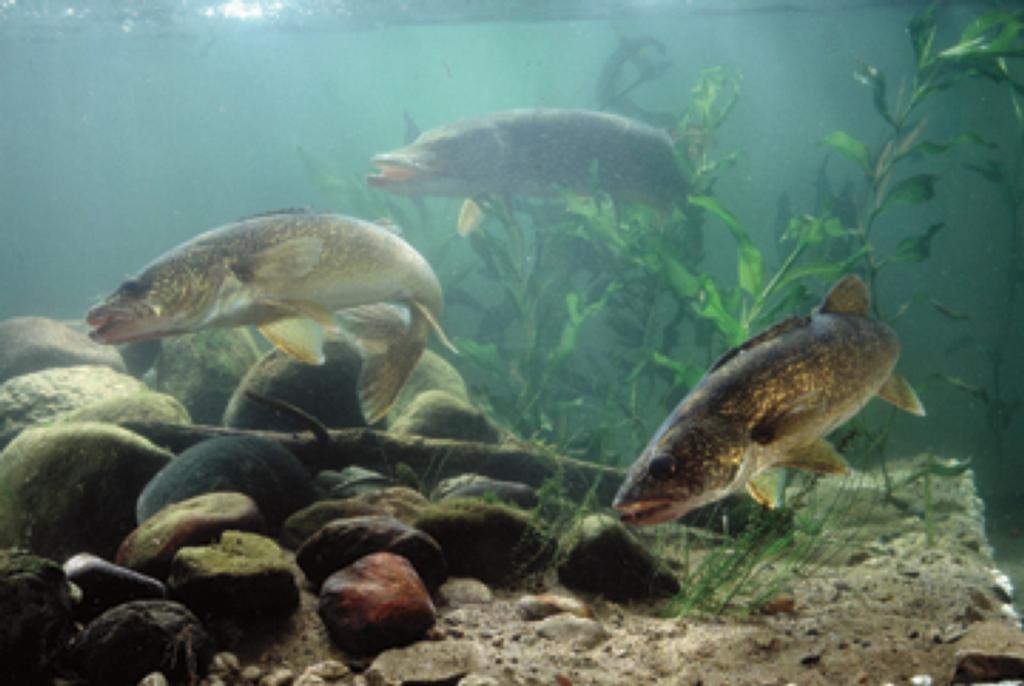 Shoreline points projecting into the river form natural current breaks – basically, nature’s version of a wing dam. Shallow rock shoals and midriver islands form natural current breaks as well – particularly if they have 10 feet or more of water nearby. Any of these areas extending into the main river basin are likely to attract fish at this time of year; similar spots in adjacent backwater sloughs are more prone to draw walleyes during high-water conditions in spring.
Bridge pilings deflect water around their bases, creating visible lines where current borders slack water. Causeways where roads cross tributary rivers funnel current through a narrow opening, creating a deep hole and current breaks on the downstream side. And where a tributary creek or river meets the main river, a combination sandbar/hole/eddy typically forms.
When the water is high and the current is swift, eddies are small, tight and have distinct current breaks along their edges, perfect for fish to feed along the distinctive edges. But during the low flow of winter, eddies are often so broad and wide that they’re almost indistinct, with very slow flow around them. In such instances, fish can spread all across an eddy, lying tight to bottom, although the most active walleyes still tend to be found near or along their perimeters.
Sometimes, you have to look carefully at the river’s surface to detect a big, slow eddy at this time of year, but once located, it’s worth checking. Somewhere in the vicinity, the proper combination of depth, current and bottom content is likely conducive to holding fish. It could even lie across a large mid-depth flat, just downstream from the point formed at a river bend.
The lesson, then, for low-water, slow-flow conditions in winter is that walleyes can be spread out in broad general midriver areas with the proper combination of depth, current and bottom content. They’re not limited to the distinct edges of visible current breaks – although they could be there, particularly when feeding.
In essence, you have a lot of potential places to check. Fortunately, you have a variety of tactics at your disposal, each with strengths and weaknesses that apply best to some types of areas and less so to others.
Presentations
At times, you can fish for walleyes with nothing more than a spinning rod, a handful of jigs and a bucket of minnows, and be right on the money. Your best bet, however, is not to arrive at the riverbank with preconceived notions. Rather, you should be prepared to adapt to changing conditions with a variety of suitable river techniques. The following are among your best options:
Vertical jigging – Classic river jigging calls for back-trolling upstream to hover, or barely slip downstream, along current breaks. Or you can slowly drift downstream, tapping your jig on and off bottom. Subtle adjustments of trolling-motor thrust and direction let you steer your jig’s path within inches of visible current seams or obstructions, or barely scratch bottom as you move downstream. If you can make your jig follow the current edges that your eyes can see, you’re on target for active walleyes.
In the slow flow of winter, you can usually get by with a smaller, lighter jig than you might need when the water is higher and faster during spring melt. I vertically jig with 1/8-, 1/4- or 3/8-ounce jigs, compared to needing a 5/8- or 3/4-ounce jumbo in deep, roaring current. Subtle hair jigs, or jigs with soft bodies and marabou tails like the Lindy Fuzz-E-Grub, tend to outproduce action tails when the water’s cold.
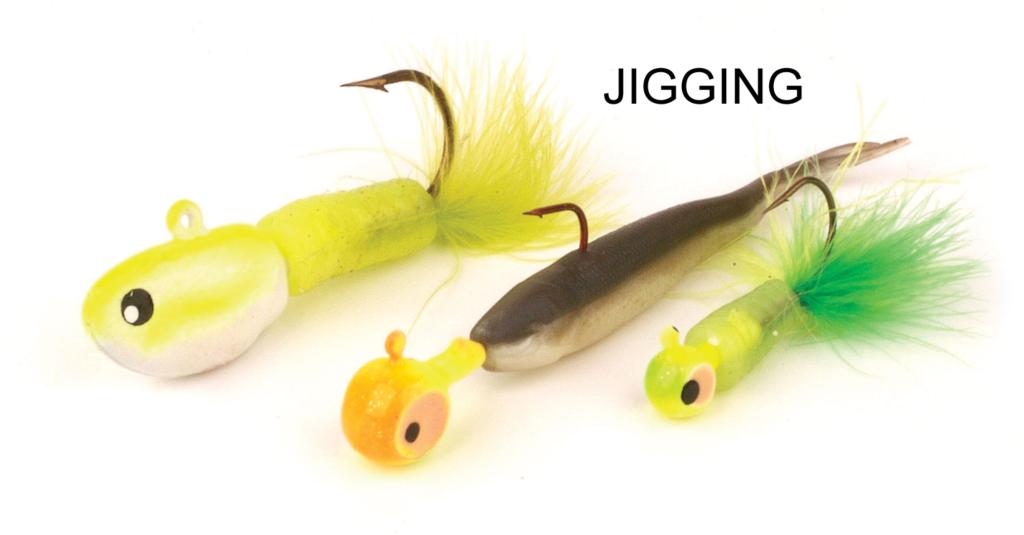 Traditionally, river anglers tip jigs with a fathead or shiner minnow, inserting the hook point up through the bottom jaw and out the top of the skull. I’m not afraid to use a substantial 3- to 4-inch minnow, either, since walleyes are aggressive and tend to bite larger baits more in fall than they do in spring, when tiny fatheads might be better. In lieu of a live minnow, I may simply dress a plain jighead with a 3- or 4-inch Gulp Alive Minnow, which has the right size, shape, texture and subtle action.
Over the years, I’ve experimented with numerous soft-plastic bodies, as well, and have caught loads of river walleyes on Berkley PowerBait shapes like Power Minnow Grubs, Power Grubs, and thumping shad-style tails like the Realistix Freshwater Power Pogy. Most of the time when fishing river walleyes, I use soft baits in favor of minnows. They’re not only handier to carry and easier to fish with, but river walleyes in particular seem to hit them as well or better than live bait. Plus, they stay on the hook better, and you can catch several fish on them, instead of having to re-bait all the time, which is a hassle in cold weather.
Whenever I hit muddy conditions, I bulk up my jig with a larger soft bait, like a 4- to 6-inch lizard, to really help get their attention in the murk. Most of the time, though, something in the 3- to 4-inch range works great.
Your best bet is to let out just enough line for your jig to scratch bottom as you proceed slowly along with your trolling motor, or drift downcurrent. As you do, apply a standard, subtle lift-drop ranging from 6 to 12 inches, raising the jig and letting it fall back to bottom. Follow it down with a taut line to the rod tip to sense light bites as the lure falls, using 6 1/2-foot medium spinning gear, spooled with 6- to 8-pound mono. Keep the bail closed, and grip the line with your forefinger to help sense bottom content and light bites.
When fish are fussy, set the hook at the slightest indication of anything unusual – or when you feel an outright thump indicating a solid bite.
If the fish are striking short, I either pause and tease them a little by tightening the line before setting the hook, or simply add a treble stinger hook to help nip short strikers.
Even though the water is generally at its clearest of the year in winter, I still use jigs featuring some combination of yellow, orange and red – highly visible colors that walleyes are able to see in dingy water or low light. Fluorescent or phosphorescent paint on the jighead is at a premium; every little bit of added visibility helps.
Casting jigs – I probably do more casting with jigs in fall than you’d expect. Folks tend to think river walleyes are always deep enough to prefer vertical jigging, especially in cold water. But given slow current, which allows walleyes to spread across wider areas, casting actually produces a lot of fish, particularly when they’re less than 10 feet deep. It’s certainly worth trying early and late in the day, when big fish tend to move shallower to feed.
Eddies, gravel shoals, wing dams and current breaks – pretty much anything with shallow potential – are fair game for casting. I go with 1/16- to 1/8-ouncers in shallow slack water and 1/4-ouncers a bit deeper or in more current flow. Cast out, let the jig fall to bottom and slowly lift the rod tip a few inches to glide the jig a foot or so, barely above bottom, before coming to rest again. Drop the rod tip as you reel up slack, then repeat. If the fish are aggressive, slow, swimming retrieves with 3-inch Power Grubs or Gulp Minnow Grubs may work as well as or better than the real thing.
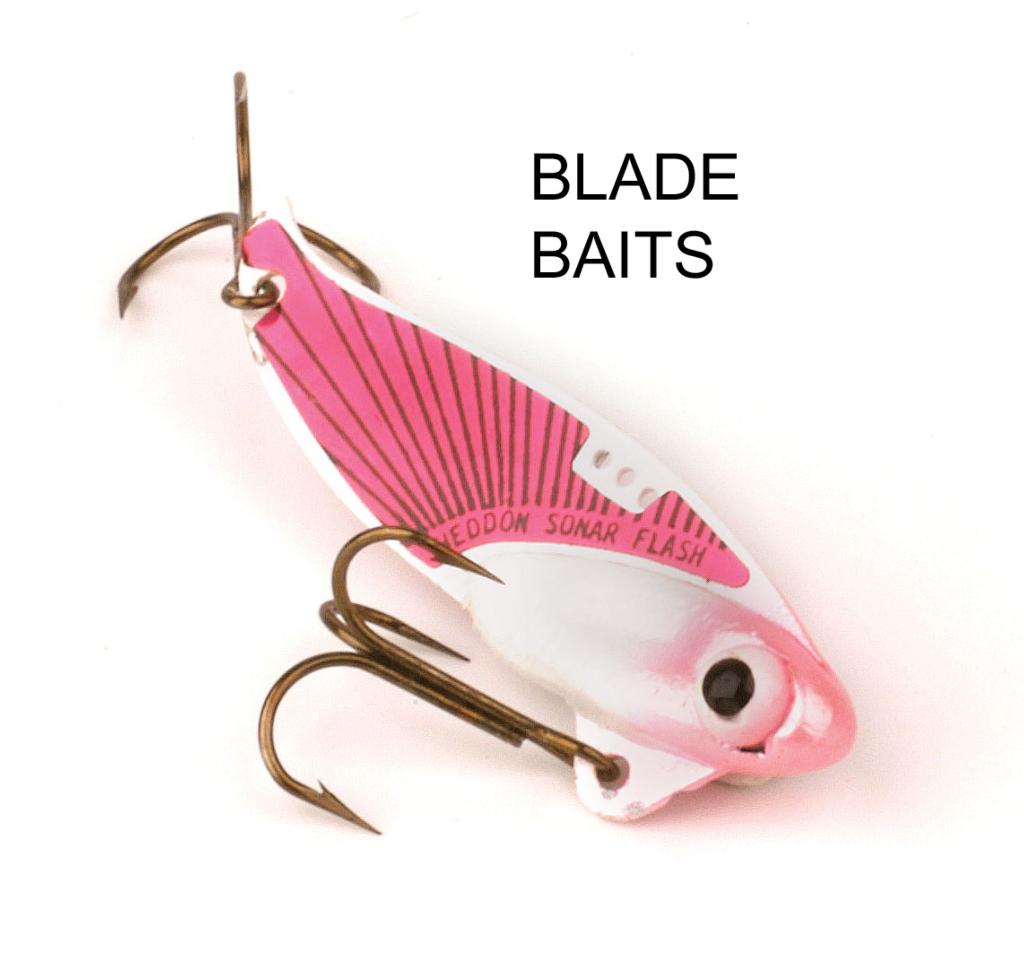 Blade baits – Blade baits are outstanding vertical jigging lures for rivers. Pump them up 1 to 2 feet with a quick pump of the rod, then follow them down with the rod tip as they sink. They vibrate hard on the lift and sort of flop down on the fall. The sudden burst of vibration triggers violent strikes in dingy-water environments. They are always worth a try when traditional jigging isn’t producing as well as it should. Use spinning or casting tackle – take your pick – with 8- to 10-pound monofilament.
Three-way rigs – Three-ways originated on rivers for fishing in substantial current. The heavy weight at the base of the dropper anchors it in position while the leader lets your baited hook, floating jighead, fly or wobbling lure flutter and dance in the current. A three-way swivel connects both segments to your main line.
A lot of folks fish three-ways from a stationary anchored position, or cast them offshore and wait for a 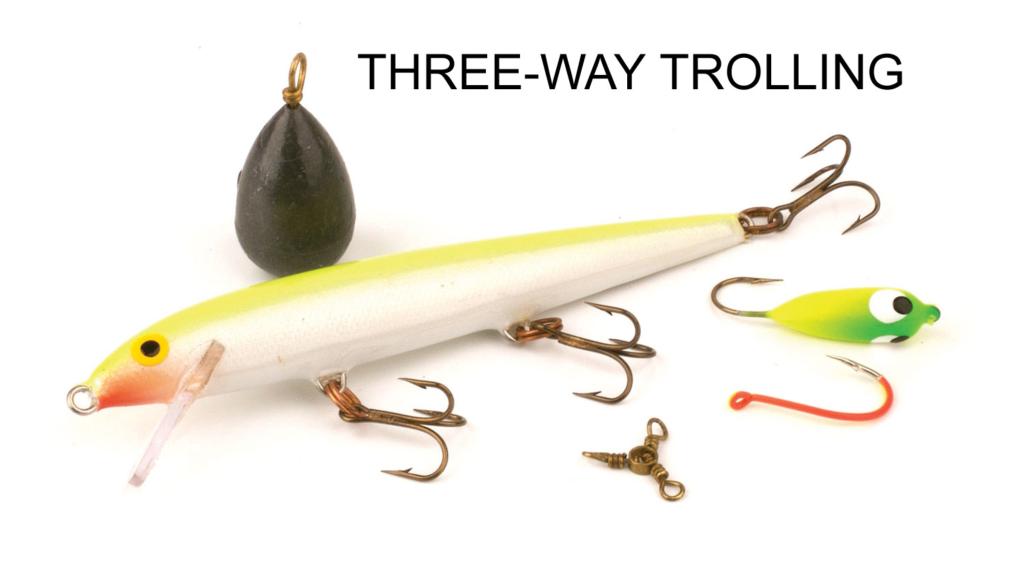 bite. I tend to prefer a more aggressive approach, moving either up- or downstream with my electric trolling motor to cover more water.
When using baited rigs, I tend to prefer floating jigheads over plain hooks, although I tip both with a minnow hooked up through the lips. A floating head bobs and weaves in the current, imitating a lively meal, and won’t settle to bottom and snag if you hit a stretch of slack current. Move along slowly with your trolling motor – not much faster than when jigging – and let the bait do its thing. Anchor or hover where necessary; the bait keeps on dancing and working in the current. When you feel resistance, set the hook.
When you’re using an ounce or more of weight to compensate for river current, the odds go to medium casting tackle and a small flipping reel with about 10-pound monofilament. Tuck the long rod handle under your forearm to take the strain off your wrist when holding and pumping a rod all day.
Trolling three-ways and crankbaits – Trolling up- or downriver is a good way to cover large areas of the basin to check for the presence of fish. I generally use a three-way rig with a minnow bait like a Rapala No. 9 Minnow or No. 10 Husky Jerk when the water is deeper than 12 to 15 feet or when I want to weave the lure precisely along current breaks.
Select a lure that will wiggle properly – not stall out or vibrate too aggressively – in subtle current. Position it barely above bottom – right where walleyes can see it and not have to move far to get it. With the right lure, I can hover in one spot with the bait still working in the current and sometimes even anchor in small, key spots.
Similar to fishing with live bait, keep both the dropper and leader fairly short: 12 inches on the drop and 18 to 24 inches on the leader. You want your bait running close to bottom. Then it’s a matter of matching your trolling speed to the current, moving upstream just fast enough to gain ground or downstream fast enough to make the lure wiggle. I pump and drop the rod occasionally to make the lure surge and stall to trigger strikes. Bumping the sinker on and off bottom signals to fish that something is approaching, and they get ready to whack the lure before it even arrives.
 I use a 6 1/2-foot medium Shimano Compre casting rod and a small reel spooled with about 10-pound mono for fishing typical river conditions. There have been occasions, when fishing in deep, swift current, when I’ve switched to wire line and heavier tackle to ply down to 40 feet, but that’s pretty extreme for walleyes. Most of the time, shallower and simpler is best.
Long-line-trolling crankbaits – In contrast, I simply long-line-troll a deep diver on Berkley FireLine when I want to cover sections of fairly stable depth, generally 12 to 15 feet and shallower. It’s a good tactic to eliminate mid-depth water between holes. Let out just enough line to tick bottom occasionally, and do the pump-drop thing once in a while. Again, adjust your trolling speed to garner the correct lure action, upstream or down.
I like subtle minnow baits and shad lures like Rapala Down Deep Husky Jerks, Minnow Raps, Shad Raps and Storm Lures Deep ThunderSticks for this application. FireLine lets me feel and interpret every pebble, wiggle and bite with ease. I tend to catch larger river walleyes on cranks in fall.
Anchoring – With pods of walleyes continually milling through good concentration spots, anchoring is a valuable and often essential tactic for winter river success. It keeps you in position and force-feeds reluctant walleyes by sticking lures or baits right in their faces and aggravating them into biting. In large eddies, I cast jigs all around the boat and work them back in, covering a large area from a single position. In small, tight eddies or along distinct current breaks, I steer my presentations right along the edge where current and slack water meet. You can accomplish a lot without even moving, provided you’ve picked a good spot to drop the hook.
Dusk to dawn
Everything we’ve discussed so far has been pretty much daytime-oriented. Yet as dusk approaches, there’s no need to go scrambling up the riverbank as the sun touches the top of the trees; nor must you be off the water at sundown, as long as it’s safe to maneuver back to the boat landing under the cover of darkness. The best bite of the day may be about to begin.
River walleyes, like their lake cousins, are triggered by changing light levels, and the sundown bite can be awesome. How far it extends on into the night depends on water clarity. I wouldn’t expect much nighttime activity in muddy conditions, but most of the time, winter means low flow and clear water conducive to a night bite, just like when fishing lakes through the ice. At the very least, the low-light periods at sunrise and sunset can be awesome.
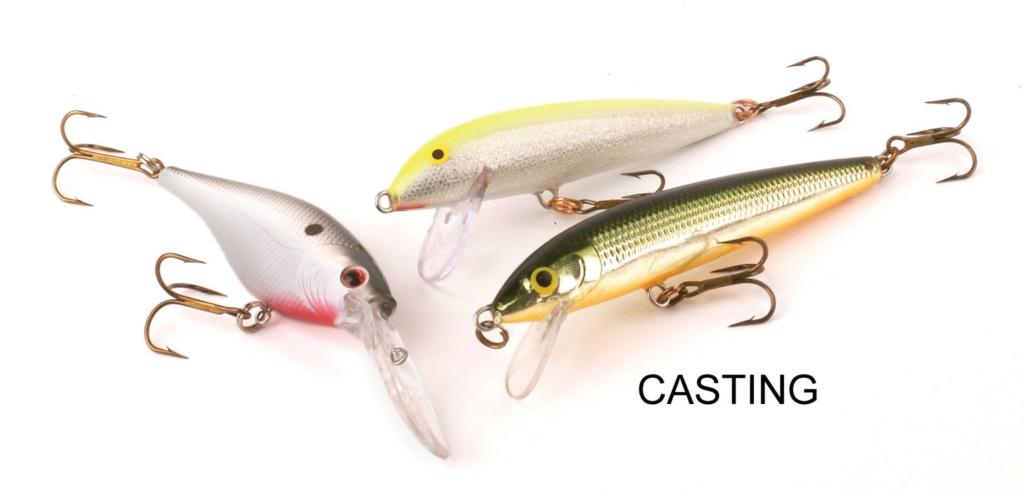 Casting crankbaits – I think the biggest fish tend to move shallower to feed under low-light conditions; the smaller ones are less likely. Casting crankbaits in shallow water may produce some of the largest fish in the system. Shallow-running shad baits, minnow imitators and suspending minnow baits tend to work best. Resist the temptation to try anything fancy. Stick to slow, gentle retrieves with occasional pumps and pauses, but don’t overwork your lures.
Select a lure size and model that ticks bottom occasionally to ensure you’re in the fish zone, but there’s no need to pound riprap, rocks, gravel or sand like you might during the day in the warm water of summer. In late fall and winter, shallow walleyes are aggressive, feeding fish that routinely hit free-running baits in low-light conditions.
If you’re limited to fishing from the bank, or wading shallow areas where the current and river bottom is safe to explore by foot, this is perhaps your best bet for catching large walleyes. Riprap sections near the dam; the downstream exit from causeways; eddies and current seams at the ends of bridges or fishing piers; tributary intersections; holes at river bends; and holes adjoining gravel shoals and sandbars – all have shallow potential come nightfall. Don’t be surprised if the fish follow your lures into shallow water and strike just off the end of your rod tip – or right at the tips of your toes.
Brrrrrrrring it on!
The coldwater conditions of winter provide some of the best fishing of the year for river walleyes. On some larger rivers, the walleye season never closes. Fish stack up in predictable areas, and their numbers continue building as reinforcements arrive. The nice thing is relatively few folks brave the elements to go after them. Pick the time and place based on the weather, fish in relative solitude, and expect to get bit, many times over.
I can’t think of a better way to spend the offseason. I avoid winterizing my small, 14-foot aluminum boat, keeping it handy for dumping in at shallow accesses, where and when shoreline ice cover permits. And if you toss in a little ice fishing on area lakes, there literally is no offseason – which is just about the way I like it for winter walleyes.