There are few places on the planet where an angler can flip for redfish – as in pitch a bait into grass 10 feet from the boat only to have 30 inches of hulking, coppery muscle thrash a lure in mere inches of water and leave the angler handcuffed to a screaming reel.
Louisiana just happens to be one of those places, and if ever given a chance to fish there, put close-range pitching and flipping for redfish at the top of the fishing wish list.
Last summer, Wal-Mart FLW Redfish Series pros Joe Crosby and Rick Steckelberg, both of Gainsville, Ga., invited me over to Cocodrie, La., to partake in what they call “flipping for redfish.”
“It’s like flipping for bass,” Crosby explained as we started the fishing day, “but much different.”
The descriptive, “like flipping for bass,” was correct, in that the presentation of the lure perfectly emulated the motion bass pros use to pitch and flip lures into small, tight targets. It was the, “but much different,” part that had me scratching my head.
About 30 minutes into the day, Steckelberg laid a flip into a grass hole just a few feet from the boat, and our peaceful fishing day exploded with water, grass and mud; it was as if we had hit a land mine in the middle of the Louisiana marsh.
“And there goes the `much different’ part,” Crosby said with a chuckle as Steckelberg could only grunt and hold on to the Louisiana land mine with a doubled-over flipping stick.
Indeed, Crosby was right. It was just like flipping for bass – a reaction bite where the fish involuntarily chomps the lure without much consideration. But whereas a bass tends to “thump” the plastic offering and hold it, a redfish jumps on the bait like a linebacker snatching up a fumble and heads for the end zone at full-throttle.
Explosive combination
In the glorious Louisiana Delta, several key elements come together to make this kind of close-range redfishing possible.
First, for some reason, Louisiana redfish fear nothing. An angler can literally idle right up to a tailing redfish, plop a bait on top of the fish, and it will wolf down a lure without a second thought. In fact, “leading” a redfish with a cast, a mandatory maneuver when fishing in Florida, is a waste of time in Louisiana.
Secondly, the Delta is loaded with lush varieties of marsh grass – spartina and cordgrass – that create gaps, pockets, holes and flooded points on the higher end of the tide.
And speaking of the tide, in Louisiana it’s usually slow and minimal, creeping into the edges of shallow marsh grass and providing 8 to 12 inches of water for redfish to hunt down anything that moves.
This lethal combination allows anglers to troll down grass lines flicking baits to holes and gaps in the grass while enjoying some explosive fishing action.
“To be that close to the furious explosion of a redfish on the end of your line is a real thrill,” Crosby said. “Rick and I are pretty much addicted to it.”
The equipment needed to sniff out Louisiana land mines from the grass is a basic flipping stick, 7 to 7 1/2 feet long in a medium-heavy to heavy action.
“You want to err on the side of being heavier in action than lighter in action,” said Crosby, who relies on a 7-foot All Pro Rod in a medium-heavy action with a fast tip. “A little tip is great, but you want to find some backbone pretty quick to move the fish out of the grass.”
As for line, come loaded for bear. Crosby and Steckelberg use no less than 40-pound-test Stren Super Braid for their main line and 25-pound test for fluorocarbon leaders.
Since fluorocarbon leaders in larger pound-tests can be stiff, both anglers use loop knots to tie on lures.
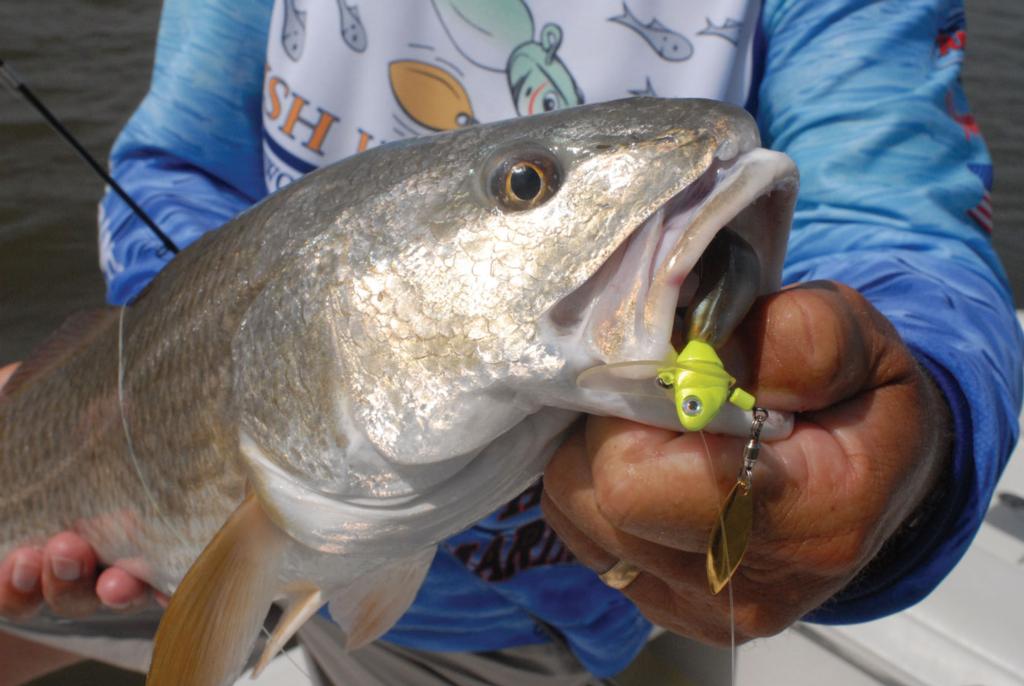 “Cinching a Palomar knot down with 25-pound-test fluorocarbon can really rob a lure of its action,” Crosby explained. “Using a loop knot allows the lure plenty of freedom of movement because the stiffness of the line is not clamped down on the lure eye.”
As for lures, just about anything tied to the end of the line will work. Crosby and Steckelberg prefer to use a Sworming Hornet Saltwater Fish Head Spin, a versatile lure Steckelberg custom designed for sniffing out Louisiana land mines (see sidebar at end of article).
Scouting targets from above
When choosing the right type of water to flip for redfish, Crosby and Steckelberg look for grass beds that have “thin” or “soft” areas within them.
“After several years of fishing hundreds of miles of marsh grass, we’ve discovered redfish definitely prefer the thinner soft spots that flood during a high tide,” Crosby explained. “We avoid fishing the long, straight, thick, hard edges of grass. But anywhere there is a `break-in’ along the hard line of grass, where the grass is thinner, or where a sparse point of grass sticks out, those are redfish magnets.”
To better read these “soft spots” along the hard line when flipping, both anglers swear by an elevated platform.
“You can read the grass so much better from high above,” Steckelberg noted. “From the lower decks, you can’t read the topography of the grass as well. From above, you can see the small, open spots back in the grass much better.”
“That’s so true,” Crosby reiterated. “We both fish from our platforms the entire day. Being on the platform is like reading the terrain in 3-D; we can see exactly where the lure needs to go. When the water is clear enough, we can actually see the fish sitting in holes from up there; we would never see those fish from the regular deck.”
Another key component to the team’s grass-flipping tactic is the high tide.
“There’s not much tide in Louisiana, maybe 10 to 12 inches, but that is a critical amount of water for flipping,” Crosby said. “The thin areas we’re talking about are virtually dry during low tide, and the grass lays over, covering the holes. But once the water starts creeping in, the grass begins to `stand up’ with the rising water, and the holes, gaps and pockets become evident – that’s when the redfish move in.”
High-speed sweeps
When flipping for redfish, Crosby and Steckelberg look like high-speed lure-pitching machines. Since this vicious bite is so reaction-oriented and there are hundreds of grass holes to cover when the tide is at a premium, the anglers don’t let moss grow under their lures.
There is no jiggling, shaking or working the bait in the holes; it gets one dunk and maybe one hop. If a land mine is not triggered, it’s on to the next hole.
“We may lollygag around a bit during the low tide, but when the upper end of the tide starts rolling in, we are all business,” Crosby added. “I’m on the front deck casting to the gaps and points along the edge, and Rick is in the back pitching back into the holes and pockets behind the edge. There is nothing but the sound of clicking reels and braid zinging through the guides. And suddenly – kaboom – the red bomb goes off and chaos ensues.”
Land-mine lures
 Take a fishing trip to Louisiana for redfish, and one thing becomes readily apparent: Delta reds are not too picky about their groceries – they bite just about anything that moves.
With this in mind, Rick Steckelberg, owner of Sworming Hornet Lures (sworminghornetlures.com), has designed a redfish flipping lure built on versatility and efficiency.
Steckelberg took his popular Fish Head Spin (a hot commodity on bass tours) and beefed it up for saltwater use by customizing it with a 4/0 Mustad UltraPoint flipping hook.
The Fish Head Spin is essentially a quality jighead with a small No. 3 willow blade dangling off the chin. The small willow blade adds an extra bit of flash and vibration needed for the off-colored water and thick marsh grass in Louisiana.
The Saltwater Fish Head Spin comes in two versions: the Original Fish Head Spin and the Fish Head Shaker, which has a small, plastic fin behind the head to increase vibration. Both can be matched with any plastic or scented trailer of the angler’s choosing.
“I like throwing spinnerbaits and pitching plastic-tailed jigs for redfish,” Steckelberg said. “But those are two different baits, and I was switching rods back and forth all day long. I wanted a single lure I could throw all day without having to switch up.”
Steckelberg’s Fish Head Spin was the answer.
“I can make long casts down outside grass edges like a spinnerbait,” he continued. “I can flip it into grass holes and pockets. I can make short casts to points and let it flutter down on the outside edge – it’s an all-in-one lure.”
The Fish Head Spin has an open-hook design, which would seem to be a problem in the marsh grass, but it’s not. The grass is hardy enough where it does not cling or grab the hook as much as one would think.
“In softer, slimier grass, like hydrilla or milfoil, the open-hook design is a problem, and that’s when we go to the Sworming Hornet Slingblade Flutter,” Crosby noted. “That’s the weedless version of the Fish Head Spin made for Texas rigging, but it still features the little willow blade for extra flash.”