
Docks, docks, they’re everywhere, and bass love them. You should love fishing them, too. If you don’t, or if you flat out stink at fishing docks, it’s probably because you’re making simple mistakes that are easily corrected with some helpful advice from FLW Tour pro David Williams. The North Carolina angler is the dock-fishing expert who cruised to victory at the 2018 FLW Tour event on Smith Lake by skipping docks with a jig. He knows what you’re doing wrong.
1. You get in a hurry
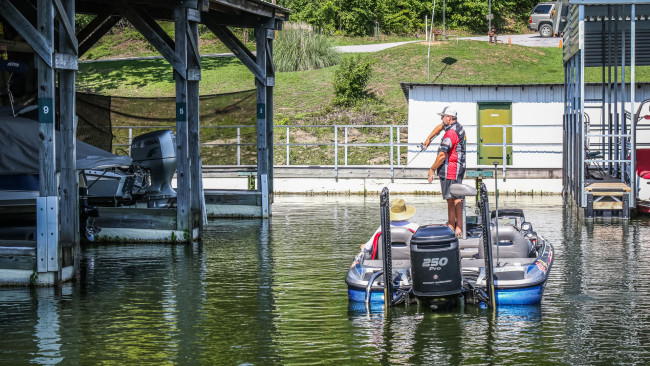
One of the most common mistakes Williams sees inexperienced dock fishermen make is rushing. Fishing quickly is good, but being out of control or in a rush can actually cost you time.
“Sometimes I think people probably get in too big of a hurry and make a mistake,” he says. “Maybe they hit the dock or don’t fish it thorough enough.”
Pinging a jig off a corner post will probably spook some bass or might result in a backlash. At the least, reeling in and resetting for another cast costs you time. Likewise, a cast that comes up short of the target does no good. It’s better to spend a bit more time on a deliberate approach and concentrate on each cast than to rush and screw it up. A few extra seconds spent on the front end leads to more casts and more docks fished throughout the day.
2. You don’t line up right
Williams preaches efficiency when dock fishing because the more ground he can cover, the more fish he’ll find. A perfect cast helps cover more ground.
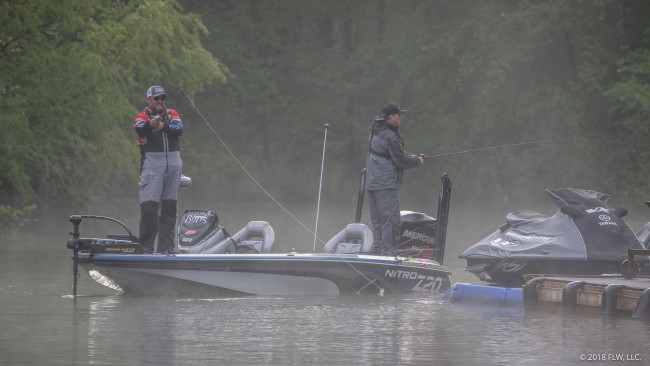
Hence, once Williams picks out a casting lane, he uses the boat to get into the perfect spot to cast far under or along the dock.
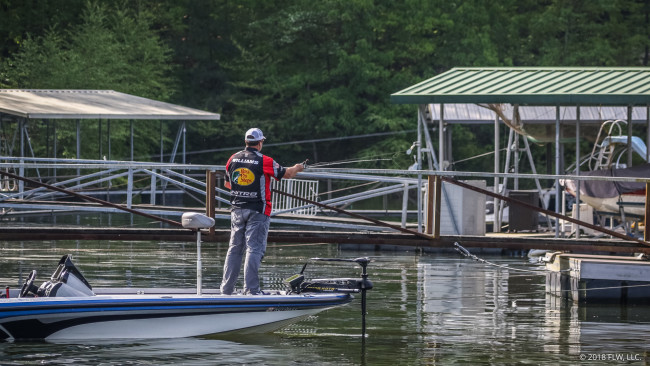
“Most of the time I fish off the side of my boat, but I try to line it up directly at 90 degrees,” he says. “I want to get perfectly straight in line where I want to cast.”
Slipping a jig through an opening at an angle runs the risk of clanging off an adjacent post or cable.
3. You make too many casts
Efficiency rules again. It’s fun to think a fish lives on every dock post or under every float, but Williams isn’t concerned about picking apart every corner.
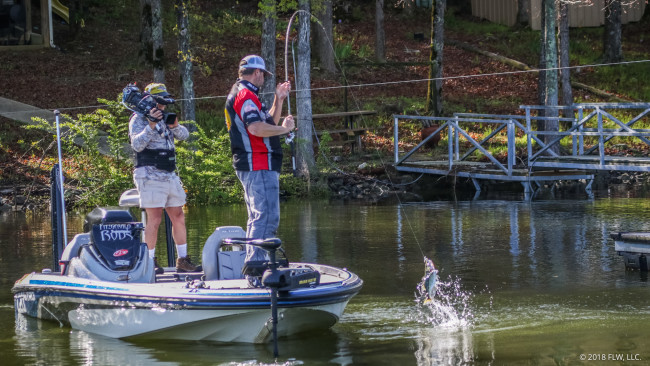
“Most of the time I’m going to make pretty much one cast to each side,” Williams says. “I’ll cast anywhere there’s shade. If there’s a hole underneath the middle, I’m going to hit the middle of it. I’m going to cover it as quickly as I can and as efficiently as I can. I’m looking for the fish that are eating. I’m not looking for the fish I have to work for.
“Typically if I catch one I’m going to pitch back in there. Or if I see a fish or something like that I may pitch back in there, or pick up another bait and pitch back in there. If I don’t know if anything’s there or I don’t get a bite or don’t see a fish, I’m probably going to be gone.”
4. You don’t think “vertically”
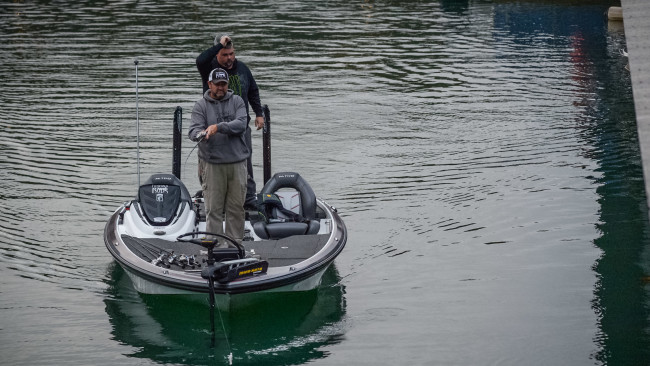
It’s easy to make the misstep of visualizing a dock in a 2-dimensional way – a squarish structure with open lanes and key features (ladders, walkways, posts, etc.) to target and maneuver around. There’s potential to overlook the key third dimension and forget that the goal isn’t just to make a nice cast; it’s to make the right presentation underneath the dock.
“One of the things you have to do is figure out how deep the fish are set up underneath the dock,” Williams says. “Sometimes they’ll be right up under the floats. Sometimes they’ll be suspended halfway down. And sometimes they’ll be on the bottom. Once you find out where they’re at then you can kind of fish all of them the same way. It takes a little bit of trial and error. They can also move up and down as the bait moves throughout the day.”
The best advice from Williams is to experiment with the presentation. Work a bait on bottom, up high and in the middle until you get a lead on where the bass are hanging out. A jig is a perfect tool for that.
“If they’re at the top I’m just going to fish the bait fast and keep it up at the top. I’ll swim it more where I can see it or keep it up right against the floats,” he says. “If they’re suspended I’m going to let it fall, maybe count it down to a particular depth where I can see them on my graph or where I’m getting bit. If they’re on the bottom I’m going to let it go to the bottom until I get slack line and hop it a couple times.”
5. You only fish a jig
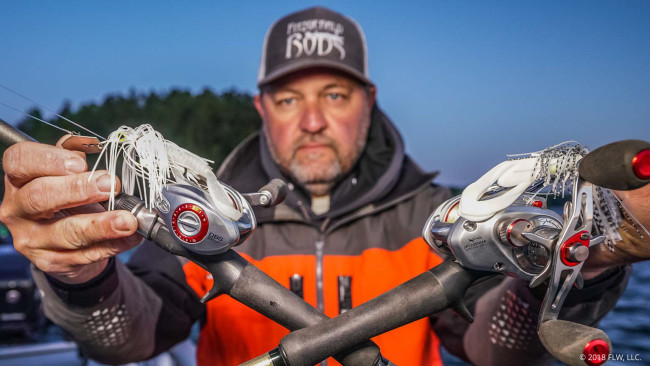
OK, so a jig is a great dock-fishing bait. Williams throws one about 75 percent of the time. The other 25 percent of the time he keys on windows of opportunity to mix it up.
In clear water, Williams likes to throw topwater, including walking baits, buzzbaits and poppers.
“If they’re biting pretty aggressively I’ll throw a buzzbait. The faster I can fish it, the quicker I can cover water. The more water I can cover, the better I can locate fish. I like to fish it tight. I’ll take a topwater and I’ll pitch it just like I will a jig. I can skip a lot of topwaters, though it’s not as easy. Also, if they don’t want a big-profile bait like a jig I’ll go to something smaller like a small topwater. Or something to try to call them up.”
When Williams locates small baitfish, he’ll match the hatch by slinging a spinnerbait with small blades, but he says that pattern requires wind to be effective.
Finally, a finesse worm is his choice when fish are finicky, or as a follow-up when a bass misses the jig.
6. You don’t consider all aspects of a pattern
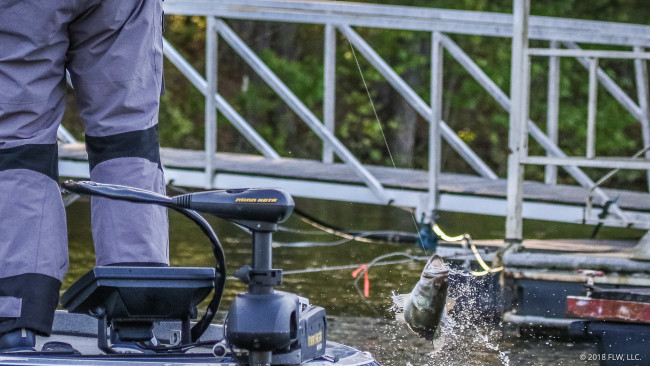
To really dial in a pattern is to look at the big picture – the conditions, the water, the area of the lake. Why were they on one walkway and not another? Why did more bites come in this creek than that one? These are the questions you need to answer.
“Sometimes they’re in the middle, sometimes on the left or sometimes on the walkway,” says Williams, “but a pattern all depends on the way the shade sets up, where the shad are, if there’s wind and current. Current plays a big factor, or if there’s a tide. It will set them up on the upstream side usually where they’re facing into the tide or current.
“There are times that once you get in a stretch of a creek where there’s a bunch of bait they’ll be under every dock. Then you may fish the whole rest of the creek and there’s no bait. When you find an area like that you can get well in a hurry. But most of the time it’s kind of random.”
7. You don’t trust your casting
Not great at skipping a jig? Those skills won’t improve by avoiding docks altogether.
“A lot of guys that’ve been with me before just aren’t comfortable doing it. They don’t trust their casting abilities enough to put it in there,” Williams says. “You have to just practice with it. The more time you spend on the water, the more comfortable you are with it.”