
Entering his rookie season on the Bass Pro Tour, Jake Lawrence would have never guessed the bait that wound up putting more bass in his boat than any other during his periods without forward-facing sonar – not to mention the most memorable catch of his young career.
At a time when finesse techniques are exploding in popularity and everyone is trying to show bass something they’ve never seen before, Lawrence leaned on a Buckeye Buzzerk buzzbait to catch “60 to 70 percent” of his scorable bass outside of the times he was able to use forward-facing sonar and a jighead minnow. He said the venerable buzzbait emerged as his primary technique at three of the seven BPT events in 2025 – including, of course, the Championship Round of Stage 4 on Nickajack Lake, where the buzzbait fooled a 5-pound, 11-ounce bass with less than 20 seconds left to lift Lawrence past Jacob Wheeler for his first Bass Pro Tour trophy.
“A buzzbait has always been in my arsenal,” Lawrence said. “However, this year was the year of the buzz, no question.”
Lawrence wasn’t the only angler to utilize a buzzbait at a high level in 2025. Edwin Evers won the Qualifying Round at Stage 7 on Saginaw Bay and nearly won the whole event on a buzzbait, using it to catch almost all of his 300-plus pounds of bass over three days. At the Tackle Warehouse Invitationals level, Dustin Smith leaned on a buzzbait in six of the seven events en route to his fifth-place finish in the Fishing Clash Angler of the Year standings. The bait was a key producer in his top-three finishes at both Lake Hartwell and the James River.
All that to say, the buzzbait can still fool bass all over the country. It catches big ones, too – Lawrence’s biggest bass of 2025, an 8-3 Nickajack giant, ate a buzzbait. The cherry on top: There are few more fun bites in bass fishing.
“One, it’s super fun, but it’s just a really effective tool,” Smith said of buzzbaits.
So, if your buzzbait box has been collecting dust, it’s time to put them back in your arsenal. Lawrence and Smith shared their tips for when to pick up a buzzbait and how to maximize its effectiveness.
Why a buzzbait?
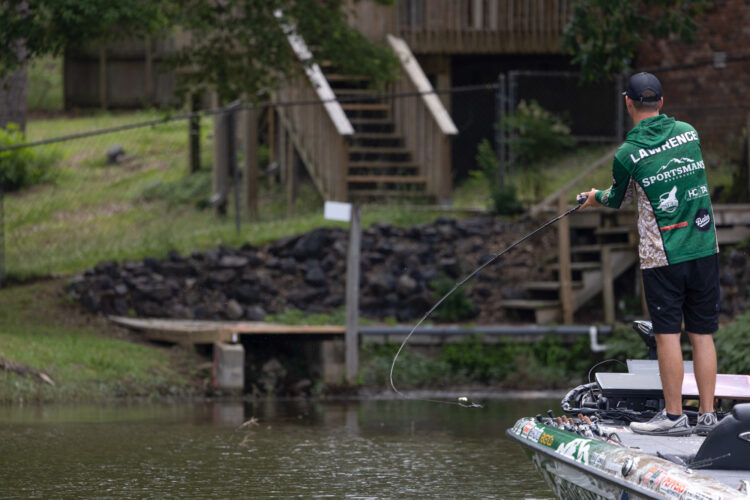
Both Lawrence and Smith emphasized that the buzzbait is not just another way to catch a bass. There are times when it can be the deal – when no other bait can generate as many bites.
Lawrence showed that at Nickajack and experienced a similar phenomenon on the Potomac River, when he used a downsized buzzbait to mimic the small needlefish bass were eating. Smith said that realization crystallized for him during a fun-fishing trip last year.
“Sometimes it’s really the bait that they want,” the Mercury pro said. “I was fun fishing with a buddy last year on Lake St. Clair for largemouth, and we found this area with some fish, and we were throwing poppers and flukes and all kinds of stuff. And it was like, man, we were getting a fish here and there. And we ended up throwing a buzzbait, and it was like a big grass flat, and we probably caught 80 bass or 100 bass or something. They wanted a buzzbait. They didn’t want a ChatterBait. Sometimes they just get really dialed in on a buzzbait.”
Even if it’s not one of those magical days, there are plenty of advantages to keeping a buzzbait on the front deck. Lawrence has gravitated to the buzzbait thanks to its efficiency. He believes he can cover more water with it than any other topwater, and even if the fish aren’t engulfing it, they often show themselves, which allows him to find areas with high concentrations of bass.
“In some cases, it’s not necessarily the best way to catch them,” Lawrence said. “But it’s a great way, whether it’s in practice or during the tournament, to kind of expand in areas. This is a great way to cover a bunch of water and get an idea of what’s living there and find those active zones.”
Both anglers also emphasized the versatility of a buzzbait. It can be fished in open water, over shallow grass flats or (where it really shines) around shallow cover. And while the fall is prime buzzbait time, it’s not a bait that only works a few weeks of the year, either. Who can forget Ott DeFoe’s epic buzzbait blowup on Toledo Bend on Feb. 1, 2024?
Both Lawrence and Smith said that, as long as the water is about 55 degrees or warmer, they’ll have a buzzbait at the ready. The biggest key to buzzbait success is finding feeding bass in shallow water – about 4 feet at the deepest, Smith said, but the shallower the better.
“Where I really put the buzzbait at the top of the list as far as techniques and ways to get them to bite is when they’re extremely shallow – 18 inches or less of water,” Lawrence said. “The reason for that is all of our bass, regardless of species, they all want to feed up. And when you’re dealing with 12 to 18 inches of water, it’s extremely hard to keep some sort of sub-surface bait above that fish. Now that we have forward-facing and the technology to see, I’m realizing how many up shallow are getting spooked by a vibrating jig or a speed senko or any sort of sub-surface bait. A lot of times in that ultra, ultra shallow water, you’ll spook them long before your bait ever gets there.”
Buzzbait or plopper?
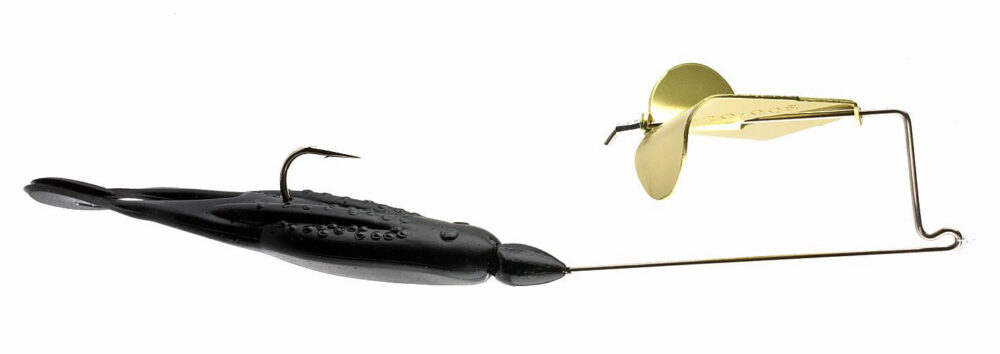
The buzzbait has often taken a backseat in recent years not only to finesse tactics but also newer topwaters – specifically, plopper-style baits like the River2Sea Whopper Plopper and Berkley Choppo. Both Lawrence and Smith utilize ploppers, but they prefer a buzzbait thanks to its versatility.
“If you come across the dock, I can skip the buzzbait under the walkway or even under the little pontoon floats,” Lawrence said. “It’s just a lot more versatile, and I can get it into areas that I simply can’t get the plopper.”

Lawrence will make the switch to a plopper when bass are swiping at his buzzbait but not engulfing it, as its treble hooks give him a better chance of landing those fish. Smith turns to a plopper when fishing shallow, rocky banks without much overhead cover.
“I throw a plopper around rock, and I think it’s got something to do with how that sound bounces off the rock underneath the water,” he said. “It drives them nuts versus a buzzbait. But any other situation, like I would much rather throw a buzzbait.”
Finding (and tuning and tweaking) the right bait

When Smith decided to take a deep dive into the world of buzzbaits, he bought every bait he could find online, took them to a pond and tested them, searching for the perfect one. His conclusion: It didn’t exist. So, he started making his own buzzbaits by combining components from different lures, something he still does today.
“One (bait), it sounds really good, but the hook sucks,” he said. “Or the hook is good, but the keeper sucks. I got to the point that I was like, I’m just going to make my own. So, I just make my own buzzbait, and it’s kind of a combination of three or four buzzbaits. I just take apart their components and build my own.”
While that might be an extreme example, buzzbaits have long been synonymous with tinkering. It’s common to hear stories of anglers rubbing wires with steel wool, crimping rivets, drilling holes in blades or even tying buzzbaits to their car antenna on the way to the lake in an effort to achieve the perfect sound.
That perfect sound is in the eye of the beholder – some anglers want a bait that squeaks, others swear by one that clacks. Lawrence likes the Buzzerk because it can do both. He said it’s naturally chirpy, and by simply bending the wire a bit, he can make the blade knock against the lead head of the bait so that it clacks.
“All I’m doing is either pushing the portion of the wire that the blade is connected to closer to the head to get it to make contact and to clack or simply pulling it away just slightly,” he said. “I essentially have the best of every world in one package there.”
While a few variations of buzzbaits exist, like double-bladed and in-line baits, both Smith and Lawrence utilize traditional, single-bladed baits with an R-bend in the wire (like a spinnerbait). Another commonality between the two is their preference for removing the skirt and threading on a soft-plastic trailer in its place.
Both anglers typically start with a toad trailer. If Lawrence wants to downsize, he’ll go to a small swimbait like the Big Bite Baits Suicide Shad. Smith opts for the Strike King Menace Grub if he needs a smaller profile. They listed a few benefits of a soft-plastic trailer: It adds weight and surface area to the bait, which makes it easier to cast and skip. The buoyancy of the plastic allows the bait to rise to the surface more quickly. And both anglers believe having more mass makes it easier for bass to engulf the bait, resulting in a better hookup ratio.
“The skipping is for sure one of the advantages,” Smith said. “But then also, I think they just get it better. When they suck it down, it’s like they have something to hold onto.”
As for size, Smith said his homemade creation uses a 5/16-ounce head. Lawrence typically starts with a 3/8-ounce Buzzerk but loves the 1/8-ounce size when fish are feeding on smaller baitfish or aren’t as aggressive. He recalled the Potomac as an example when downsizing paid big dividends.
“That second morning of practice, I actually tied on that little 1/8-ounce Buzzerk buzzbait – same exact buzzbait, just everything’s downsized, making it real finessey – and I went from getting one bite an hour to 5 or 10 bites an hour,” he said. “It was all just based on the old adage match the hatch.”
Tackle and other tips
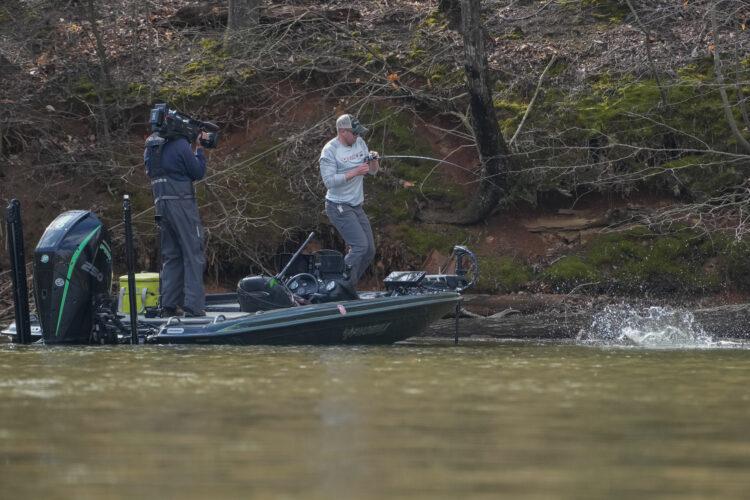
The good news for those looking to give buzzbait fishing a try is it’s not a complicated technique – just cast it out and wind it back along the surface. However, both Lawrence and Smith shared a few tips that will help you turn more buzzbait blowups into bass caught.
That starts with their tackle setups. Both anglers use medium-heavy rods that don’t have too fast of actions – Smith uses a 7-foot-4 model, while Lawrence opts for the 7-1 Dobyns Kaden 713C. While different anglers disagree on the best line for buzzbaits, both Lawrence and Smith like 30-pound braid.
“I’ve tried mono, I’ve tried fluoro, and I always kind of end back at braid,” Smith said. “I usually throw 30-pound just so I can get some extra casting distance or skipping distance, and I don’t have any problem breaking them off, so I run 30.”
That note about casting distance is key. Both anglers stressed the importance of making long casts in shallow water, especially if they’re not targeting specific pieces of cover. Another key to buzzbait success: Be patient with the hookset. Lawrence advised beginners to go so far as to hold their rod out of position on purpose.
“Most people hold the rod with their left hand – if you’ll hold that rod over your right shoulder or toward that direction across your body, you don’t give yourself any room to set the hook,” he said. “So, when one eats it, you’ve got to give him that extra second or so to wind down and get your rod in the right place.”
Their final piece of advice: Don’t pigeonhole the buzzbait as just an early-morning, late-evening or overcast day bait. Not only is it a technique that produces across multiple seasons, both Lawrence and Smith said they’ve found some epic buzzbait bites under bluebird skies. As long as there’s bass feeding shallow, they’ll be throwing a buzzbait.
“You think of a buzzbait day as an overcast, rainy day, and those can be really effective days for a buzzbait,” Smith said. “But I’m looking out my window right now, and it’s probably going to be 95 degrees today, sun and no wind, and that can be an ideal buzzbait day as well targeting shade lines and shade pockets under trees and bushes and stuff. Especially during the summer. So, don’t be afraid to throw it when it’s like the opposite of what most people would think would be a topwater day.”