————————————–
Editor’s note: This is just one article from a recent issue of FLW Outdoors Magazine, which publishes both a Bass Edition and a Walleye Edition. To learn more about the magazine and how to subscribe, click here.
————————————–
It was a bit of a shock for Alvin Shaw to see a group of boats working over his bedding fish. Those fish were supposed to be his backup plan for day one of the 2005 Wheeler Lake FLW Tour event. The State Road, N.C., pro had locked upstream to Lake Guntersville to fish ledges for postspawn bass, but they weren’t biting. So to see a crowd sight-fishing was heartbreaking.
Scrambling, Shaw moved to a shallow, sandy point with submerged grass beds and sight-fished one lowly keeper to get his day started. That doesn’t sound like much at first, but that bass tipped him off to something more. He noticed how it built its bed in a small hole in the grass. All around Shaw there was more grass. It was growing in about 4 feet of water, and there were more open holes. He couldn’t see what was in the holes, but each was about the size of a dinner plate – the same as a bass bed.
Carefully, he pitched a green pumpkin Zoom Brush Hog and let it fall into one of the holes. He waited, imagining a bedding bass had spooked at his falling lure. He let it sit until – in his imagination – the bass had circled back into the bed. Then, he shook it. Lightly, it felt like a bass picked up the lure and started moving it out of the hole, only it wasn’t his imagination.
Everyone knows the next step. Shaw set the hook and landed the fish. He continued using the same technique and eventually caught a limit. The next day he returned, but the other anglers didn’t. They had burned up the visible spawners on that shoreline and moved on. Shaw caught another limit of unseen fish, then did it again on day three. On the last day, wind made it difficult for other anglers in the finals to sight-fish. But because Shaw didn’t need to see the fish he was catching, he wasn’t affected. With the only limit of the final day, he went on to win the tournament.
The only fish Shaw saw was the first keeper on day one. The rest he caught off beds without ever seeing them, but using the same lure and presentation as if he had.
The lesson he learned is catching bedding bass that aren’t visible is a game of imagination. It is seeing what you know is there, even if you can’t see it, and then catching it.
Preferred spawning cover
The first step toward catching spawning bass when they aren’t visible on their beds is simple: Make sure bass are committed to their beds.
Fishing reports, weather, time of year, moon phase and water temperature can all lead to that determination. Other times, despite most fish not being visible, it is possible to spot one or two in a pocket of clear water or the extreme shallows. Without determining they really are on beds, it is difficult to have the confidence to adjust tactics toward catching spawning fish. And confidence is crucial.
 “You may not be able to see him there,” Shaw said, “but if you really truly believe he is there, and he is, then you are able to fish it with enough confidence that he’ll bite. And he will.”
There are many conditions that make it difficult to see bass on beds. The four most notable are dirty water, fish spawning too deep, temporary low-light conditions and windy conditions.
That said, when an angler is faced with any of the conditions mentioned, he can still search for bedding fish if he locates the right combination of lake area, bottom content and spawning cover.
Bass prefer to spawn on hard, sandy or gravel bottoms, typically 4 feet and shallower, with some exceptions. These areas can be located by visually scanning the shoreline, or even carefully poking the bottom with the rod tip. Smallmouths spawn on similar bottom content, but from about 3 to 10 feet deep and perhaps near larger rocks and boulders.
Next, most bed-fishermen agree, focus on north shorelines in shallow cuts and coves. The north side is protected from the north wind and warms the fastest.
The final step is to identify specific features in those areas that attract spawning bass.
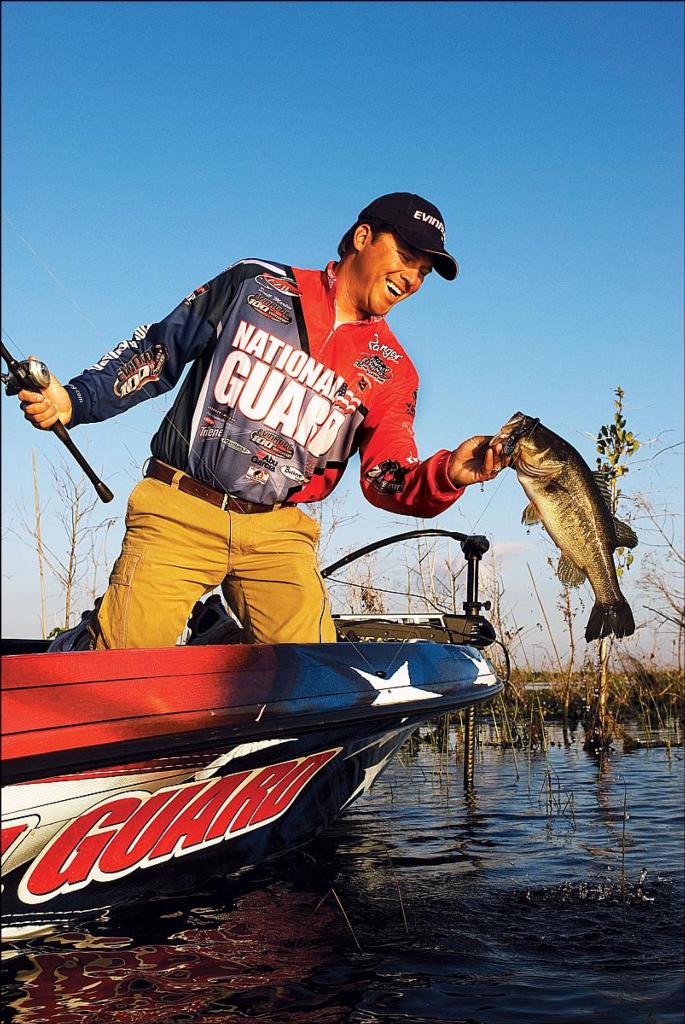
“Bass like to spawn on subtle little contour changes and subtle little dips in the shoreline,” said National Guard pro Scott Martin of Clewiston, Fla. “If you look at a shoreline and it is straight as an arrow and there is one little dip or one little shoreline nook, it is those little details that attract bass to spawn. It might be a lay-down tree. It might be a dock. It might be a little miniature point or a little turn in the bank or where it makes a little bit of a depth change. Those are the places you want to concentrate on first.”
Natural cover like grass or stumps will also attract fish to spawn, but there are better “parts” of those to focus. Bass need sunlight penetration in order to incubate the eggs. Thus, flipping into the thickest grass mats or the heart of lay-down branches isn’t always best.
Instead, fish alongside the thick trunk of a lay-down tree, the outside edge of the outside post on a dock, open holes in grass or the edge of the root system of a stump. Bass want the security of spawning alongside some cover, but it can’t be fully shaded.
The same is true for smallmouths, albeit they spawn deeper than largemouths and may relate to different types of structure and cover.
“When I’m fishing for smallmouths in Lake Champlain, for example, I’m going along and looking for individual boulders,” said Martin, who won the 2004 Lake Champlain FLW Tour event by catching spawning smallmouths. “I’d say a lot of the fish I catch, I’m not really seeing them. I’m just seeing the structure they are spawning up against.”
Shakes, drags and pauses
Once a potential bed has been located, catching a bedding bass without seeing it takes skill and an understanding of how fish on beds react to being pestered.
“I usually go with the theory that when the bait first drops in there, if it is not a real aggressive buck, then it is going to spook the fish to start with,” Shaw said. “It is going to leave. So then you’ve got to wait, and you can sort of pretend like you’re watching that fish go out around two or three clumps of grass, and it is making a circle, comes up and sees the bait back in the bed.
“You may have to let that thing sit there a minute, which is a long time when you’re just sitting there.”
At that point, a few shakes, just like when you can see you have a bass’s attention on a bed, can be all 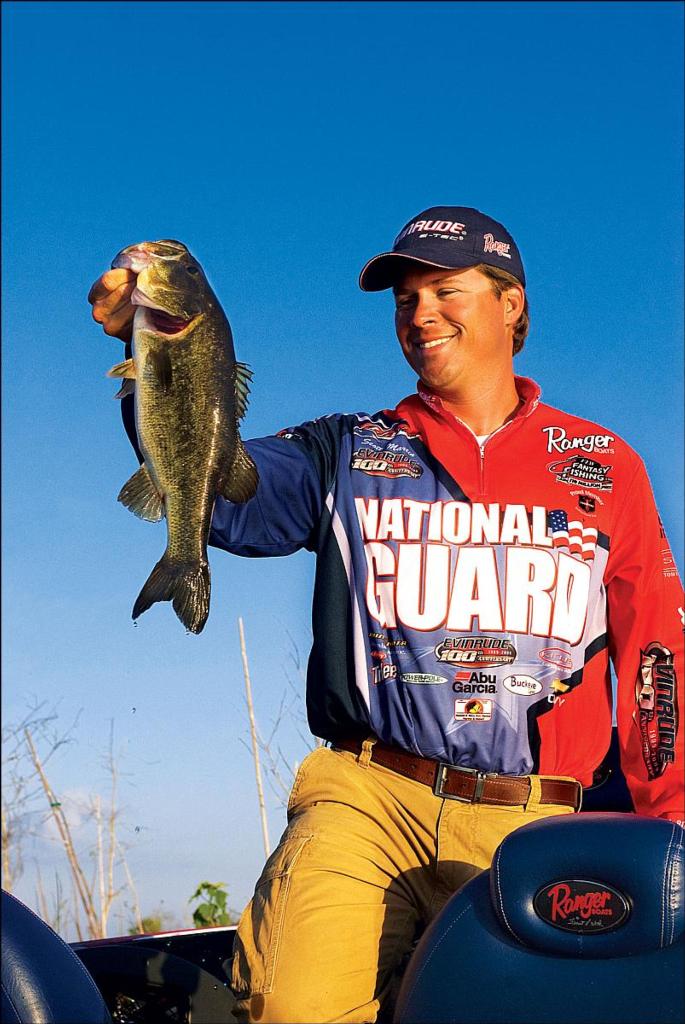 it takes to make it bite. Other times, it may take another cast in the bed. The most important thing is to experiment. Most pros will say every fish acts differently on the bed when sight-fishing, and each must be treated as an individual. But if you can’t see them, the odds of catching them go up if you can figure out some effective pattern.
“Here is the thing about bass when they spawn – smallmouths, largemouths, spotted bass, everything,” Martin said. “They have a couple-week cycle. Every day in that process the bass is going to act a little bit different.”
Early in the cycle, when the male makes the bed, before a female comes to lay eggs, the bass is territorial to a general area. Dropping a lure within a couple of feet of the bed may be enough to get the bass to bite because it will be aggressive. But when the female is on the bed, the male’s focus is on her.
“When she is on the bed, the male won’t bite anything unless it is dead center on the bed,” Martin said. “He is not paying attention to anything else. Those days are real important for accuracy.”
Once the female leaves, the fish is territorial to the sweet spot of the bed. The lure has to hit the spot that finally pushes the fish to its limit. You may need to let it sit there for 30 seconds, instead of five seconds. You may need to shake it in place, rather than pulling it through the nest.
Once the eggs hatch and the fish begins guarding fry, he’ll again bite in a larger area. Working more quickly and casting to a larger area will again get bites.
The most important lesson from this cycle, however, is to determine the activities of the fish each day. If fishing slow works for one bass, try it again on another potential bedding spot. But if it doesn’t work there, change things up again.
“You can’t look at a clock or a calendar and know what they’re doing,” Martin said. “The only way to figure that out is to pay very close attention to where you get your bites. Where was your bait in relation to the hole? Was it very tight to the hole? Was it a foot and a half to the side of it? Did he bite it real quick?”
Of course, all this action is based on the assumption that there is some idea of the exact spot where a bed is located. Searching open areas takes a little more dedication. Most importantly, fish with something that can be pulled and kept stuck to bottom. Martin uses a 3/8- to 1/2-ounce Texas rig or jig when he is searching an area he thinks holds beds but where he doesn’t have a precise spot located. The heavy weight helps keep the lure on the bottom where it can pester a bedding fish, and it ensures he will feel what is down there.
“With a light weight, your worm is going to want to lift up off the bottom and glide forward 2 or 3 feet when you pull it forward,” Martin said. “You want to drag that worm more than you want to lift it. You are trying to imitate something coming in to invade the bed. Drag it 6 or 8 inches and stop it, pause and drag it again. When it stops in a bed area, those bass will instantly attack that bait.

“Dragging is very important. When you can’t see the beds but you have a feeling there are some there, dragging is very important.”
Stay stealthy
One advantage to seeing a bass on the bed is you can hopefully see it before you spook it, or you can leave and come back and try to catch it out of visual range. For bedders that aren’t visible, anglers aren’t so lucky. Additionally, bass are tuned in enough with their environment that they often know an angler is nearby, even in low-visibility conditions.
Catching them requires stealth. Maintain the trolling motor to keep it quiet when searching bedding areas. Keep it on a low speed and try not to start and stop frequently. If casting to precise targets, consider using a Power-Pole or even a hand-held push pole.
Approach the potential bed from an angle that gives the best lighting for a chance to see slight movement, or even a slight change in the bottom color that may indicate a bed, even if the fish isn’t visible. Even use the wind to your advantage.
“Preferably, approach from upwind of the spot for the most control of your lure,” Martin said. “Crosswind or throwing into the wind, the wind will throw the line around and give it some movement you aren’t giving it.”
Most importantly, if you know fish are on beds but cannot see them, don’t be afraid to take time to go after them. Just because you can’t see them doesn’t mean they aren’t there. And if they are on beds, and you have any bed-fishing experience, then you already have an idea of how to make them bite. Visualize the fish and the presentation, and you’ll soon be seeing the real thing on the end of your line.
Bluegill tattletales
 There are dozens of subtle clues that should hint to an angler where a bedding bass is located, even if the fish are not visible. Of course, there are a few clues that should be as obvious as a fish leaping out of the water.
“Pay attention if you’re in a spawning area and you see a fish blow up on a bluegill or see a bluegill fly up out of the water,” National Guard pro Scott Martin said. “That is a pretty good indication that there is a big bass there. Bluegills are natural predators. If you see a fish blow up multiple times there is a bass bed there – 100 percent.”
Take mental notes of where the blowups occurred and sneak in to fish it quietly. Do the same any time you see an unusual movement in the grass. Sometimes it may only be a ripple. Other times the grass may part. Both are signs that a bass is cruising the area, possibly guarding fry or protecting a newly built nest.