When you ask the most prolific professional anglers in the world where bass fishing began for them, you seldom hear names like Okeechobee, Table Rock, St. Clair or Toledo Bend. Instead, their minds will likely drift to small, quiet waters, a cherished lure and the youthful anticipation of battle with a behemoth bass.
For most of us, bass fishing dreams are born on the small creeks, rivers, countless ponds/pits/lakes and other solitary fisheries throughout the country. For generations of anglers, those small waters have provided convenient places to nurture a love of the outdoors and find memorable adventure.
Small waters are training grounds, too — where a birthday rod and reel combo makes its debut, where a kid learns to cast and experiments with a new technique, where a brand new lure gets its trial run. In a few cases, that training serves as the foundation for bass fishing as a livelihood.
We connected with a handful of Bass Pro Tour anglers to find out how small waters have factored into their careers. Along the way, we extracted tips on how to size them up, fish them, and, in some cases, access them.
Brent Chapman: Where it all began
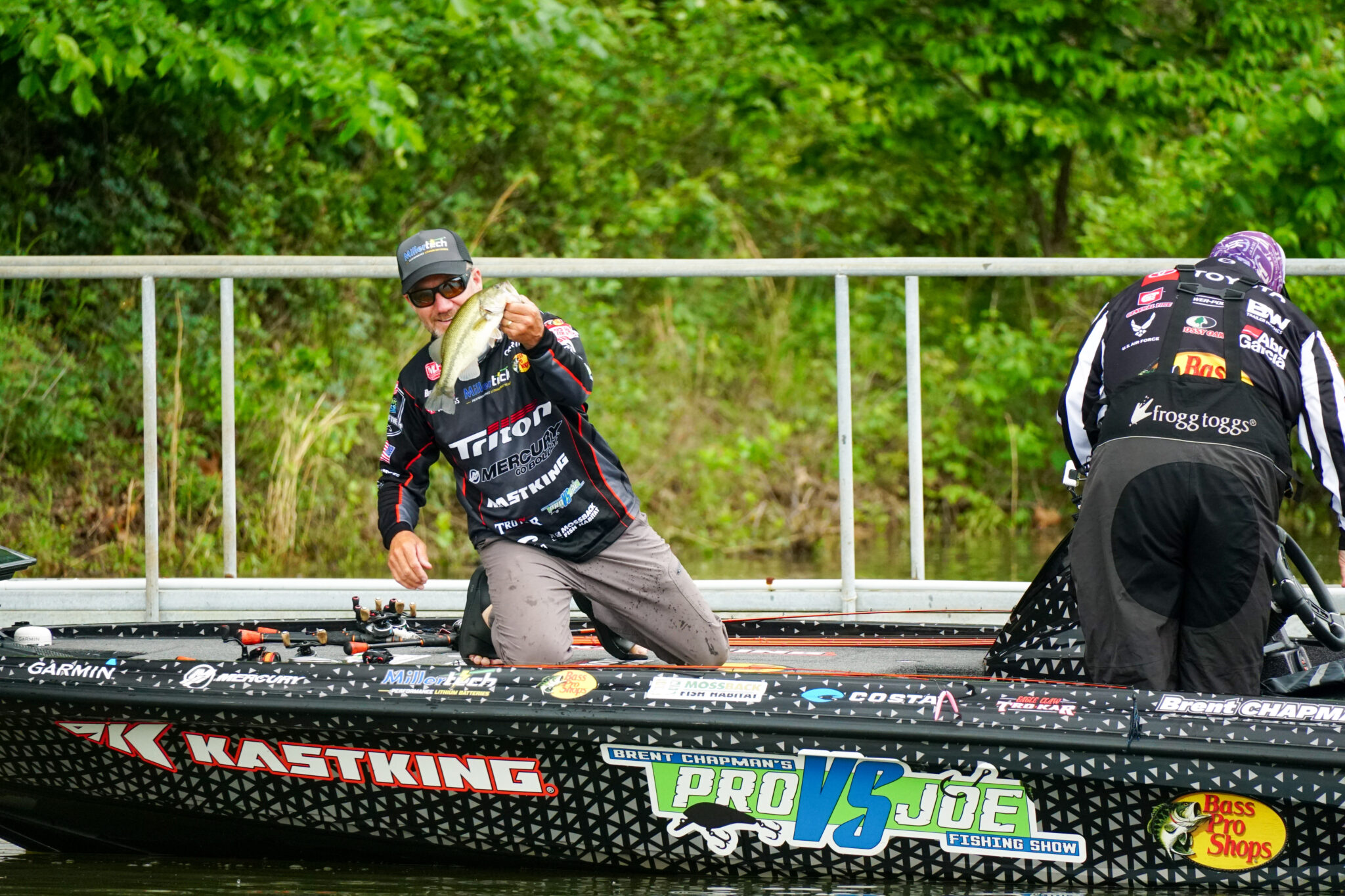
Mercury pro Brent Chapman’s passion for catching bass started many years ago on small ponds and lakes. Photo by Tyler Brinks
Small waters have a special hold on Brent Chapman. With nearly $2.5 million in career tournament winnings, Chapman credits the small bodies of water of his native state, Kansas, for igniting his bass fishing passion.
“For me, fishing small waters is where it started, where I built a love for bass fishing,” the Mercury pro says. “Most of my childhood memories revolve around small bodies of water. And, as I look back at my life as a professional bass angler, they stand out as great places to learn.”
Chapman recalls fun times fishing city park lakes with friends as a kid. Bass weren’t always the target. Some lakes held only catfish and bluegill.
“When you’re a kid, you take what you can get,” he says.
Farm ponds had special appeal. Most were cattle ponds accessed through his dad’s connections.
“Sometimes we knocked on doors and asked for permission to fish them,” Chapman recalls.
“Fishing small waters is where it started, where I built a love for bass fishing.”
Tournament anglers often shy from live bait for obvious reasons, but Chapman puts great stock in lessons learned from dangling critters on a hook.
“You learn what a live nightcrawler looks like in the water, what a shiner looks like in the water, how a crawfish darts through the water,” he says. “That crawfish taught me how my jig should move. That shiner darting, how my jerkbait is supposed to look.”
Chapman still lists bank and pond fishing among his favorite pursuits and believes the formative period he spent living on a 200-acre lake catapulted him from a weekend angler into a full-time touring pro. He cherishes both his small-waters upbringing and the ongoing role that pond fishing plays in his career today.
Lessons learned:
The importance of casting angles – The path your bait runs may be as important as the fish’s location.
The proper working and selection of baits – “You learn techniques that are viable fishing from shore,” Chapman says.
The thrill of topwater fishing – “Ponds offer some of the best frog and topwater fishing.”
Taming lunkers – Don’t discount the value of encounters with big carp or catfish. “Those fish may not be bass, but they hone skills on how to fight big fish.”
Favorite lures:
Chapman continues to fish and test lures on a 3/4-acre backyard pond today. Pond favorites include hollow-body frogs, wacky-rigged plastic worms and spinnerbaits. The Z-Man ChatterBait and Rebel Pop-R get special mention.
Chris Lane: ‘Sneaky, hidey spots’
Mercury pro Chris Lane honed his shallow-water prowess fishing the many small ponds and pits that dot Central Florida. Photo by Phoenix Moore
Small waters framed the childhood and shaped the future of two of the biggest names on the Bass Pro Tour. The Lane brothers, Chris and Bobby, grew up in America’s small-waters Mecca: Polk County, Florida, near the city of Lakeland.
“Growing up in Florida, we didn’t even have to sneak away,” Chris recalls. “We just told our mom we were going fishing – whether it was that small creek with an eddy where we caught bluegill and pound-and-a-half bass or wading where we shouldn’t in those big ponds with alligators. If we had to put a jon boat in, we did. If we had to walk the banks, we did.”
Small waters dot the Florida map. Natural lakes, creeks, development ponds, park waters, draw pits, quarries — all those and more hold bass in abundance, and the Lanes fished as many of them as often as they could.
The best were waters off the beaten track.
“My son has come up with the best name for them,” says Chris. “He calls them ‘sneaky, hidey spots,’ and he is right. These are the places nobody else fishes. When you find them and have success, it is really rewarding.”
Decades after growing up fishing together, Chris and Bobby Lane got to compete from the same boat in the General Tire Team Series Challenge Cup in their home state of Florida. Photo by Rob Matsuura
The Lanes had access to some of the most productive and unique small-water fisheries in America in the form of the phosphate pits of central Florida. Mining pits of various types are small-water staples throughout the country. Whether it be coal mining in the heartland, sand extraction in the Carolinas or rock quarries almost anywhere, water from springs, seeps, nearby streams or runoff fills the cavity remaining after earthen excavation and provides a home for bass.
Florida’s phosphate pits, which produce roughly 60% of the phosphorous in the U.S., are highly fertile — no surprise considering phosphorous is used principally in fertilizers. The fisheries age – that is, mature – rapidly.
Mining practices leave most phosphate pits deep and structurally unremarkable. Floating hyacinths are often the dominant form of vegetation. Working the edges of the hyacinths with topwater lures is always a “blast,” the Mercury pro notes.
“Phosphate bass are very aggressive,” he says. “They will eat anything! Birds, rats, frogs, snakes, mosquitoes… They are not (selective) like Tennessee River bass. The lakes have bluegill, and a lot of them have tilapia, a great source of protein. The fish are so aggressive, and the lakes have so much food. You can throw everything at the bass.”
Canal waters are also abundant in Florida. Many look appealing, but not all are productive. Finding the best ones is mostly a matter of trial and error. Chris offers one guideline, however: “Those canals connected to bigger lakes tend to be best.”
Small-water experiences flood Chris’s recollections and underscore many of the best times shared by one of America’s best known fishing families. The most memorable?
“The biggest highlight is probably when my brother Bobby caught a 15-pounder.”
Talk about brotherly love!
Lessons learned:
Access – Small waters are numerous, diverse and often close to home.
Finding fish – The challenge of fish location is limited. Much of the lake can be sized up with visual cues before ever making a cast.
Time spent fishing – No need to make long runs in a bass boat. If you only have a few free hours, small lakes allow more time for fishing.
Favorite lures:
“Find lures to fish each level of the water column,” Lane advises.
> River2Sea Lane Changer – The Lanes love prop baits. Chris designed this namesake lure with soft-plastic propellers.
> Bass Pro Shops XPS Crawdigy Craw – Kicking claws act and attract. Says Chris: “It’s one of my favorites because you can fish it on the bottom and punch it in the grass.”
Alton Jones Jr.: Lone Star lessons
Even before he started traveling with his father, Alton Jones Jr. got his bass-fishing start on private lakes and farm ponds. Photo by Phoenix Moore
Bass anglers know Texas for its outsized reservoirs. But, for Alton Jones Jr., it’s the small waters that made the best memories.
“From the time I learned to cast, I was fishing small waters in east Texas, any water I could,” says Jones, the 2023 Heavy Hitters champion.
He spent his formative years fishing stocked ponds on his buddies’ farms or private lakes. Chief among the latter was the Westlakes Club, a hunting and fishing club near Mineola to which his grandparents had membership.
“My earliest fishing memories are from there,” the Mercury pro says. “It’s where my dad (fellow BPT pro Alton Jones) learned to fish as well, so I guess we’ve come full circle.”
He characterizes those cherished waters as “swampy, flat lakes” filled with alligators and visible cover. They served as a chalk board for some of his most important lessons.
“Visible cover provides something you can see and read,” he explains. “Docks, rocks, lily pads, cattails, stumps — bass treat those as pathways. You learn what they want to be around on a given day.”
Bladed jigs in all their various forms are tough to beat for triggering small-water bass. Photo by Brandon Rowan
Jones echoes a familiar theme — that small waters are great places to hone skills, test new baits and gain confidence in new techniques. He recommends seeking out waters that take you out of your comfort zone.
“In Texas, we have a lot of small, deep, rocky lakes, too,” he says. “It’s important as an angler to use opportunities to fish different types of waters.”
Capping volumes of memories was a fish caught on Jones’ 14th birthday.
“I caught what seemed the fish of a lifetime,” he recalls. “I got it on a Yum Ribbontail worm. I didn’t have a livewell, but I found a stringer and tied the fish to the dock. I had this fear that the fish would get away as I ran to get my dad, who was in the shower. It was my first 10-pounder – 10 pounds, 1 ounce. It was a true lunker, and I have a replica of it. I’ve only caught a few bigger since.”
Lessons learned:
Dissecting cover – “Learning to pick apart cover methodically is the core of bass fishing.”
Feel – “We didn’t have electronics on those waters. We had to visualize what was under the surface with just the feel transmitted through your rod.”
Ambush position – “You learned to predict where a bass would sit.”
Triangulation – Jones learned to locate underwater structure the old-fashioned way, lining up shoreline points to create triangular sets of lines to locate a specific object or casting position. “I learned to triangulate at a very young age. I could find a stump in the middle of a 100-acre lake in 10 or 15 minutes and catch a big bass.”
Favorite lures:
> Bladed jig – “I remember testing a ChatterBait when they first came out, working it around lily pads.”
> Ribbontail worm – “I cut my teeth throwing a 7-inch YUM Ribbontail worm in green pumpkin.”
Marty Robinson: Irrigation lake expeditions
Marty Robinson (right) fell in love with bass fishing on small waters, and he made sure his son Mitchell experienced a similar start. Photo by Jody White
Small waters tend to shine thanks to their simplicity. Among the “simple” reasons for their appeal is a practical one: They get less pressure than big waters — and often hold big fish. Marty Robinson can attest to that: A farm pond produced his biggest bass, a 10-pound, 12-ounce pond giant.
“I caught it on a jig-and-pig – the old pork rind trailer,” Robinson says with fond recollection.
Small ponds and lakes have had lifelong influence on Robinson, who lives on Lyman Lake in South Carolina.
“My two boys have grown up fishing the lake,” says Robinson, whose son Marshall joined him on the Bass Pro Tour in 2024. “They would go out on it in a small boat every day.”
But the 350-acre lake is sprawling water compared to the settings for Marty’s own bass upbringing.
“When I was young, growing peaches was the major produce business in the area,” recalls Robinson. “I would get a new rod or new bait and go to the 1- to 3-acre irrigation ponds for the orchards and catch bass.”
Old-school anglers will recognize one of Marty Robinson’s favorite pond baits: the motor oil worm.
Typically, these intimate waters were triangle-shaped, dug out of the region’s red clay. An earthen dam formed a straight bank at the deepest portion of the reservoir. The side banks tapered to the shallow end, where the creek entered. Some ponds had rock in the basin, some had stumps. Most of the cover was shore-related – bank grass or overhanging trees or bushes.
“Most had really big fish!” he adds.
A typical mix of pond species was bream, bass and catfish. Some hosted crappie as well. Small bass up to 1.5 pounds were plentiful, but most lakes also had “two or three giants, up to 8 or even 10 pounds.”
Lessons learned:
Getting a feel for it – “When I started fishing ponds, I would get a bite and watch my line, see something moving off with it,” says Robinson with a chuckle. “When I started fishing lakes, I couldn’t watch my line like that because the boat was moving.”
Favorite lures:
Like many pond prowlers, Robinson didn’t carry a ton of tackle. He relied on a one-two punch.
“My most reliable bait by far was a rubber worm, a motor oil rubber worm,” he says. “I could catch them on worms when nothing else would work. Still can today.”
Robinson’s second choice was some kind of topwater lure — poppers, twitch baits, prop baits, you pick.
Casey Ashley: Farm pond classics
A career that started on farm ponds has taken Casey Ashley to the top of the sport. Photo by Garrick Dixon
Grandparents are special people … especially those with farm pond connections.
“When I was young, I stayed with my grandparents while my parents worked,” recalls Casey Ashley, the popular MLF pro whose career winnings have topped the $2 million mark. “They were old timers, and they knew everybody, so I got to fish everybody’s pond. I know I aggravated them, because I wanted to go every day.”
These ponds were often simple, spring-fed waters with little vegetation.
“The only cover was what was left when they built the ponds,” he recalls. “Stumps, trees and the bulrushes that grew along the edges.”
The ponds were generous with bass. Good ones yielded 5- to 8-pounders. One of the more memorable ponds was built on a drainage ditch.
“It had contours,” the Mercury pro says, recalling its mid-lake structure. “We caught them offshore on that one.”
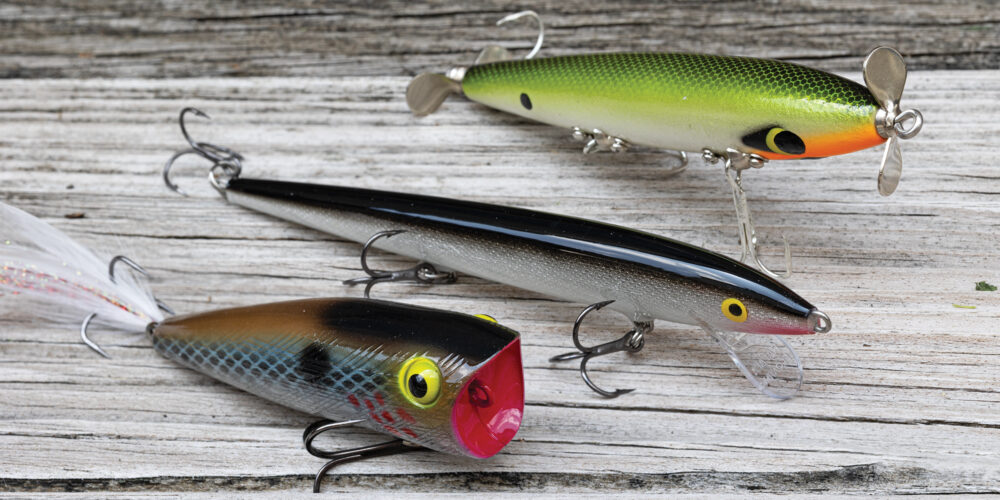
This trio of OG plugs (from left: Rebel P71 Pop-R, Rapala Original Floater, Smithwich Devil’s Horse) has accounted for countless bass over the decades. Photo by Brandon Rowan
Lessons learned:
Carryover to big waters – “Florida fishing is like farm-pond fishing.”
Recognizing situations – “When you fish a lot, you get attuned to how fish react when conditions change, like how bass would really bite after a rain or before a big storm. … And you learn what works best at a given time.”
Feeling the bite – The quiet and isolation of pond fishing assists concentration and feel. “The best thing of all is getting to feel the bite,” says Ashley.
The basics – “Ponds are great places to learn the basics, to capture the beginnings of things you need to learn,” he says. “When a bait is worked right, feeling the bite, knowing you got that fish to bite, that’s what intrigued me about bass fishing.”
Favorite lures:
“Farm ponds are where I fell in love with topwater,” says Ashley. Classic baits ruled his childhood.
> Original Rapala Floating Minnow – This revolutionary balsa bait has charmed bass and bass anglers since its arrival in the U.S. “I would not leave the house without it,” Ashley says.
> Smithwick Devil’s Horse – “The Devil’s Horse was really good, especially when you had spawners,” Ashley says of the tapered propeller bait. “When you found a big one spawning shallow in a farm pond, there was no better bait than the Devil’s Horse. It’s still a big deal for me in Florida.”
> Rebel Pop-R – It’s hard to talk pond fishing without referencing this legendary and versatile popper/chugger.
Grae Buck: No weeping at the willow tree
Grae Buck gleaned some valuable lessons from fishing his family’s small pond, including the importance of a good first cast to fishy cover. Photo by Phoenix Moore
Ponds paved the way to Grae Buck’s burgeoning pro career.
“Small waters got me hooked on fishing,” says the Pennsylvania pro with four Phoenix Bass Fishing League wins.
Buck’s family moved into a Pennsylvania farmhouse when he was in fourth grade. The home’s most beloved feature was a 1/3-acre pond.
“I tore those poor fish up every day,” he says. “But they got my love of bass fishing growing.”
Pond hopping with buddies followed. Most of the waters were seepage ponds, 8 feet at the deepest. Some had submerged grass. A few were rimmed with cattails, the edges of which were “sweet spots.”
He learned early on the importance of the first cast to a prime, bass-holding spot.
“We had a willow tree growing on a pond,” he remembers. “When we fished there, everyone wanted to make the first cast to the tree. You just knew you would catch a good one!”
Lessons learned:
Importance of that first cast – The willow tree lesson was of paramount importance. “It still makes me think about where I will be making my first cast,” says Buck.
Stealth – With little fishing pressure or human traffic, pond bass are often hyper-alert to footsteps and disturbance. That lesson has carried over to his tournament tactics. “I make a stealthy approach to an area,” says Grae. “I stop the boat, work quietly, quickly.”
Favorite lures:
> ChatterBait – “When it first came out, we tormented bass with that bait, and it usually got the big one.”
> Bill Lewis Rat-L-Trap – “At ice out, we would work it super slow through the deepest part of the pond, just crawling it. The fish would be pure white.”